Scientists Find Methane-Rich Saturn-Sized Planet With Temperatures Like Earth
Saturn-sized exoplanet with Earth-like temperatures spotted sporting methane-rich atmosphere rare glimpse into temperate gas giant chemistry
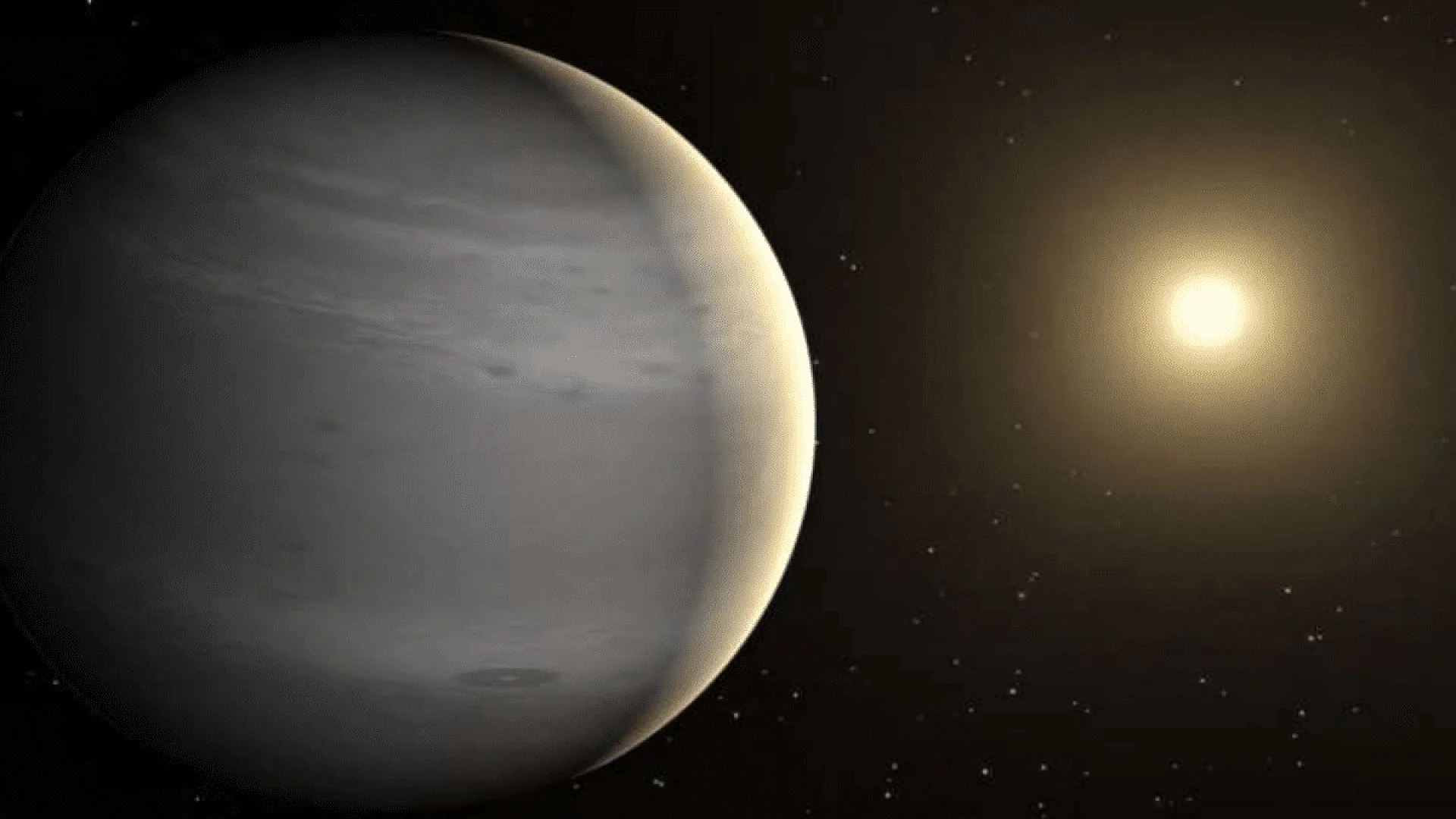
Using the James Webb Space Telescope, astronomers have identified a Saturn‑sized exoplanet whose temperature hovers around 175 °F, a range comparable to that of Earth. The planet’s atmosphere is dominated by methane, providing the first comprehensive chemical portrait of a temperate gas giant, according to a study released in The Astronomical Journal.
Temperate Giant Discovered Around Distant Star
Designated TOI‑199b, the world orbits a star located more than 330 light‑years from our Sun, completing a revolution roughly every 100 days. Its modest warmth places it between the blistering “hot Jupiters” and the frigid giants of our own system, creating a rare example of a temperate, large exoplanet that scientists have long sought to characterize.
JWST’s Transmission Spectroscopy Reveals Atmospheric Layers
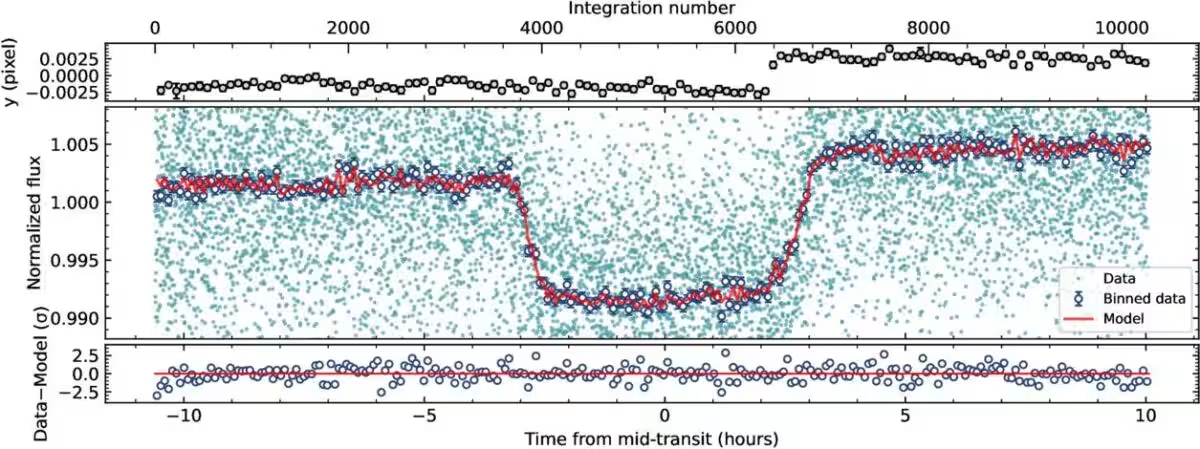
The research team applied transmission spectroscopy, tracking how starlight filters through the planet’s gaseous envelope during a transit. “When the planet moves in front of its host, a portion of the stellar light passes through the atmospheric shell, imprinting specific absorption features that JWST can detect,” explained Aaron Bello‑Arufe, a postdoctoral researcher at JPL and lead author of the paper (The Astronomical Journal). “Each molecule leaves a distinct fingerprint in the spectrum, allowing us to decode the composition.”
During a seven‑hour transit, JWST captured continuous spectral data, which the scientists compared against a 20‑hour baseline of the star’s unfiltered light. This approach enabled a high‑confidence identification of atmospheric constituents.
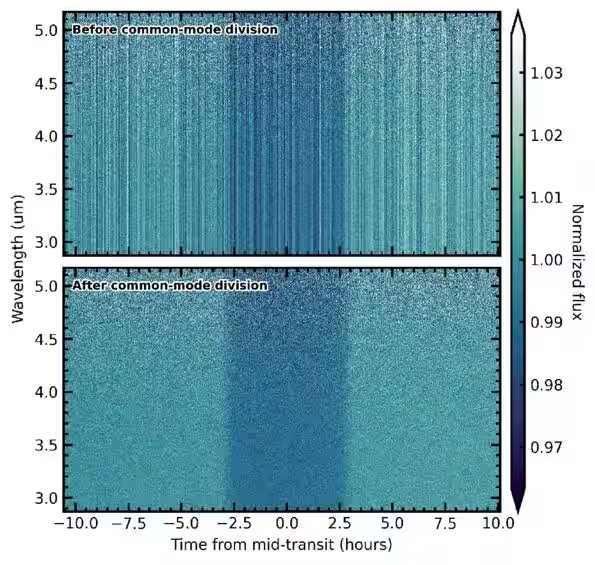
and binned to Δλ = 0.004 μm, before and after dividing out the common-mode noise model.
Credit: The Astronomical Journal
Methane Confirmed, Trace Gases Detected
Spectral analysis uncovered a pronounced methane signature, with tentative indications of ammonia and carbon dioxide. “Comparing the in‑transit spectra to the out‑of‑transit baseline, we observed clear absorption at wavelengths where methane is expected,” said Bello‑Arufe. “Our models predicted methane should dominate these temperate giants, so the detection provides a reassuring validation of those theories.”
Credit: The Astronomical Journal
Broader Impact on Planetary Formation Research
The discovery carries significant weight for theories of planetary development. “Studying exoplanets lets us sample a diversity of worlds that our solar system lacks, helping us piece together how planetary systems evolve,” noted Renyu Hu, an associate professor at Penn State and the project’s lead investigator. “Since the first exoplanet was identified in 1992, we’ve catalogued thousands, but detailed atmospheric data for temperate giants remain scarce. This is the inaugural in‑depth look at such a world.”
By pinning down the chemical makeup of TOI‑199b’s envelope, scientists can fine‑tune models of atmospheric chemistry and planetary birth, potentially shedding light on the processes that shaped Earth’s own atmosphere. Ongoing observations aim to determine whether methane‑rich skies are a common trait among similar exoplanets or an exceptional case.
This article has been fact checked for accuracy, with information verified against reputable sources. Learn more about us and our editorial process.
Last reviewed on .
Article history
- Latest version
Reference(s)
- Bello-Arufe, Aaron., et al. “Methane on the Temperate Exo-Saturn TOI-199 b.” The Astronomical Journal, vol. 171, no. 6, May 20, 2026, pp. 354 American Astronomical Society, doi: 10.3847/1538-3881/ae4fba. <https://doi.org/10.3847/1538-3881/ae4fba>.
Cite this page:
- Posted by Aisha Ahmed