Lucy Flyby Reveals Peanut-Shaped Asteroid As Fragmented Relic Of Violent Early Collisions
Lucy’s close flyby uncovers the violent past and fractured interior of the peanut‑shaped asteroid Donaldjohanson, revealing its ancient history.
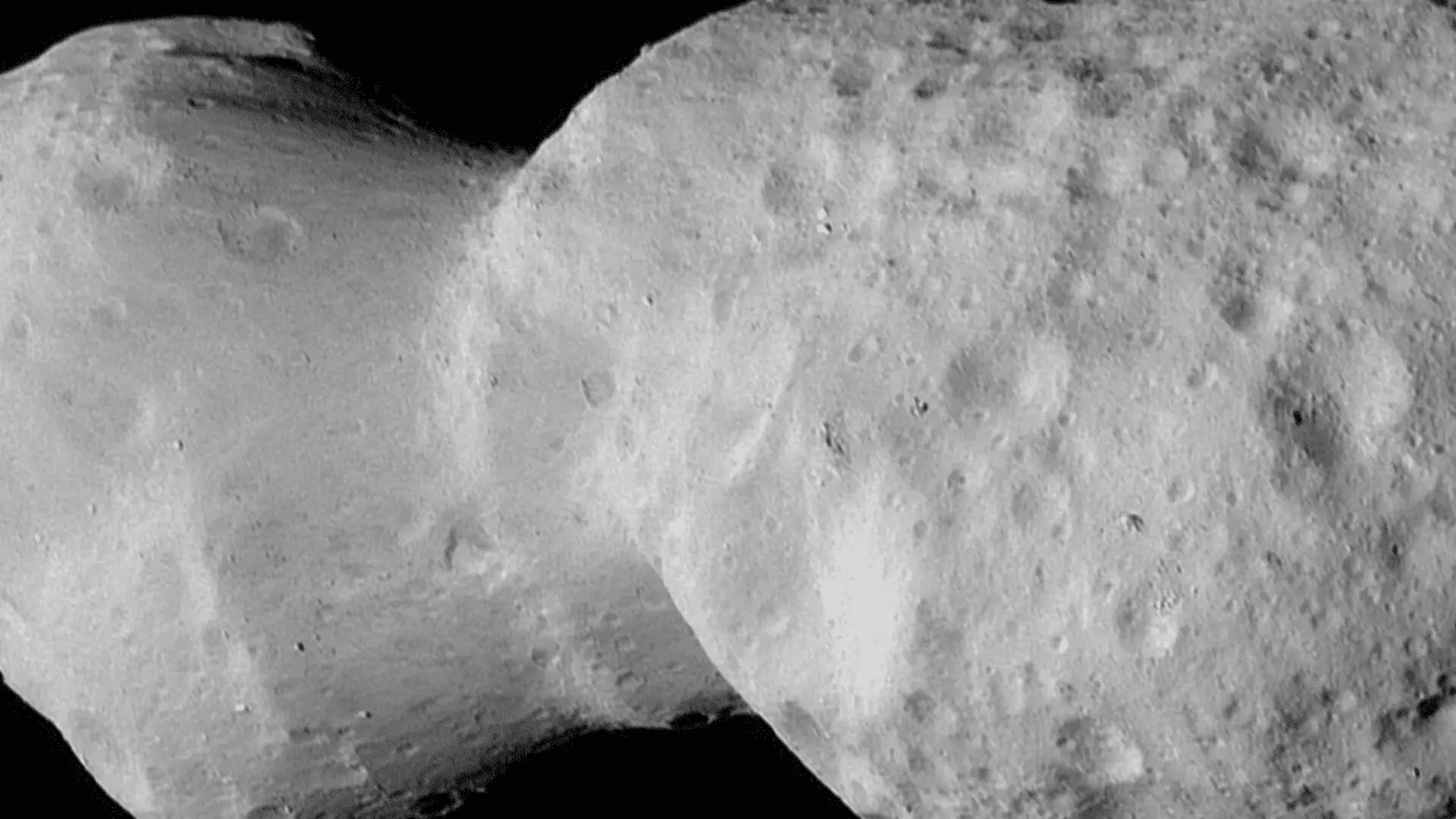
NASA’s Lucy spacecraft passed a tiny main‑belt asteroid on 20 April 2025, capturing images that expose a shattered fragment from the solar system’s formative era. The body, dubbed Donaldjohanson, bears unmistakable scars of violent disruption, offering a rare visual record of ancient collisions that built today’s asteroid families, according to a paper in Science.
Lucy’s Flyby Reveals a Battered Asteroid
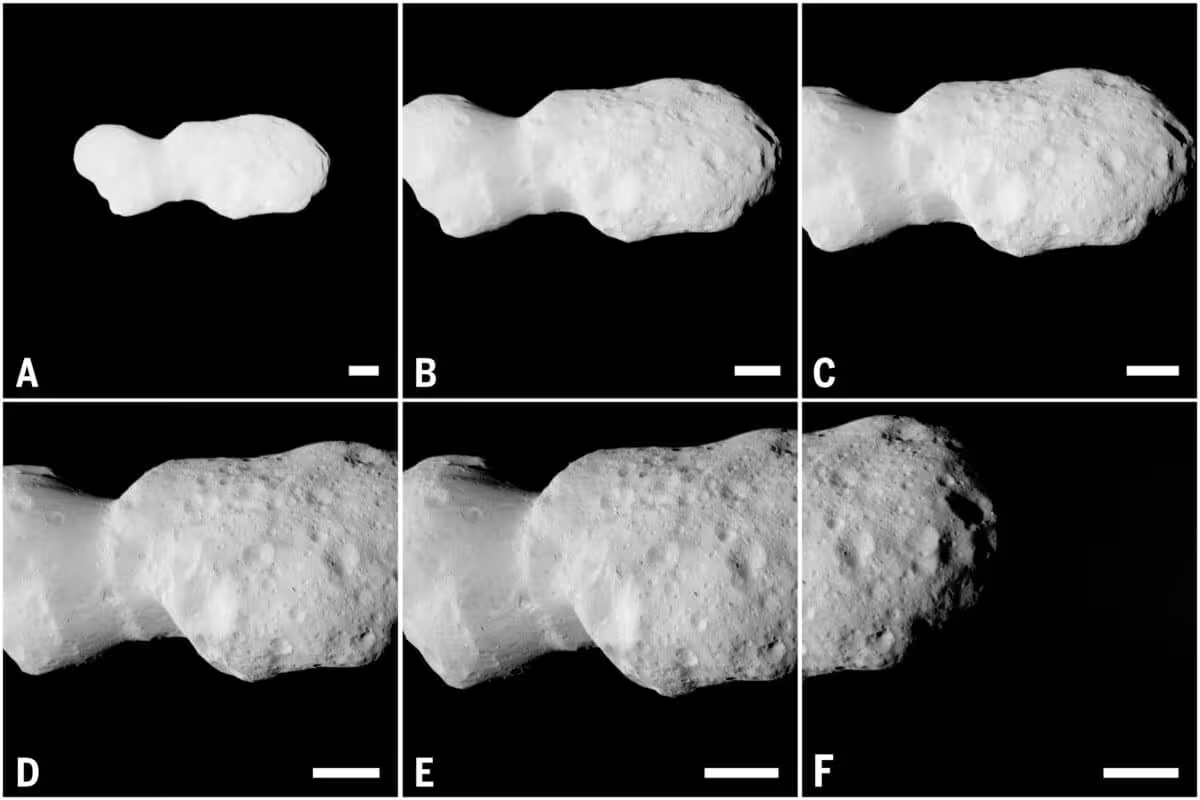
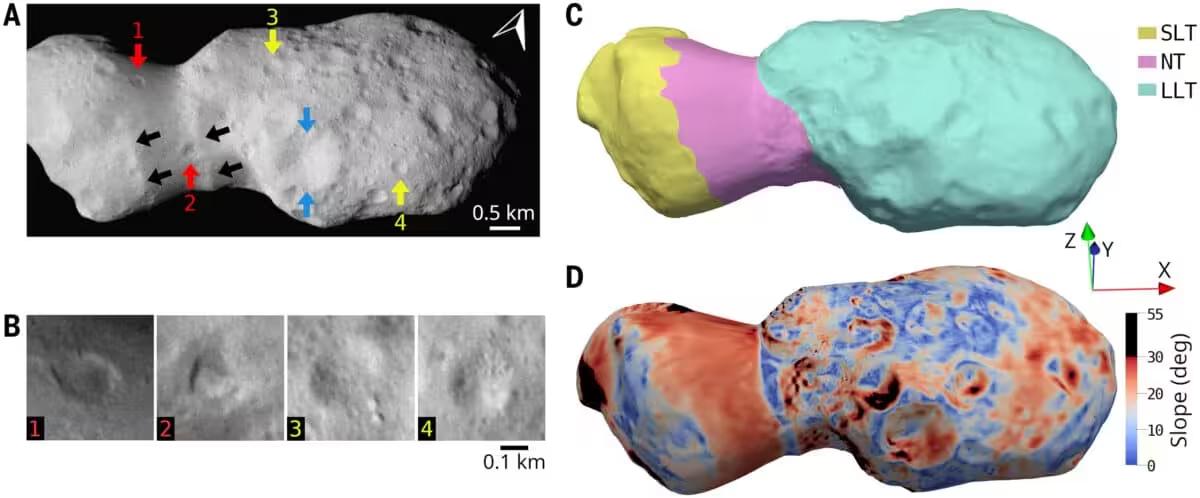
During its transit toward the Jupiter Trojans, Lucy skated within roughly 600 miles of Donaldjohanson, allowing its instruments to resolve surface details that had previously been inferred only from Earth‑based photometry. The asteroid stretches about 5 miles long and 2 miles wide, but its most striking characteristic is a bifurcated, peanut‑shaped silhouette linked by a slender neck. Such a configuration points to a complex origin, likely the result of fragments re‑coalescing after a catastrophic breakup early in solar‑system history.
Situated in the main belt between Mars and Jupiter, Donaldjohanson resides among countless remnants that never merged into a planet. Lucy’s passage through this region was designed as a series of opportunistic flybys, each providing calibration data for the instruments that will later study the distant Trojan asteroids. The encounter also uncovered a heavily cratered terrain, suggesting a long record of impacts without substantial resurfacing.
Analysis Links the Object to the Erigone Family
A team from the Southwest Research Institute examined the flyby data and published their results in Science. Their work connects Donaldjohanson to the Erigone family, a cluster of roughly 1,800 asteroids that share a common origin in a massive collision about 155 million years ago. The original parent body, estimated at 50 miles in diameter, was struck by a 12‑mile impactor, shattering it and scattering debris that later re‑aggregated into smaller fragments like Donaldjohanson.
“This is just one of many surprising things learned since NASA’s Lucy spacecraft flew by Donaldjohanson on April 20, 2025,” said SwRI’s Dr. Simone Marchi, deputy principal investigator of the Lucy mission and lead author of the study. “Lucy images confirmed its elongated shape, initially suggested by Earth‑based telescope observations. The flyby showed that the half‑mile‑wide asteroid looks like a peanut, with two lobes joined by a narrow neck.”
Crater density measurements on the surface match the age of the Erigone family, while the erosion of smaller pits hints at later seismic activity triggered by subsequent impacts. These observations underscore that even modest‑sized asteroids can retain a layered geological record spanning hundreds of millions of years.
What the Findings Mean for Planetary History and Upcoming Missions
Beyond its odd shape, Donaldjohanson preserves clues about the distribution of water‑bearing minerals in the early belt. Spectral signatures of iron‑rich phyllosilicates suggest that its parent body once hosted water, supporting theories that volatile compounds were more widespread among primitive asteroids than previously thought.
The flyby also served as a rehearsal for Lucy’s primary science phase among the Jupiter Trojans—asteroids that share Jupiter’s orbit and are considered some of the most pristine remnants of planetary formation. Testing the spacecraft’s cameras and navigation systems during the Donaldjohanson encounter helps ensure that the mission will capture high‑quality data when it reaches its ultimate targets.
“This encounter gave us an opportunity to test our instruments and our procedures to make sure we are ready when we get to Jupiter’s Trojans,” Marchi said. “Once we start learning more about the Trojans, a completely different population of space rocks with very different histories, our understanding of solar system formation is likely to be challenged.”
As Lucy proceeds toward its Trojan targets, each successive flyby adds a new piece to the puzzle of planetary evolution. Donaldjohanson’s fractured form and ancient lineage serve as a reminder that even modest asteroids can bear the imprint of colossal events that shaped the architecture of our solar system.
This article has been fact checked for accuracy, with information verified against reputable sources. Learn more about us and our editorial process.
Last reviewed on .
Article history
- Latest version
Reference(s)
- Marchi, Simone., et al. “The Lucy flyby of (52246) Donaldjohanson: A bilobed asteroid with tumbling rotation.” Science, vol. 392, no. 6804, June 18, 2026, pp. 1287-1291. American Association for the Advancement of Science (AAAS), doi: 10.1126/science.aec0503. <https://www.science.org/doi/10.1126/science.aec0503>.
Cite this page:
- Posted by Aisha Ahmed