Astronomers Finally Uncover What Is Hiding Inside The Universe’s Mysterious Little Red Dots
Astronomers are rethinking the mysterious tiny red dots spotted by the James Webb Space Telescope, suggesting the true story may lie hidden in the glare.
Astronomers investigating the mysterious phenomena known as “Little Red Dots” have pivoted their research strategy, moving away from the elusive central objects to focus on the environments that house them. By analyzing a sample of 217 of these celestial anomalies, a research team has identified that the host galaxies are distinctively compact and possess a notably low concentration of heavy elements. These findings, detailed in the late-August issue of Nature Astronomy, provide the first substantial evidence regarding the origin and nature of these enigmatic structures.
Since the James Webb Space Telescope (JWST) began its deep-space survey in the summer of 2022, it has profoundly reshaped our understanding of the early universe. However, it has also introduced significant challenges for astrophysicists, with the Little Red Dots (LRDs) standing out as particularly stubborn puzzles. These compact objects appear sporadically in the early cosmos and seem to vanish entirely before the universe reaches an age of roughly 2 billion years.
Because these objects lack a clear counterpart in our local cosmic neighborhood, they remain a unique relic of the early universe. Jorge Zavala of the University of Massachusetts Amherst suggests that LRDs represent a specific evolutionary phase that astronomers had previously overlooked, given their absence in modern observations.
Shifting Focus Beyond the Central Core
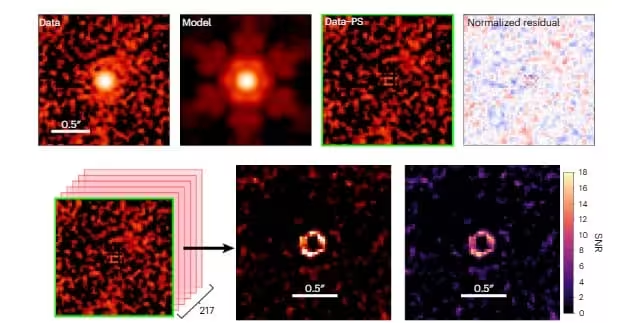
Historically, research on LRDs has fixated on their intense, compact central components, which emit the vast majority of the object’s luminosity. However, this brilliant central light often masks the surrounding galaxy, making traditional observation nearly impossible. By utilizing a new analytical approach on 217 JWST images, researchers were able to filter out the glare and isolate the faint light emanating from the host galaxies themselves.
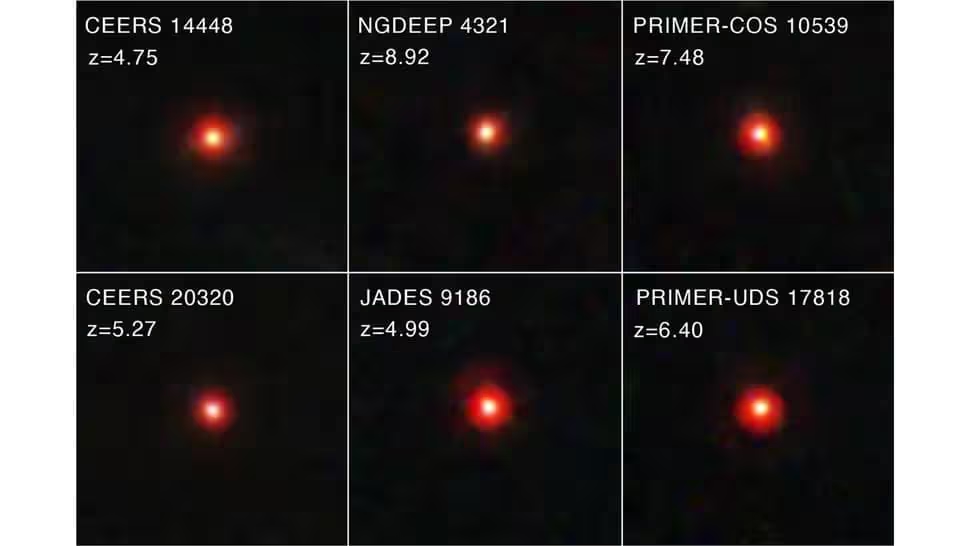
This study suggests that past oversight in ignoring these hosts hindered progress. By understanding the host environment, researchers hope to determine if LRDs are linked to specific dark matter properties, environmental density, or if they represent a precursor to modern galactic structures.
Structural Insights: Compact and Metal-Poor
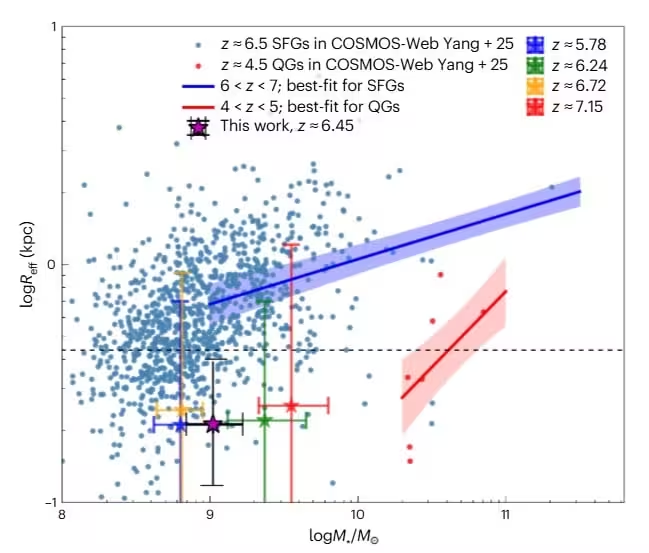
The data suggests that these host galaxies are exceptionally small, measuring around 1,400 light-years across. When compared to other star-forming galaxies from the same epoch, LRD hosts are roughly 2.5 times more compact. Furthermore, they exhibit a significantly lower ratio of “metals,” which in astronomical terms refers to elements heavier than hydrogen and helium.
According to Zavala, these characteristics point to a unique environment defined by high stellar density and active star formation. This density might serve as the trigger for the intense physical processes that define the LRD phenomenon.
Decoding the Mystery
While the study stops short of confirming a mechanism, Zavala posits that LRDs could be tied to extreme starburst events. These events may be the result of high gas density, potentially leading to the formation of supermassive stars or providing the foundational conditions for the ancestors of black holes at the center of these galaxies.
Future research will likely shift from photometry to high-resolution spectroscopy. By breaking down the light into specific wavelengths, scientists hope to differentiate the light of the host galaxy from that of the central engine and analyze the chemical composition and physical states of the surrounding gas. Finding local analogs in our own universe also remains a top priority, as closer proximity would allow for more granular examination of these short-lived, high-energy systems.
This article has been fact checked for accuracy, with information verified against reputable sources. Learn more about us and our editorial process.
Last reviewed on .
Article history
- Latest version
Reference(s)
- Zhang, Yiyang. “Extended components of little red dots in the rest-frame optical.”, vol. 10, no. 9, pp. 1387-1397., doi: 10.1038/s41550-026-02945-z. <https://www.nature.com/articles/s41550-026-02945-z.epdf?sharing_token=gp22W7qSa04AyiNliR7oFNRgN0jAjWel9jnR3ZoTv0Ooy4sj6hSpAD5M07AW19j888f33k0cxPNLr3VvpGwSNA4jmT7JVC_kxPAVb2ASced9V0XluZPv2ncCg1p4KfPx2KfVfeXz_Fa-fhEii5ZXLi_I2kMPiolpU_Abqbs0oevlCVfmSI9kgxRgvuhNcHNucMZXys0oXOMMjpLFvNy3StBQ_zfTpufhG3GxjQIONfk2DSuEVBqBfIsXbqEIgUJHTDKJ2fCwnrj3HAuuaWpi0FagTc9xOIrda9YeVmhF_1RlfeT4N8QA5dTTjTFajQUPbNXHyZ_U1h8tXkzUcdq5Ii5VEdRC_7kMPB62hbefpkZ7pQq1nUcp2IDzIEJkeMZclcAMZ1zZkggU8lHkPoGkSw%3D%3D&tracking_referrer=www.space.com>.
Cite this page:
- Posted by Aisha Ahmed