New AI Uses Reflected Sunlight to Spot Tumbling Satellites in Earth Orbit
A new AI system can now detect suspicious satellite activity by analyzing reflected light, offering a powerful new tool for monitoring objects in orbit.
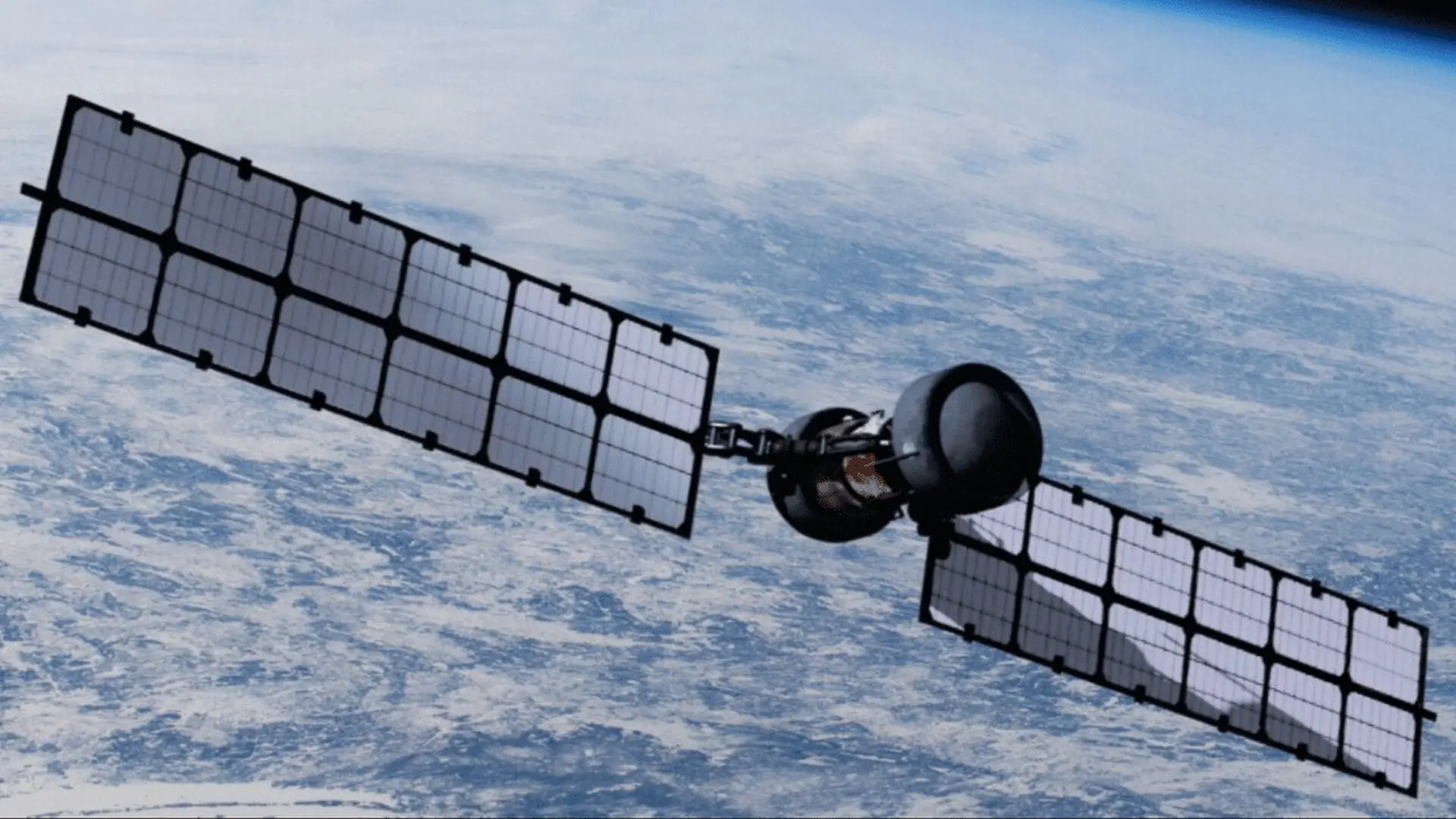
A sophisticated new artificial intelligence framework is set to enhance space situational awareness by interpreting the subtle fluctuations in light reflected from orbiting hardware. As Earth’s orbital pathways become increasingly congested, this technology offers a vital mechanism for tracking spacecraft behavior and predicting complex orbital dynamics, according to findings recently published in Expert Systems.
The initiative, titled AI4 Space Safety and Sustainability (AI4S3), aims to mitigate the rising risks associated with the proliferation of satellites. Developed by the Alan Turing Institute’s Defence AI Research Centre (DARe), the project represents a collaborative effort involving experts from the University of Strathclyde, the University of Arizona, MIT, the University of Waterloo, and various industry partners.
Transforming Satellite Observation through Intelligent Automation
Historically, monitoring the growing population of satellites has been a labor-intensive process, requiring human specialists to manually parse massive volumes of observational data. With the orbital environment becoming more crowded, this manual approach has reached its functional limits. The AI4S3 model replaces these bottlenecks with an automated system capable of rapidly detecting anomalous events that may signify mechanical failure or unexpected trajectory shifts.
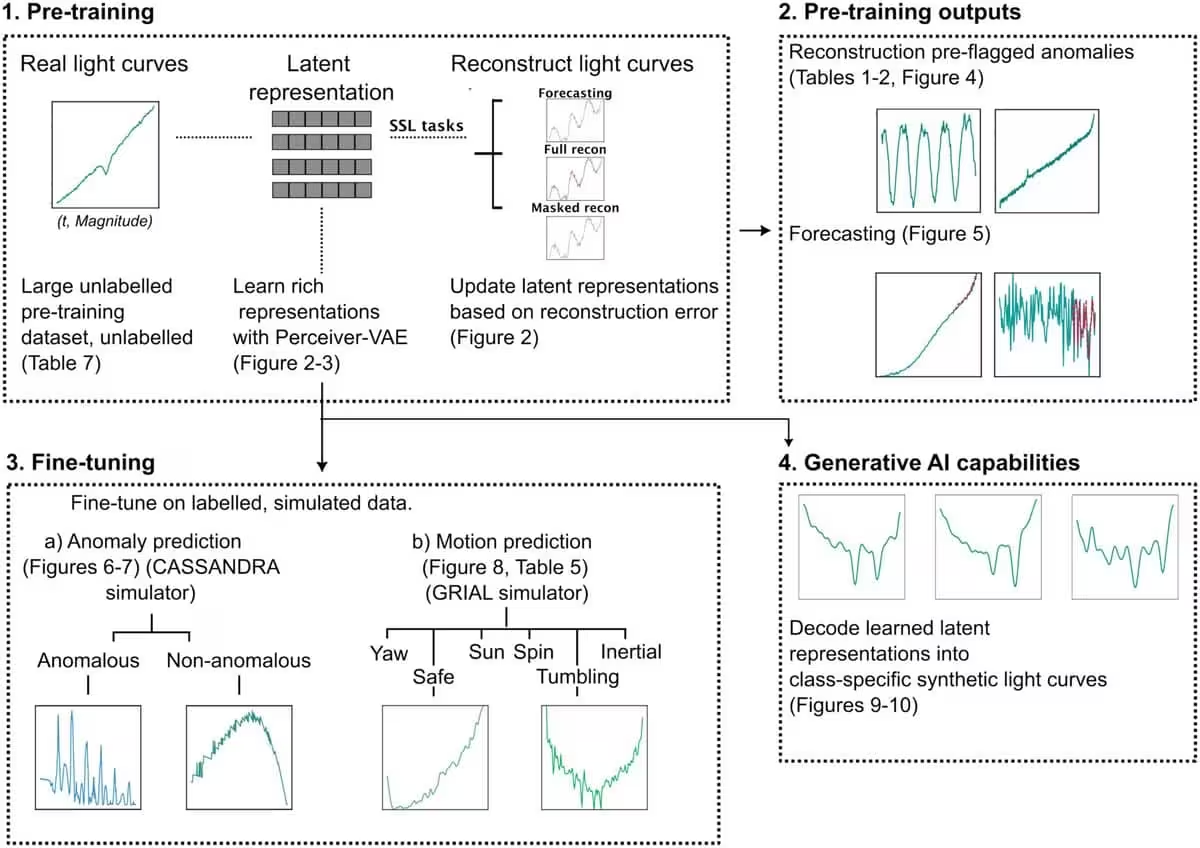
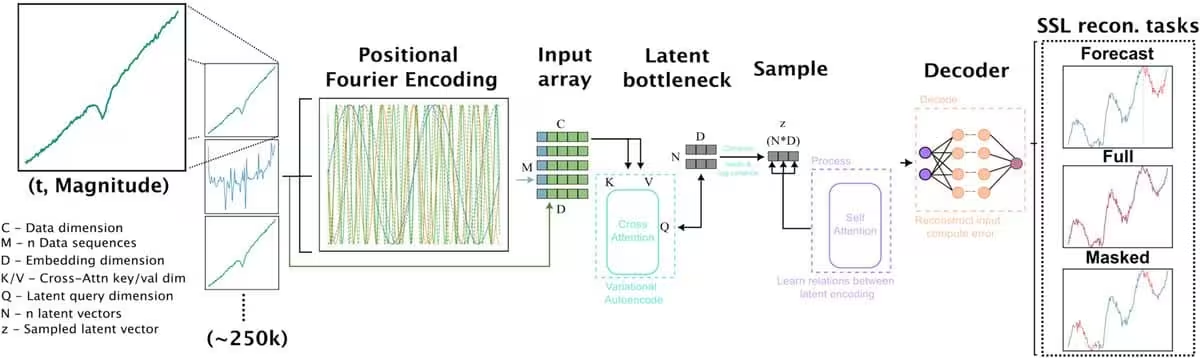
Instead of relying exclusively on traditional radar or trajectory tracking, the model utilizes light curves—the patterns of brightness observed as sunlight reflects off a spacecraft’s surface. By analyzing these fluctuations, the system can distinguish between routine operations and irregular behavior. Researchers trained the neural network on extensive datasets of telescope-gathered brightness measurements, further refining its performance using high-fidelity simulations developed by GMV and the Aerospace Centre of Excellence at the University of Strathclyde.
During testing, the AI demonstrated an 88% success rate in identifying unusual light patterns. Beyond simply flagging anomalies, the model can classify specific types of motion, such as identifying if a satellite is spinning or tumbling, providing operators with granular insights into the health and status of individual assets.
Leveraging Optical Data for Enhanced Space Stewardship
The core of this technology rests on the principle that an object’s visual signature—its brightness, orientation, and rotation—is inherently linked to its physical configuration. By deciphering these “light curves,” the AI can provide immediate diagnostics for satellites that may have become unresponsive or drifted from their intended orbits.
Paving the Way for Future Orbital Safety
Professor Massimiliano Vasile, who leads the Aerospace Centre of Excellence at the University of Strathclyde, emphasizes that this technology is essential for the long-term sustainability of space activities.
“Understanding and explaining the behavior of space objects is critical to predict the evolution of the whole space environment and guarantee the safety of essential services for our everyday life. In the Aerospace Centre, we have been working on understanding the motion of space objects for a long time, but with AI4S3 I wanted to see if modern AI technology could help to detect regular and anomalous behaviors even from a single pixel in the sky.”
According to Vasile, the breakthroughs achieved by the Alan Turing Institute represent a foundational step toward a systematic, comprehensive monitoring strategy for all human-made objects in orbit. As the commercial and scientific reliance on space infrastructure grows, tools like AI4S3 will likely become the standard for maintaining order and safety in an increasingly crowded sky.
This article has been fact checked for accuracy, with information verified against reputable sources. Learn more about us and our editorial process.
Last reviewed on .
Article history
- Latest version
Reference(s)
- Groves, Ian., et al. “A Self‐Supervised Framework for Space Object Behaviour Characterisation.” Expert Systems, vol. 43, no. 10, August 23, 2026 Wiley, doi: 10.1111/exsy.70382. <https://onlinelibrary.wiley.com/doi/10.1111/exsy.70382>.
Cite this page:
- Posted by Asif Iqbal