These New Teardrop Robots Can Leap Over Any Terrain Without Needing To Reset
Engineers have developed a revolutionary self-resetting design that eliminates the need for manual intervention between jumps, paving the way for new tech.
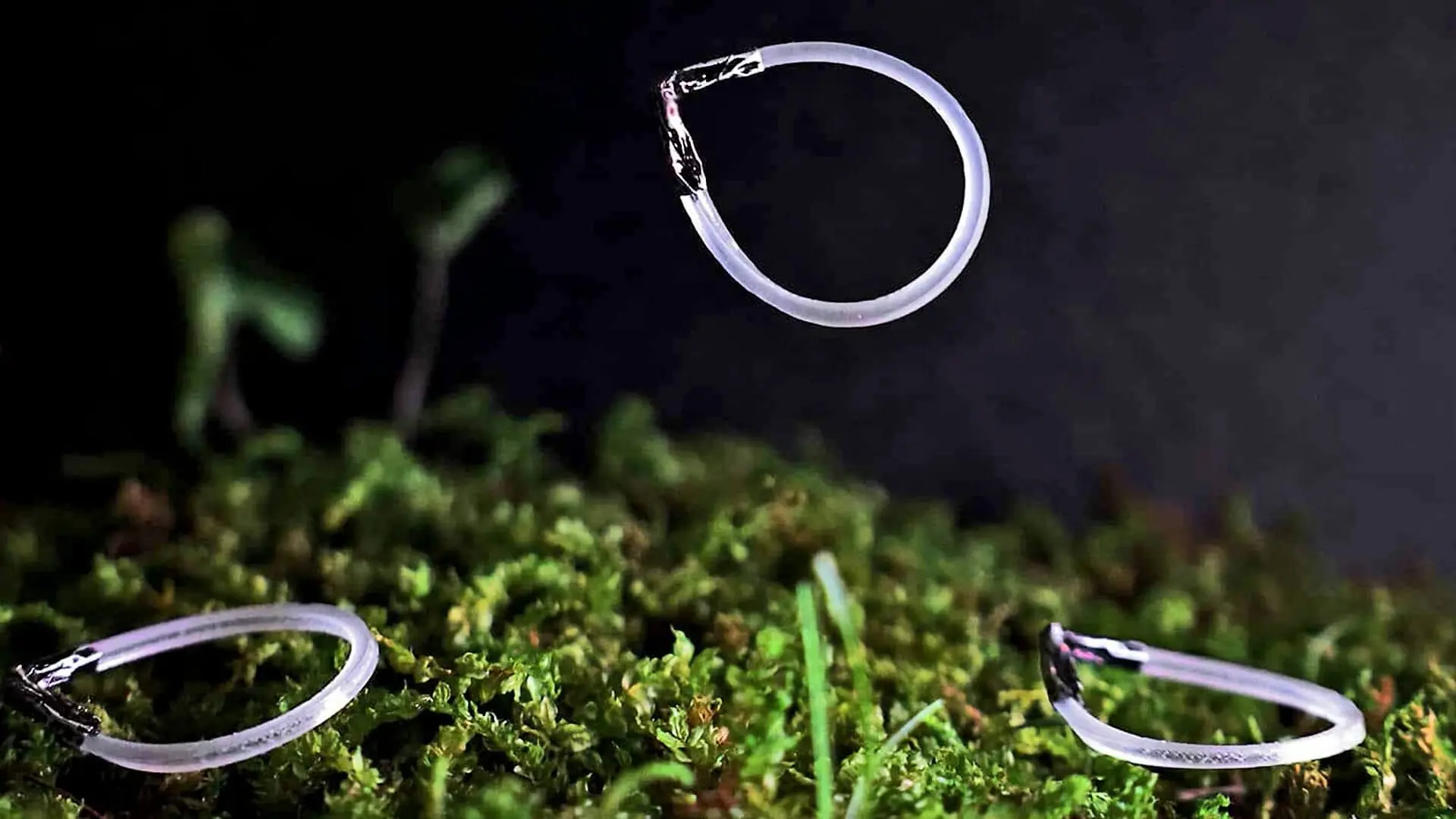
Engineers develop self-propelling soft robots capable of continuous leaping
A team of researchers at North Carolina State University has engineered a novel class of soft robots capable of rhythmic, persistent jumping when stimulated by infrared light. These teardrop-shaped devices rely on a unique mechanical architecture that allows them to store and release elastic energy repeatedly without requiring manual intervention, marking a significant step forward in autonomous soft robotics.
The core innovation behind these robots is their ability to reset their own state after each launch. By utilizing a liquid crystal elastomer ribbon integrated with a rigid, V-shaped aluminum component, the devices transform thermal energy into mechanical movement. When exposed to an infrared source, the elastomer surface contracts, inducing a rotation that the V-shaped frame resists. This tension causes the structure to twist, accumulating elastic energy until it hits a threshold, at which point the energy is released in a sudden snap against the ground, propelling the robot into the air.
According to Jie Yin, a professor of mechanical and aerospace engineering and the paper’s corresponding author, the simplicity of this “ring leaper” design is its greatest strength. Because the robot naturally returns to its initial teardrop shape after the stored energy is exhausted, the cycle of contraction and release continues indefinitely as long as the infrared beam remains active.
The research, published in PNAS, highlights how subtle geometric adjustments allow for high levels of control over the robot’s locomotion. Postdoctoral researcher and first author Fangjie Qi notes that the angle of the V-shaped aluminum attachment acts as a primary control parameter for the robot’s trajectory. A wide, 120-degree angle results in a crawling motion, while tightening this angle to 90 degrees enables forward jumping, and a narrow 50-degree angle allows the device to achieve vertical leaps.
Beyond geometry, the team discovered that fine-tuning the robot’s center of mass by adding weight to the rounded end of the teardrop could significantly improve its stability and jump distance. Furthermore, the intensity of the light source serves as a critical variable; while higher intensity is required to trigger the leaping mechanism, excessive power can cause the robots to behave erratically.
In experimental trials, the teardrop-shaped prototypes demonstrated impressive versatility, successfully navigating challenging environments such as sand, grass, mulch, and rocky terrain, while clearing various obstacles. While the technology is currently in the fundamental research phase, the team suggests that these self-resetting mechanisms hold promise for future applications in swarm robotics and navigation across complex, unstructured landscapes.
This study was conducted with support from the National Science Foundation.
This article has been fact checked for accuracy, with information verified against reputable sources. Learn more about us and our editorial process.
Last reviewed on .
Article history
- Latest version
Reference(s)
- Qi, Fangjie., et al. “A self-resetting soft ring for autonomous, continuous leaping in unstructured environments.” Proceedings of the National Academy of Sciences, vol. 123, no. 35, August 27, 2026 National Academy of Sciences, doi: 10.1073/pnas.2607940123. <https://doi.org/10.1073/pnas.2607940123>.
Cite this page:
- Posted by Asif Iqbal