Workers Building a Railway in Northern Mexico Uncovered a Hidden 1,200-Year-Old Village Beneath Their Feet
Archaeologists uncover centuries-old lost village in northern Mexico after construction stumble

While excavating a railway corridor in Sonora, workers uncovered a settlement that predates the famed Cerro de Trincheras culture. Mexico’s National Institute of Anthropology and History (INAH) confirmed that archaeologists have revealed a sizeable pre‑colonial village and two nearby rock‑art sites, a find that emerged from salvage digs linked to the Ímuris‑Nogales railway bypass.
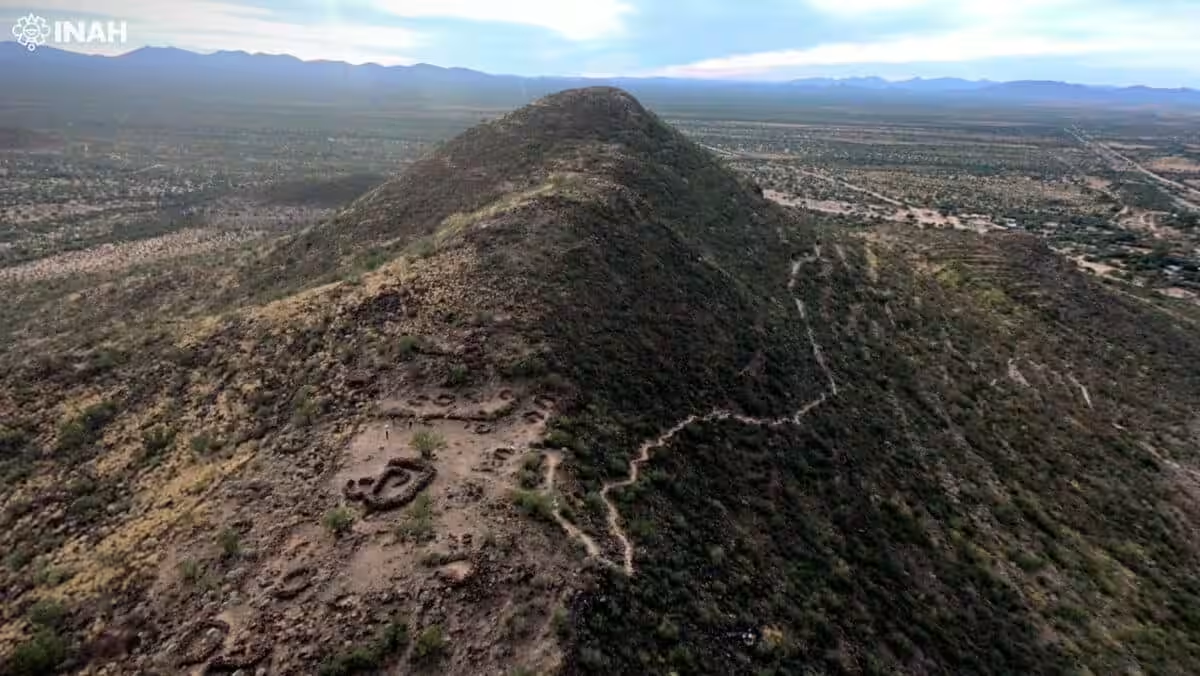
The settlement, identified as La Ciénega, occupies a canyon and valley of the Cocóspera River close to the Arizona border. A six‑person team from INAH’s Sonora Centre, directed by Júpiter Martínez Ramírez, spent several months mapping the remains, describing the discovery as one of the most significant recent archaeological recoveries in the region.
The site had originally been noted in 2008, when researchers recorded only ten scattered dwellings. Subsequent construction activity exposed a much larger complex, prompting a reassessment of the village’s extent.
Subterranean Dwellings Stretch Across the Plateau
Unlike many neighboring groups, the inhabitants of La Ciénega built oval or rectangular homes that sit partially below ground, descending between one and 2.2 metres beneath the surface. Over successive generations, interior walls were expanded with earthen fill, indicating repeated rebuilding and long‑term occupation.
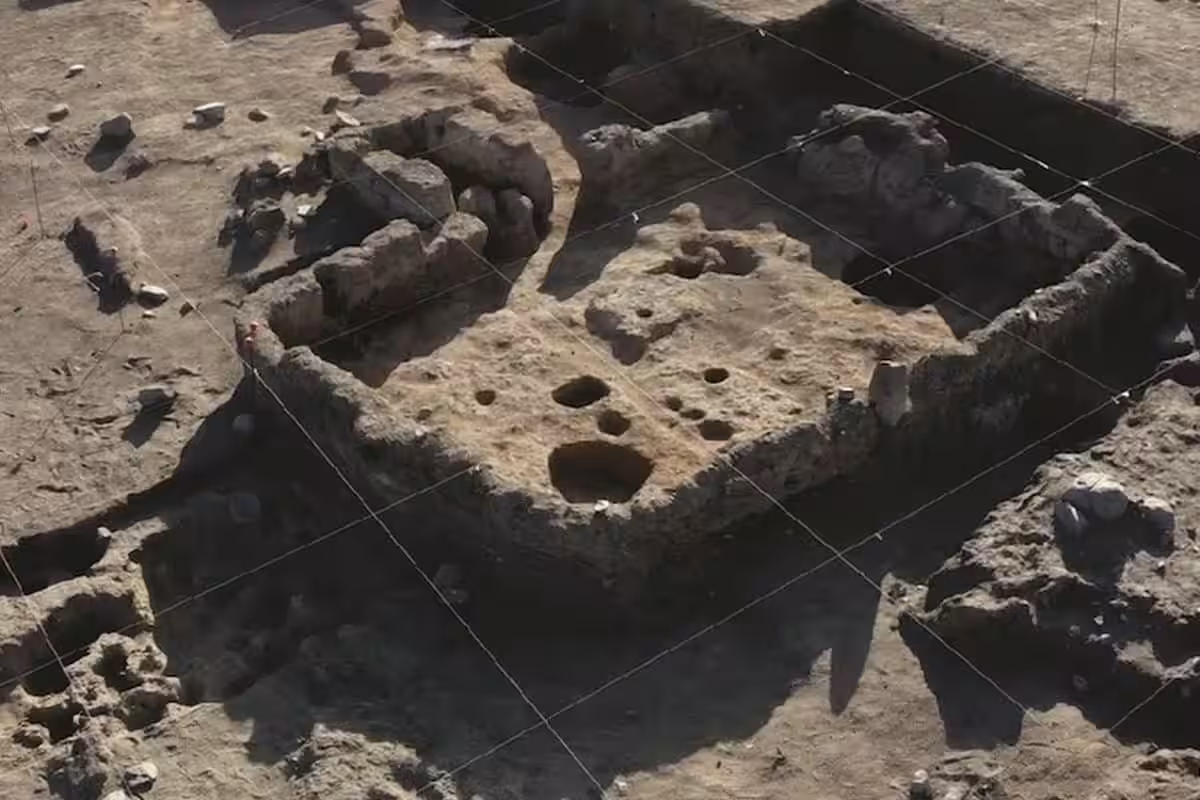
Inside these semi‑underground compounds, archaeologists identified interior partitions that formed enclosed, family‑like neighborhoods, suggesting that extended kin groups occupied tightly clustered residential units.
“The architectural remains are scattered across the entire plateau, which measures 250 meters long by 250 meters wide, where there were once around sixty houses. Additionally, the lands near the watercourse were cultivated,” stated Martínez Ramírez.
The location’s proximity to fertile floodplains likely attracted settlers seeking arable land and reliable water sources.
Burial Assemblages Reveal Social Diversity
Human remains uncovered at the site shed light on burial customs and social stratification. According to a report in Heritage Daily, excavations across three residential zones revealed two distinct mortuary areas containing more than one hundred individuals linked to the Trincheras tradition.
The assemblage includes roughly forty flexed burials, twenty‑eight cremations placed in ceramic vessels, and a number of graves adorned with simple shell ornaments, hinting at differential access to prestige goods.
“We observe traces of the Trincheras and Hohokam traditions, which we have long considered parallel without fully understanding the connections between them. Here we see repeated migrations and abandonments. This leads us to believe that La Ciénega was a border site for the circulation of resources.”
Petroglyphs Add Symbolic Context
INAH’s press release notes that two rock‑art locales were documented near the village. The Babasac site features six panels spread over 200 metres, displaying geometric motifs and anthropomorphic figures.
A second location, dubbed Bear Footprints, contains carvings inside a small cave that resemble bear tracks. Although precise dating remains uncertain, researchers suggest the motifs were created between AD 800 and 1400.
Together, the settlement layout, burial practices, and rock‑art assemblage provide a more nuanced view of how La Ciénega’s inhabitants organized their community, managed resources, and expressed cultural identity.
This article has been fact checked for accuracy, with information verified against reputable sources. Learn more about us and our editorial process.
Last reviewed on .
Article history
- Latest version
Reference(s)
- <https://www.researchgate.net/profile/Jupiter-Martinez>.
- Milligan, Mark. “Archaeologists find ancient village with rock carvings in Northern Mexico.”, March 4, 2026 HeritageDaily <https://www.heritagedaily.com/2026/03/archaeologists-find-ancient-village-with-rock-carvings-in-northern-mexico/157234>.
Cite this page:
- Posted by Zara Tariq