From Seward’s Folly to Gold and Oil: How Alaska’s $7.2 Million Purchase Became a Treasure
Discover how the US bought Alaska for pennies, faced ridicule, and later revealed the massive wealth Russia missed out on.
On March 30, 1867, Secretary of State William H. Seward and Russian envoy Edouard de Stoeckl concluded a treaty in Washington that transferred Russian holdings in North America to the United States. In exchange, Washington agreed to a payment of $7.2 million—equivalent to roughly $157 million in today’s dollars—for a landmass of approximately 600,000 square miles, a price of under two cents per acre.
The pact, officially known as the Treaty of Cession, handed over the area that would become the state of Alaska to U.S. jurisdiction. It capped a century‑long Russian presence that had been built on a now‑defunct fur trade, strained by a costly war and protracted negotiations before a price could be settled.
Early Russian Fur Outpost in Alaska
Russian seafarers Ivan Fedorov and Vitus Bering first reached the Alaskan shoreline in 1732 and 1741, respectively, paving the way for imperial claims and a colony whose economy revolved almost entirely around pelagic trade.
The settlement’s commercial lifeblood was sea‑otter pelts, which fetched premium prices in European markets. To manage this trade, the Russian‑American Company was established, operating alongside American merchants who acted as partners in the venture.
Geographic isolation proved problematic: the outpost lay thousands of miles from Saint Petersburg, making regular shipments to Europe cumbersome, while its population never rose above roughly 2,500 individuals, according to Science et Vie. Intensive hunting further depleted the otter stocks that underpinned the colony’s revenue.
Russia’s fiscal situation deteriorated during the 1853‑1856 Crimean War, a conflict lost to France, Britain, and the Ottoman Empire. The defeat left the empire cash‑strapped and made the remote Alaskan possession increasingly untenable.
Strategic Calculations Prompt Russia to Offer Alaska
By the 1850s, Russia had secured new Pacific territories nearer to its core. It annexed land along the Amur River in 1858 and the Maritime region near present‑day Vladivostok in 1860, according to the Library of Congress. These acquisitions reduced the strategic need for a distant, costly colony.
Simultaneously, Britain’s Hudson’s Bay Company eyed expansion into Alaska, and British forces had already targeted Russia’s Kamchatka Peninsula during the Crimean conflict. A British seizure of the territory was unacceptable to Russian officials.
Choosing the United States as a buyer solved two problems at once: it avoided a British takeover and aligned with a fellow nation that had opposed Britain during the Civil War. On December 16, 1866, Alexander II convened his ministers at the Winter Palace and authorized a sale, setting a floor price of $5 million before dispatching Stoeckl back to Washington to hammer out the details.
Stoeckl presented the offer to Seward, who pressed for a higher valuation. After intense negotiations, the two parties settled on $7.2 million on March 30, 1867.
Seward Pushes Through Purchase Amid Skepticism
William H. Seward, serving as Secretary of State under Presidents Lincoln and Johnson for nearly eight years, championed the deal despite widespread doubt on both sides of the Atlantic.
In Russia, some officials viewed the transfer as a humiliation; in the United States, critics derided the acquisition as a wasteful spend on a frozen, barren expanse.
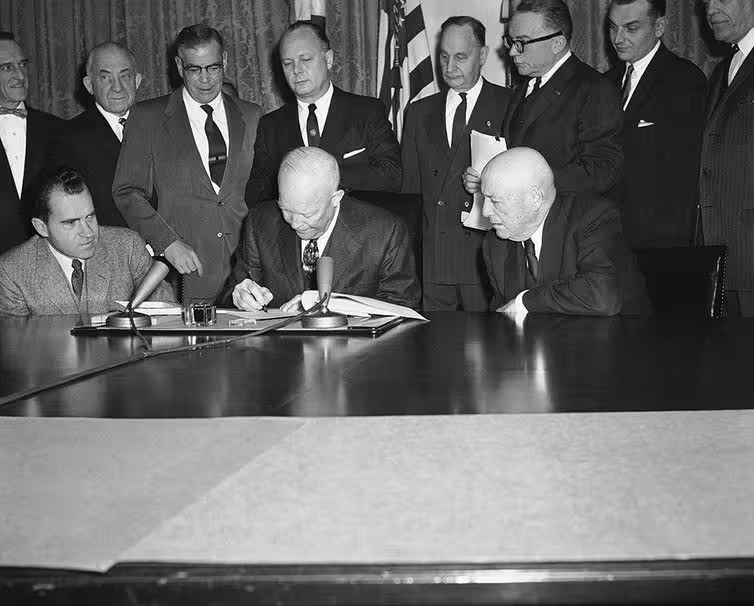
The Senate ratified the treaty on April 9, 1867, and President Andrew Johnson signed it on May 28. Formal handover occurred on October 18, 1867.
Payment lagged because the necessary appropriations bill struggled through the House, a delay compounded by Johnson’s 1868 impeachment. The Treasury finally issued the check on August 1, 1868.
Contemporary newspapers mocked the purchase as “Seward’s Folly” or “Seward’s Icebox.” For nearly thirty years, the federal government administered Alaska loosely through military, naval, or Treasury authorities, only establishing a civil government in 1884 to enforce mining regulations.
Alaska’s Wealth Unlocked by Gold and Resources
The perception of the territory shifted dramatically in 1896 when a rich gold vein was uncovered in the Yukon, positioning Alaska as the gateway to the Klondike Gold Rush. The windfall generated returns that far eclipsed the original purchase price and reshaped American attitudes toward the region.
Subsequent exploitation of timber, fisheries, and minerals such as gold, zinc, and coal provided steady income streams. Later discoveries of oil and natural gas added even greater fiscal value, collectively dwarfing the $7.2 million investment.
Alaska’s strategic importance resurfaced during World War II, and the territory ultimately entered the Union as the 49th state on January 3, 1959.
Alaska Appears in Modern Russo‑American Disputes
The 1867 sale has never fully erased the issue from bilateral relations. After Russia’s 2022 invasion of Ukraine, some Russian lawmakers threatened to reclaim Alaska if the United States froze Russian assets.
Alaska’s governor dismissed the threat, wishing Russian politicians “good luck” with their plan, a remark that U.S. officials treated as largely rhetorical.
Unverified claims later spread on Russian social media, alleging that Russia had nullified the 1867 agreement in both 2022 and 2024, citing a purported “non‑compliant” contract—despite the absence of any official reversal.
The symbolic weight of the deal resurfaced in 2025 when former President Donald Trump invited Vladimir Putin to Alaska for talks on the Ukraine conflict, underscoring how the 158‑year‑old transaction continues to influence diplomatic narratives between Washington and Moscow.
This article has been fact checked for accuracy, with information verified against reputable sources. Learn more about us and our editorial process.
Last reviewed on .
Article history
- Latest version
Reference(s)
- “Check for the Purchase of Alaska (1868).”, September 7, 2021 National Archives <https://www.archives.gov/milestone-documents/check-for-the-purchase-of-alaska>.
- <https://www.loc.gov/collections/meeting-of-frontiers/articles-and-essays/alaska/the-alaska-purchase/>.
Cite this page:
- Posted by Zara Tariq