Why Your Dream Of A Moon City Might Run Out Of Water Sooner Than You Think
Lunar settlements are gaining momentum, but new research suggests that securing enough water may be the ultimate hurdle for future moon bases.
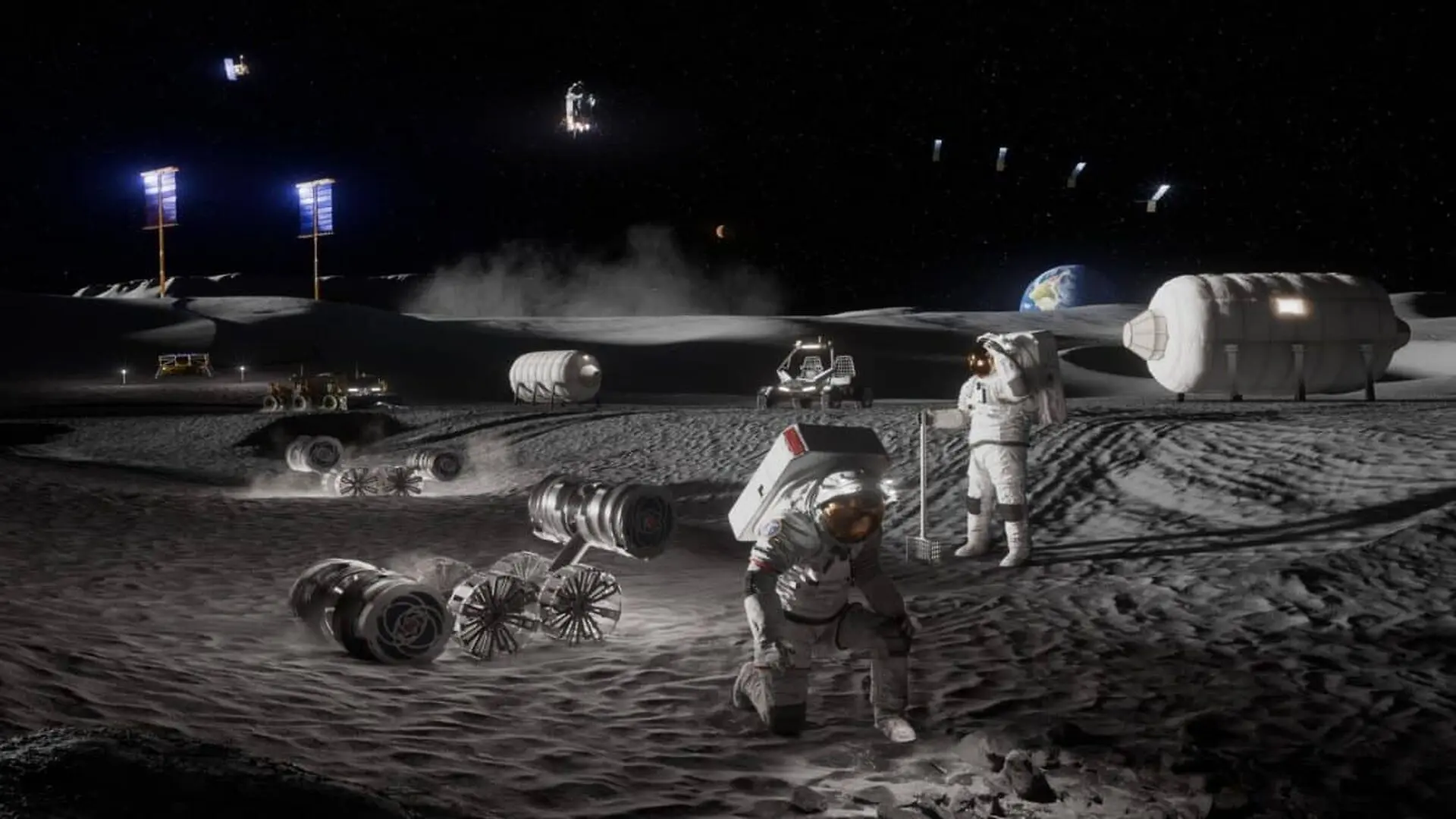
Ambitious proposals for sprawling lunar cities, championed by industry titans like Jeff Bezos and Elon Musk, face a sobering reality check. While the Moon’s polar regions have long been heralded as the foundation for permanent human expansion, new research indicates that the lunar water supply may be insufficient to sustain large-scale habitation.
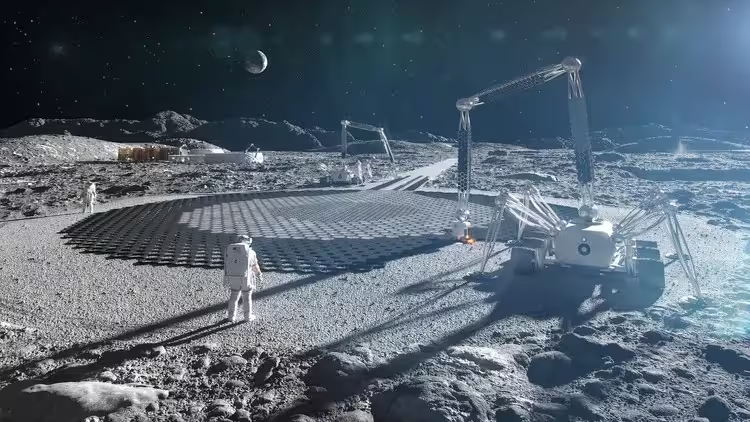
A study recently published in Frontiers in Space Technologies challenges the prevailing optimism surrounding lunar colonization. For years, scientists have focused on the Moon’s poles, where deep, permanently shadowed craters—often described as “cold traps”—have preserved water ice for nearly 4 billion years. These deposits, likely delivered by ancient asteroid impacts, were intended to be the lifeblood of future missions, providing essential resources for drinking, oxygen production, and rocket fuel.
The Resource Bottleneck
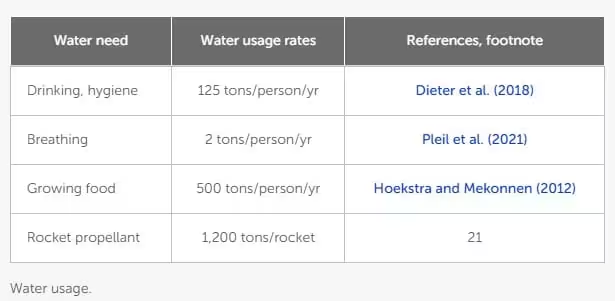
Optimistic models have suggested the presence of up to 1 billion tons (910 million tonnes) of water ice, a figure that has driven visions of self-sustaining colonies. However, the new analysis indicates that even under these generous estimates, a major city would struggle to survive. Researchers modeled consumption rates for various population sizes and found that without near-perfect resource management, large settlements would exhaust their water reserves within years.
Even with advanced recycling technologies capable of recovering 98% of water, a city of 1 million inhabitants would likely deplete these resources within little more than a century. The challenge is compounded by more conservative estimates, which suggest that actual ice deposits could be as much as 30 times lower than the most favorable projections, drastically shortening the potential lifespan of any lunar settlement.
Power vs. Sustenance
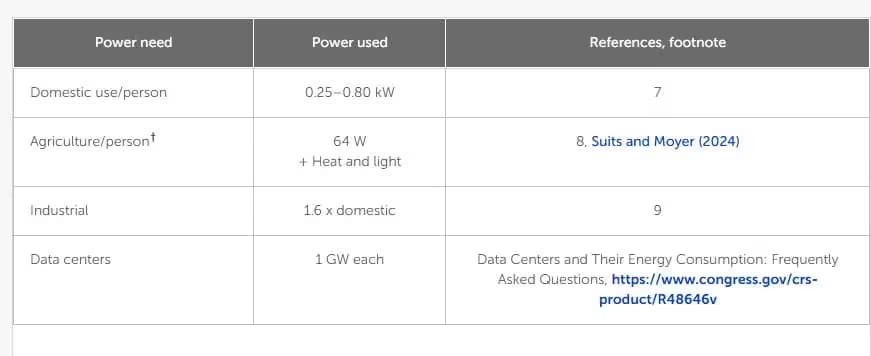
While water remains a critical hurdle, other infrastructural requirements appear more attainable. The Moon’s polar regions are rich in sunlight, with potential for solar infrastructure that could generate approximately 3 gigawatts of electricity. Given the abundance of silicon in the lunar crust, some scientists believe it may eventually be possible to manufacture solar hardware on-site.
However, energy sufficiency does not equate to long-term habitability. The researchers noted that while small outposts of 1,000 to 10,000 people might remain viable for extended periods, scaling to a metropolis presents severe logistical constraints. Future survival may depend on breakthroughs in water-efficient agriculture, aggressive recycling protocols, or even the complex task of importing water from nearby asteroids.
Current exploration has only scratched the surface, literally, by surveying the top few meters of the lunar regolith. Scientists hold out hope that deeper subsurface layers might contain larger, untapped reserves. Until those deposits are confirmed, however, the availability of water will remain the definitive factor in whether humanity truly becomes a multi-planetary species or remains limited to short-term scientific ventures.
This article has been fact checked for accuracy, with information verified against reputable sources. Learn more about us and our editorial process.
Last reviewed on .
Article history
- Latest version
Reference(s)
- Elvis, Martin. “No cities on the Moon: a billion tons of water is not enough for sustainability.” Frontiers in Space Technologies, vol. 7, September 14, 2026, pp. 1894104 Frontiers, doi: 10.3389/frspt.2026.1894104/full. <https://www.frontiersin.org/journals/space-technologies/articles/10.3389/frspt.2026.1894104/full>.
Cite this page:
- Posted by Zara Tariq