One Typo in This Ancient Ring Reveals the Surprising Truth About Pontius Pilate
An ancient copper ring unearthed at Herodium bears the name of Pontius Pilate, but a curious spelling error may reveal a surprising new history.

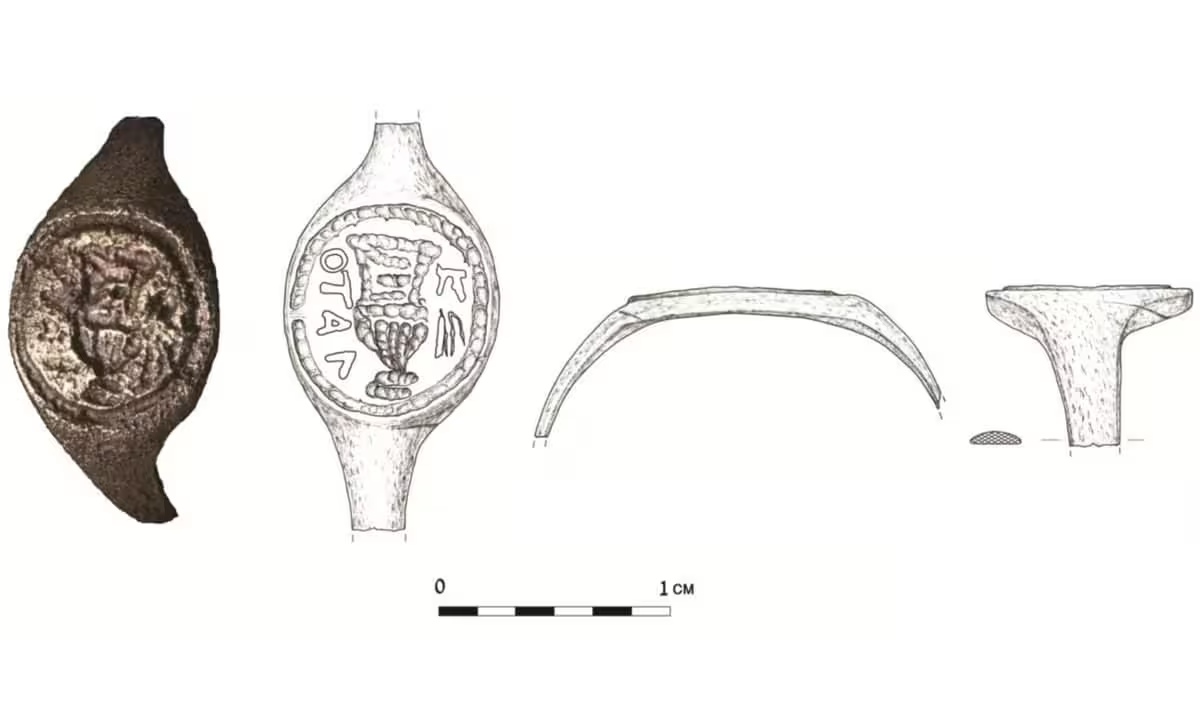
For decades, a nondescript copper alloy ring found at the desert fortress of Herodium remained a historical curiosity. Unearthed in the late 1960s by a team from Hebrew University, the band appeared too utilitarian and modest to hold any significant status. However, a cleaning process in 2018 revealed a detail that transformed the artifact from a piece of forgotten debris into a focal point of archaeological debate: an inscription featuring the name Pilate.
Deciphering a Linguistic Anomaly
The engraving, which features a calyx krater surrounded by the Greek letters ΠΙΛΑΤΟ (PILATO), initially sparked speculation that it might have belonged to Pontius Pilate, the Roman prefect of Judea. Yet, scholars were immediately struck by a grammatical inconsistency. If the ring were intended to denote ownership by the governor, the Greek suffixing would typically follow a different convention, such as PILATOS.
This linguistic mismatch has long been a source of confusion, but new research suggests the deviation is exactly what identifies the ring’s true purpose. UCLA scholar Catherine Bonesho posits that the engraver was not attempting to write a name in standard Greek, but was rather transliterating the Latin form PILATO directly into the Greek alphabet.
A Tool for Administrative Logistics
According to Bonesho’s analysis, the ring was likely not a piece of personal jewelry worn by the prefect, but rather a functional administrative seal. In the diverse, multilingual environment of Roman Judea, such seals were used to impress wax on crates, documents, and containers to signify they belonged to the official office of the governor.
This interpretation aligns with the object’s physical limitations. The engraving appears cramped, as if the craftsman had carved the central vessel first and was forced to squeeze the lettering into the remaining space—even leaving a stray mark that suggests a failed attempt to fit a letter correctly. The coarse quality of the copper alloy further supports the theory that the wearer was likely a low-level servant, laborer, or administrative clerk handling the daily logistics of the Roman occupation.

Humanizing the Roman Bureaucracy
While the link to Pilate provides the ring with its historical gravity, its true significance lies in what it reveals about the reality of Roman governance. The artifact is a testament to the thousands of unnamed individuals who kept the wheels of the empire turning. It serves as a reminder that the reach of the Roman administration was maintained not just by elite prefects, but by a network of intermediaries whose names have long since vanished from the historical record, even if their tools remain.
This article has been fact checked for accuracy, with information verified against reputable sources. Learn more about us and our editorial process.
Last reviewed on .
Article history
- Latest version
Reference(s)
- Steinmeyer, Nathan. “OnSite: Herodium.”, September 12, 2022 Biblical Archaeology Society <https://www.biblicalarchaeology.org/daily/bas-onsite/onsite-herodium/>.
- “Catherine Bonesho - Near Eastern Languages & Cultures - UCLA.”, May 2, 2018 Near Eastern Languages & Cultures - UCLA <https://nelc.ucla.edu/person/catherine-bonesho/>.
- Bonesho, Catherine E.. “The Pilate Ring: A Reconsideration.” Palestine Exploration Quarterly, July 30, 2026, pp. 1-28. Informa UK Limited, doi: 10.1080/00310328.2026.2695544. <https://www.tandfonline.com/doi/full/10.1080/00310328.2026.2695544>.
Cite this page:
- Posted by Zara Tariq