Quantum Experiment Creates Clock From Entropy Showing Time May Be Emergent
Birmingham team shows
In a study appearing in Physical Review Research, Professor Giovanni Barontini and his team demonstrate that a tabletop quantum experiment can address one of cosmology’s deepest puzzles – whether time is a fundamental backdrop or an emergent property of the universe.
Why Time Might Emerge From Within a Quantum System
The “problem of time” arises from the Wheeler‑DeWitt equation, a cornerstone of quantum‑gravity research that depicts the cosmos as a single, timeless quantum state. This static description clashes with everyday experience, where events undeniably follow a forward‑moving temporal order.
A proposed resolution, outlined in the Physical Review Research paper, suggests partitioning the universe into interacting subsystems and using the flow of entropy between them as an internal clock. Barontini’s experiment puts this idea to the test with a miniature, isolated quantum system.
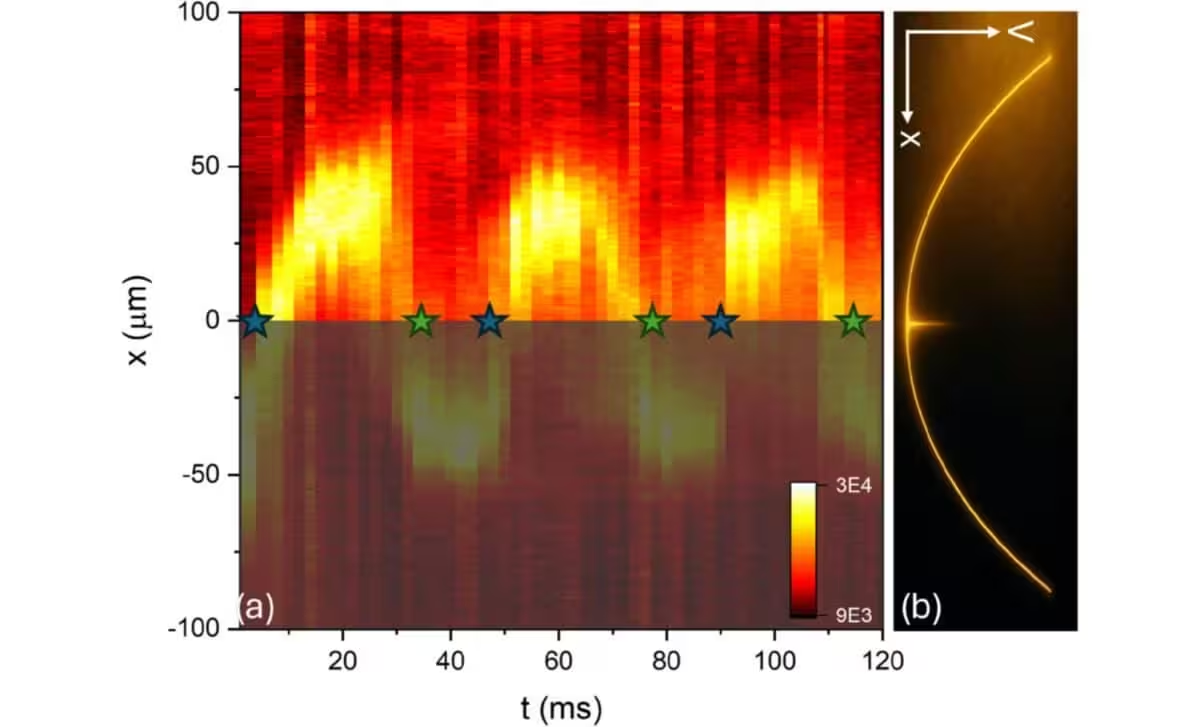
The apparatus contains roughly 24 000 rubidium atoms chilled to a few millikelvins above absolute zero. Two intersecting laser beams carve the cloud into a “bright” region that can be observed and a “dark” region that remains hidden. An adjustable optical barrier regulates atom exchange, while the entire assembly stays sealed from external influences.
Measuring Time Without an External Clock
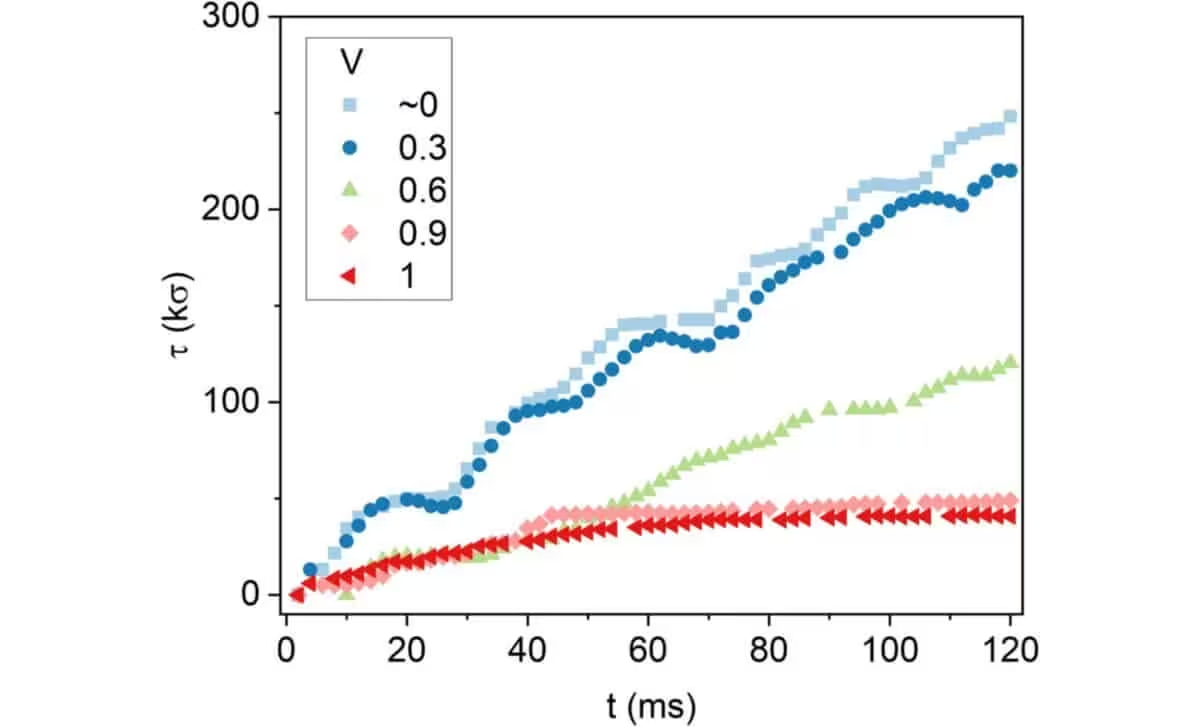
Instead of relying on a conventional timer, the researchers defined “entropic time” – a metric that increases whenever disorder (entropy) shifts between the two sectors. As atoms migrate into the bright region, the system’s entropy rises and the entropic clock ticks forward; when the distribution steadies, the clock effectively pauses. Because the combined entropy of bright and dark sectors never changes, the setup remains a genuine closed system.
Repeated cycles of expansion and contraction in the bright sector mimic a cosmological “Big Bang” followed by a “Big Crunch.” Across multiple runs, the entropic clock consistently ordered these events, advancing in a single direction without reference to any laboratory chronometer, such as the external quantum clock. Adjusting the barrier height altered the rate of entropy exchange, allowing the researchers to fine‑tune the speed of entropic time.
Building on the experimental data, the team rewrote the Schrödinger equation – the fundamental rule governing quantum evolution – entirely in terms of entropic time. Numerical simulations using this reformulated equation reproduced the observed dynamics of the atom cloud with striking accuracy.
Beyond its theoretical impact, the platform offers a versatile testbed for simulating phenomena such as black‑hole horizons, exploring competing models of time emergence, and probing the physics of the early universe under controlled conditions. It could also help determine whether singularities at the “Bang” and “Crunch” are smoothed out by quantum effects, leading to a bounce rather than a true collapse.
The key takeaway is that a closed quantum system can generate its own temporal ordering from internal entropy exchanges, eliminating the need for any external timekeeping device.
This article has been fact checked for accuracy, with information verified against reputable sources. Learn more about us and our editorial process.
Last reviewed on .
Article history
- Latest version
Reference(s)
- “Professor Giovanni Barontini.” University of Birmingham <https://www.birmingham.ac.uk/staff/profiles/physics/barontini-giovanni>.
- Barontini, Giovanni. “Testing the problem of time with cold atoms.” Physical Review Research, vol. 8, no. 2, June 11, 2026 American Physical Society (APS), doi: 10.1103/1h9j-df4k. <https://journals.aps.org/prresearch/abstract/10.1103/1h9j-df4k>.
Cite this page:
- Posted by Farah Siddiqui