Facial Reconstruction Reveals Mystery Man Who Defies Britain’s Saxon And Norman Divide
Scientists have reconstructed the face of a man from the Norman Conquest era using forensic analysis and DNA to reveal his life in 11th-century England.
Ancient DNA and Isotope Data Challenge Simplistic Narratives of 1066
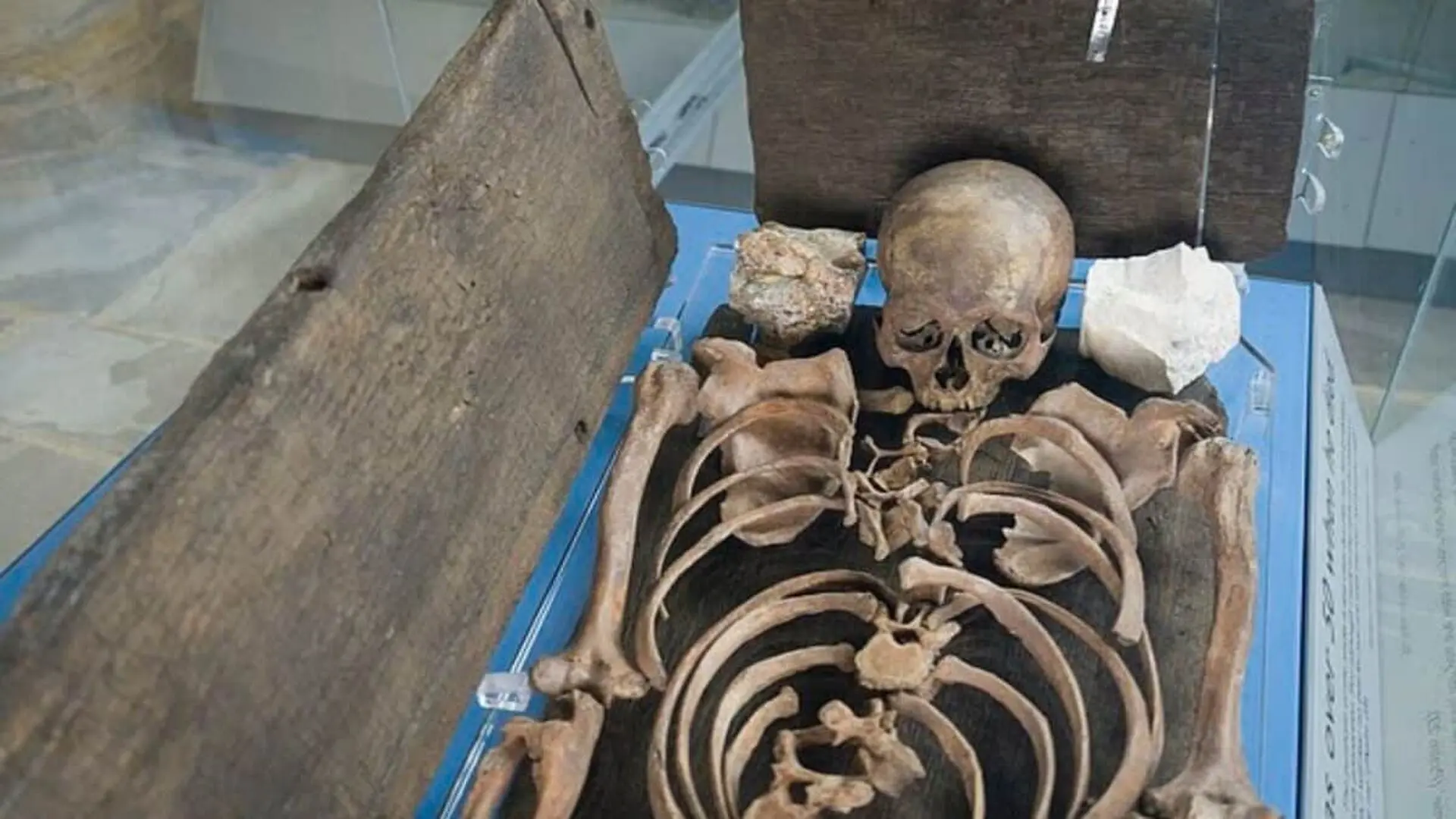
The remains of an 11th-century individual discovered at St Peter’s Church are upending traditional historical classifications of the Norman Conquest. Rather than fitting neatly into the binary of Anglo-Saxon defender or Norman invader, this individual—dubbed the “Conquest Man”—appears to represent a more complex, interconnected reality of Northern European life during a period of immense social upheaval.
Excavated roughly 50 years ago, the skeleton was found in a burial site that predates the 1066 man’s era but later fell under the influence of Gilbert De Ghent, a knight in the service of William the Conqueror. A multidisciplinary investigation involving English Heritage, the Francis Crick Institute, and the University of Southampton has now utilized ancient DNA, isotope analysis, and digital facial reconstruction to piece together his life story.

The findings suggest a life defined by mobility. While his teeth display strontium levels consistent with the local Barton environment, oxygen isotope data hint that he spent his formative adolescent years in a much colder climate. Genetic evidence points toward continental European ancestry, with skull morphology analysis, as noted by The Guardian, suggesting strong Scandinavian roots.
Dr Sarah Stark, a skeletal biologist at Historic England, emphasized that the data resists a simple origin story. Instead, the evidence paints a portrait of an individual whose identity was likely rooted in the fluid, cross-border exchanges common across the North Sea during the 11th century.
A Life Lived at the Crossroads of Tradition
The burial itself provides further clues to this man’s cultural background. He was interred with significant care, resting on a grass pillow with chalk supports and accompanied by three applewood staffs—objects linked by English Heritage researchers to Scandinavian funerary customs. The coffin, crafted from a single oak tree felled around 1079, suggests he lived well into the post-conquest era.
Kevin Booth, head curator of collections at English Heritage, argues that the man’s background reflects the legacy of the Danelaw and the deep-seated connections between eastern England and Scandinavia. “He was born into a world where England, Denmark, and Norway were frequently linked under rulers like King Cnut,” Booth explained. “This makes the movement of people across the North Sea a matter of course rather than an anomaly.”
Physically, the man was short and remarkably robust. Standing roughly 5 feet to 5 feet 1 inch tall, he possessed a powerful, muscular frame and carried the marks of a physically demanding life, including several healed fractures. Whether he arrived with the Norman invasion force or migrated independently remains a point of debate, though researchers caution against assuming he was a member of William’s army without further proof.
Ultimately, the “Conquest Man” serves as a reminder that the 11th century was not merely a static era of opposing armies. His life and death illustrate a period where regional identities were porous, and an individual’s final resting place could host a blend of cultural traditions, defying the rigid historical labels often applied to the era.
This article has been fact checked for accuracy, with information verified against reputable sources. Learn more about us and our editorial process.
Last reviewed on .
Article history
- Latest version
Reference(s)
- “Our Researchers.” English Heritage <https://www.english-heritage.org.uk/learn/research/our-researchers/>.
- “The Francis Crick Institute.”, August 21, 2026 <https://www.crick.ac.uk/>.
- Davis, Nicola. “Researchers find Britain’s 11th-century ‘Conquest Man’ was Scandinavian – but did he land with the Norman army?.”, August 30, 2026 The Guardian <https://www.theguardian.com/uk-news/2026/aug/30/11th-century-conquest-man-scandinavian-norman-army>.
- <https://soton.academia.edu/SarahStark>.
Cite this page:
- Posted by Elizabeth Taylor