Solar Regenerated Salt System Cools to -2°C and Stays Below 10°C for 8 Hours Without Electricity
Scientists chill samples below freezing without a compressor using a sunlight‑reset salt cycle, offering a novel, energy‑saving cooling method.
Air conditioners and electric fans account for nearly 20% of the electricity used in buildings worldwide, equivalent to about 10% of global electricity consumption, according to the International Energy Agency’s The Future of Cooling.
Scientists at King Abdullah University of Science and Technology have demonstrated a new cooling concept that bypasses traditional refrigeration cycles. The prototype, named NESCOD, relies on ammonium nitrate dissolved in water to generate a chill, and solar energy to reconvert the salt for repeated use.
In controlled experiments, the ammonium nitrate solution dropped to approximately −2.4 °C within 20 minutes. Under solar‑driven regeneration conditions, the team estimated a cooling output of up to 191 W per square metre.
Endothermic Dissolution Drives Temperature Drop
When ammonium nitrate mixes with water, the dissolution process absorbs heat from its surroundings, causing the mixture’s temperature to fall. The researchers evaluated several salts before selecting ammonium nitrate for its superior performance. Their paper in Energy & Environmental Science also compared potassium nitrate, sodium nitrate, ammonium chloride, potassium chloride and potassium bromide.
The selection criteria considered how much each salt could dissolve in water and the heat absorbed when forming a saturated solution. Ammonium nitrate emerged as the most effective, delivering the highest calculated cooling capacity.
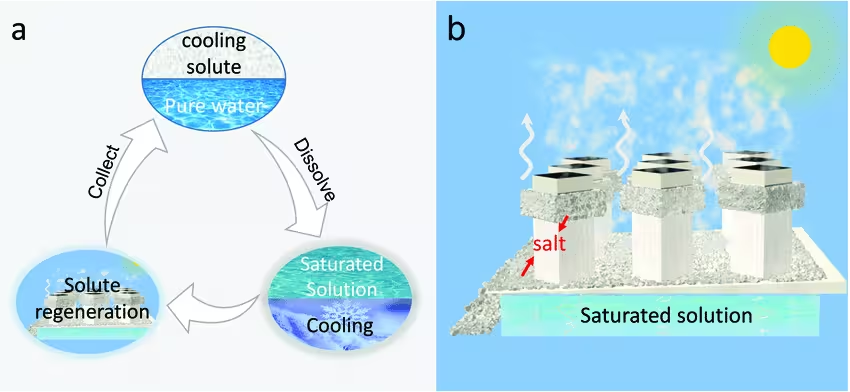
Ammonium nitrate’s high solubility allowed a large quantity of salt to dissolve in a modest water volume, yielding an enthalpy of saturation of 187.6 kJ kg⁻¹. In a Dewar flask, the solution reached about −2.4 °C after 20 minutes, while the surrounding air cooled more gradually to 9.1 °C after 51 minutes.
A subsequent trial placed a metal cup inside an insulated polystyrene box, with ammonium nitrate surrounding it. Water was added incrementally to sustain dissolution. The cup’s temperature fell to roughly 6.2 °C after 26 minutes and later to 3.6 °C after 220 minutes, staying under 10 °C for more than eight hours and under 15 °C for over fifteen hours.
Solar‑Powered Regeneration Restores the Salt
After each cooling cycle, the salt remains in solution and must be reclaimed. The team constructed a three‑dimensional solar regenerator that uses sunlight to heat the solution, evaporate water, and concentrate the ammonium nitrate until it crystallizes.
The device featured a light‑absorbing base for solar capture and an outer region where evaporation and crystal growth occurred. Early experiments showed a dense crust of salt forming on the regenerator, hindering fresh solution flow and slowing evaporation.
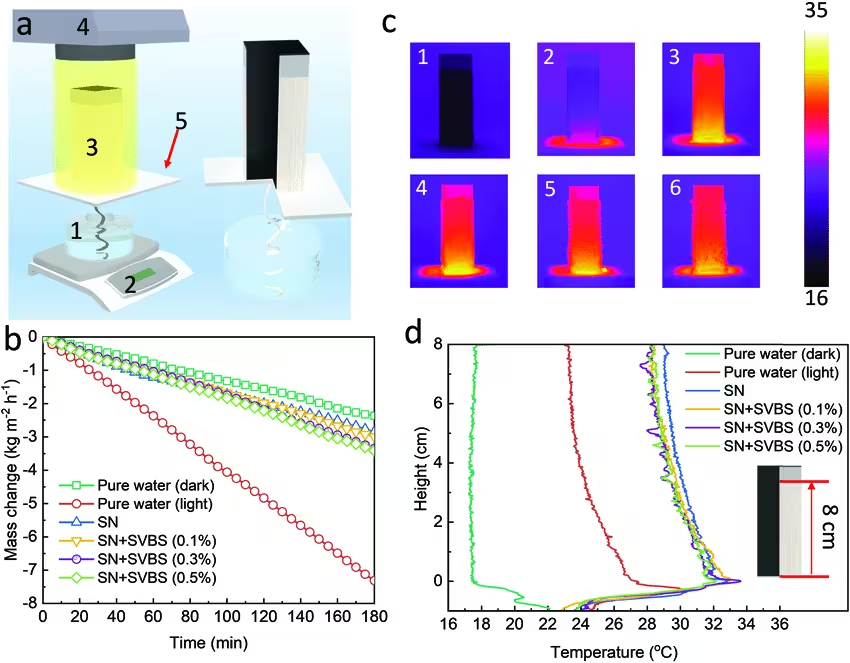
To mitigate crust formation, the researchers added sodium 4‑vinylbenzenesulfonate (SVBS) to modify crystal morphology and introduced a PTFE film to shield parts of the device from salt buildup. With these adjustments, the system achieved an evaporation rate of about 2.2 kg m⁻² h⁻¹ and a salt recovery rate of roughly 4.6 kg m⁻² h⁻¹ under one‑sun illumination.
Using the measured regeneration performance, the authors projected a cooling output of up to 191 W m⁻², assuming an ambient temperature of 35 °C and a final solution temperature of 25 °C. Water collected during regeneration displayed ion and total organic carbon concentrations below 1 ppm.
Separate Modules Enable Flexible Deployment
NESCOD isolates the cooling phase from the solar regeneration phase, allowing the solid ammonium nitrate to be stored after crystallization and later mixed with water to trigger cooling again. Because the two steps are independent, the solar regenerator can be positioned on a rooftop while the cooling module operates elsewhere in a building.
The study explored targeted cooling scenarios, such as chilling a bed rather than an entire room, and demonstrated that the system operates without electrically powered compressors or moving parts, classifying it as a fully passive technology.
The International Energy Agency warns that global cooling demand could more than triple by 2050 if efficiency improvements lag behind adoption. Their forecast suggests that two‑thirds of households worldwide may possess air‑conditioning units by then, with China, India and Indonesia accounting for half of the total installations.
In the insulated‑storage test, the metal cup stayed below 10 °C for over eight hours and under 15 °C for more than fifteen hours. Solar regeneration experiments recorded a salt recovery rate of approximately 4.6 kg m⁻² h⁻¹ under standard sunlight conditions.
This article has been fact checked for accuracy, with information verified against reputable sources. Learn more about us and our editorial process.
Last reviewed on .
Article history
- Latest version
Reference(s)
- “The Future of Cooling – Analysis - IEA.”, May 14, 2018 IEA <https://www.iea.org/reports/the-future-of-cooling>.
- <https://pubs.rsc.org/en/content/articlelanding/2022/ee/d1ee01688a>.
Cite this page:
- Posted by William Moore