3,200-Year-Old Bronze Sword Recovered From Volcanic Lake Is Still Sharp Enough To Cut
Divers exploring a submerged Bronze Age village have discovered a rare blade and mysterious artifact, potentially revealing the owner’s ancient social rank.
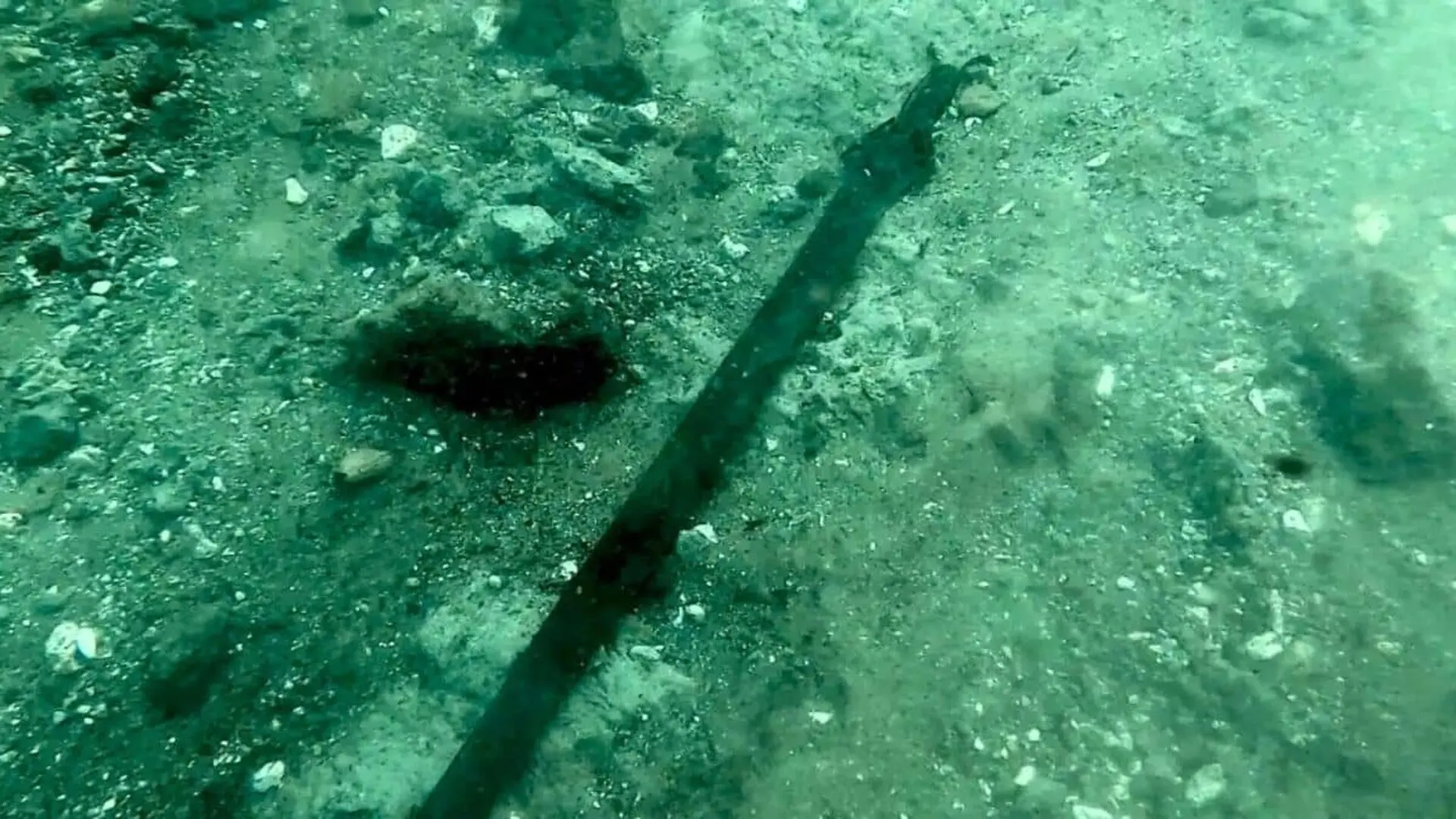
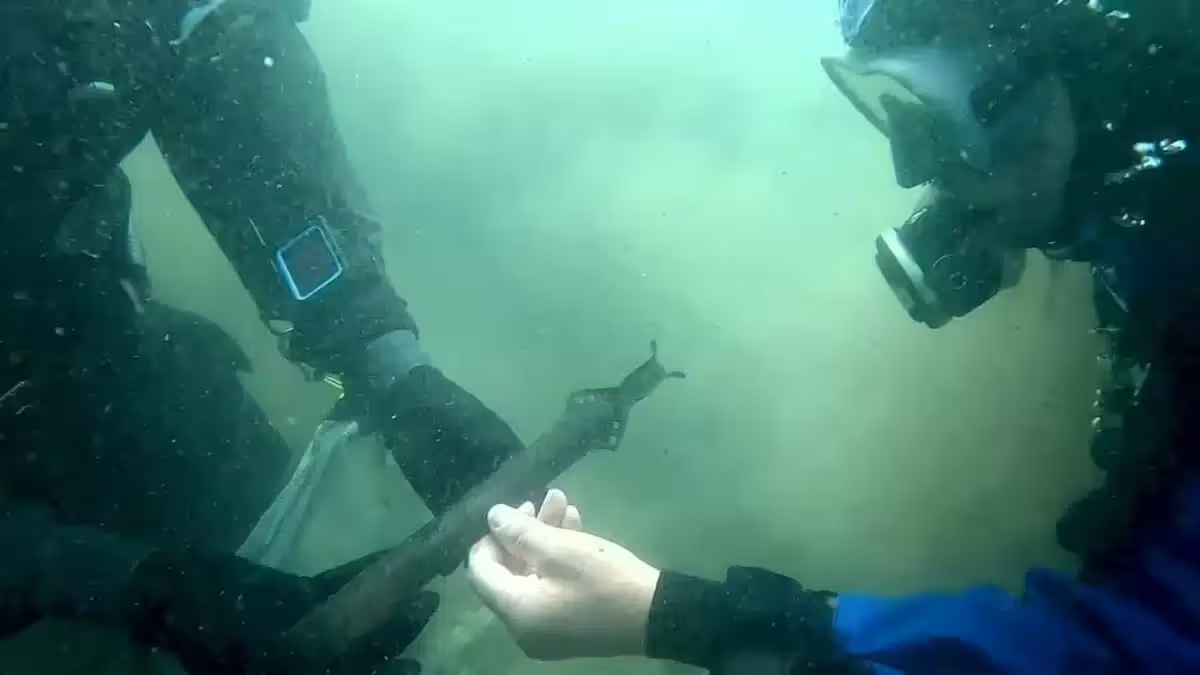
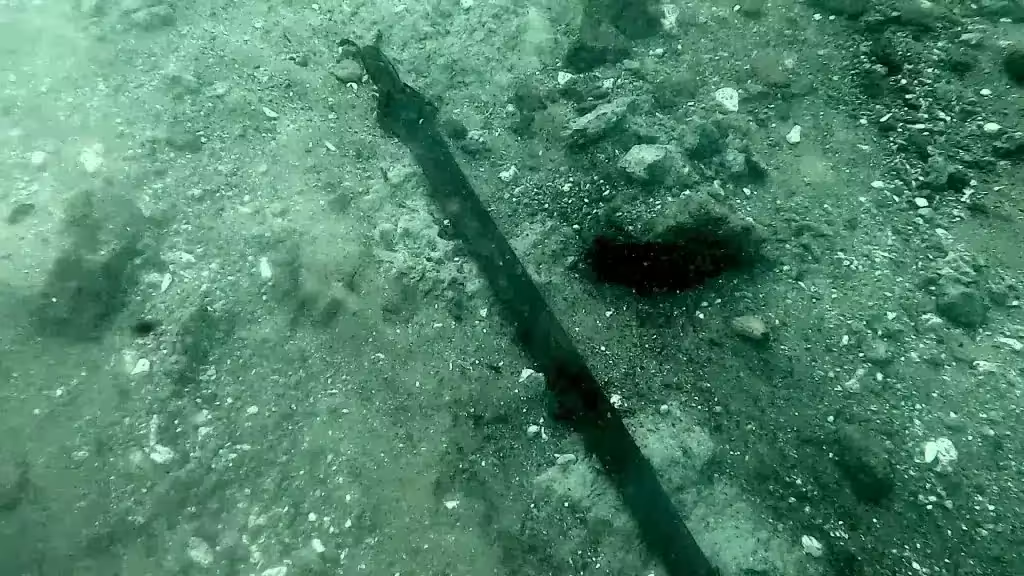
Archaeologists exploring a volcanic lake north of Rome have pulled a remarkable relic from the depths: a 13th-century BC bronze sword that remains remarkably sharp even after three millennia underwater. The weapon was discovered on the bed of Lake Mezzano, located in the Tuscia region of northern Lazio, where it rested among the submerged remains of a prehistoric stilt-dwelling village.
The discovery represents only the third sword identified at this site since divers first began investigating the area in the early 1970s. Of particular interest to researchers is the blade’s proximity to a bronze razor, a pairing frequently interpreted by archaeologists as a status symbol associated with high-ranking individuals.
Military Craftsmanship from the Bronze Age
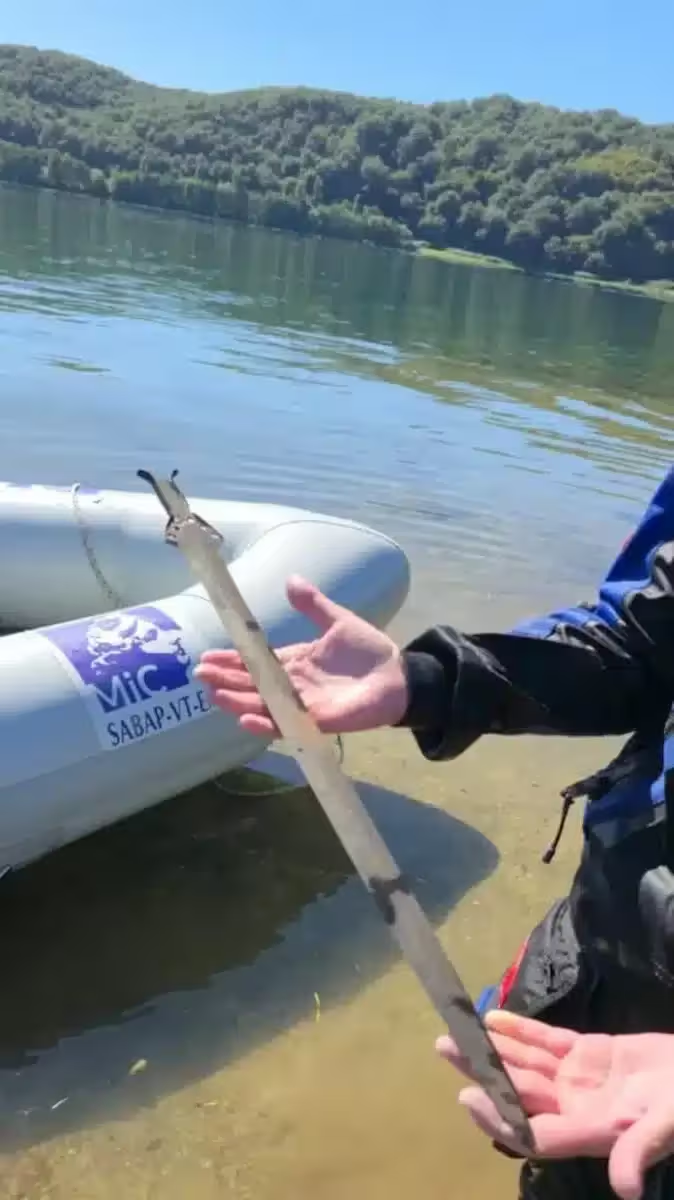
The sword dates back to the Bronzo Recente, a period in Italian history contemporary with the reign of Ramesses II in Egypt. The find originated from the lake’s southern shore, a sector that has received minimal archaeological attention until recently. According to the Soprintendenza Archeologia, Belle Arti e Paesaggio, which oversaw the recovery mission alongside the Carabinieri’s underwater unit, the weapon exhibits the characteristic design of central Italian metalwork from the close of the Bronze Age.
The sword’s hilt, featuring a distinct swallowtail design and a flat metal tongue, identifies it as a flange-hilted weapon. As noted by archaeologist Andrea Basso in Geopop, the blade belongs to the Naue II classification. Originally identified by German archaeologist Julius Naue in the 19th century, these robust, wide-bladed weapons became a hallmark of military technology that traversed the Mediterranean and Europe throughout the 13th century BC, reflecting widespread trade and cultural exchange long before the emergence of the Etruscan civilization.
Life Within the Latera Caldera
Lake Mezzano sits within a small crater inside the Latera caldera, a volcanic feature situated west of Lake Bolsena. Spanning roughly half a square kilometer with a maximum depth of 36 meters, the lake’s water levels were historically volatile. Research by ENEA geologist Carlo Giraudi indicates that the lake frequently flooded surrounding plains until an outflow channel was deepened in the 18th century.
The submerged village, which was occupied between 1700 and 1150 BC, reveals a settlement that adapted to fluctuating water levels over six centuries. Mapping efforts in 2025 identified more than 600 wooden piles embedded in the clay lakebed. These remains form a continuous ring following the ancient shoreline, rather than clustered neighborhoods, suggesting a long-term architectural response to the shifting environment.
Historical Protection and Modern Discovery
The site was originally brought to light by geologist Lamberto Ferri Ricchi in 1972. Seeking to prove that ancient settlements were often lost to climate-induced rising waters rather than volcanic catastrophes, Ferri Ricchi documented the submerged wooden stilts. Early excavations, including a 1973 mission, successfully recovered pottery, bronze axes, and wooden structural elements before looters could disturb the site. Many of these items were preserved and are currently housed at the Museum of the Prehistory of Tuscia in Valentano.
Recent research efforts have yielded a wealth of new material, including intact pottery, arrowheads, daggers, and jewelry, all protected from corrosion by the lake’s oxygen-deprived clay layers. Fragments of bronze ingots suggest that the villagers conducted their own metalworking on-site. Furthermore, signs of fire on some of the artifacts, alongside their specific positioning, suggest that a portion of the settlement may have succumbed to a blaze.
Archaeologists believe the presence of high-status weaponry, such as the sword and razor, in the lake may represent ritual offerings, a common practice across Bronze Age Europe. As excavations continue, researchers from CSR Restauro Beni Culturali are providing immediate stabilization for each recovered item, with plans to further map the site using 3D technology to better understand the dynamics of this ancient community.
This article has been fact checked for accuracy, with information verified against reputable sources. Learn more about us and our editorial process.
Last reviewed on .
Article history
- Latest version
Reference(s)
- “Valentano (VT) – eccezionale rinvenimento nel Lago di Mezzano: recuperata una spada dell’Età del Bronzo – Soprintendenza Archeologia Belle Arti e Paesaggio per la provincia di Viterbo e per l'Etruria Meridionale.” <https://sabapviterboetruria.cultura.gov.it/valentano-vt-eccezionale-rinvenimento-nel-lago-di-mezzano-recuperata-una-spada-delleta-del-bronzo/>.
- Basso, Andrea. “Una spada di 3.200 anni riemerge dal lago di Mezzano: era nascosta nel villaggio sommerso.”, October 6, 2026 Geopop <https://www.geopop.it/una-spada-di-3-200-anni-riemerge-dal-lago-di-mezzano-era-nascosta-nel-villaggio-sommerso/>.
- Giraudi, C.. “The Lago di Mezzano (Valentano - Viterbo) level oscillations: Climatic variations and human impact [Le oscillazioni di livello del lago di mezzano (valentano -vt): Variazioni climatiche e interventi antropici].”, vol. 17, February 23, 2017 Divisione Impatti Antropici e del Cambiamento Climatico sul Territorio <https://ambiente.sostenibilita.enea.it/pubs/4235>.
Cite this page:
- Posted by William Moore