Engineers Design Skyrmion Bubbles in Centrosymmetric Magnets
Researchers overcome a major hurdle in quantum materials by using chemical doping to stabilize complex topological spin textures without relying on traditional interactions.
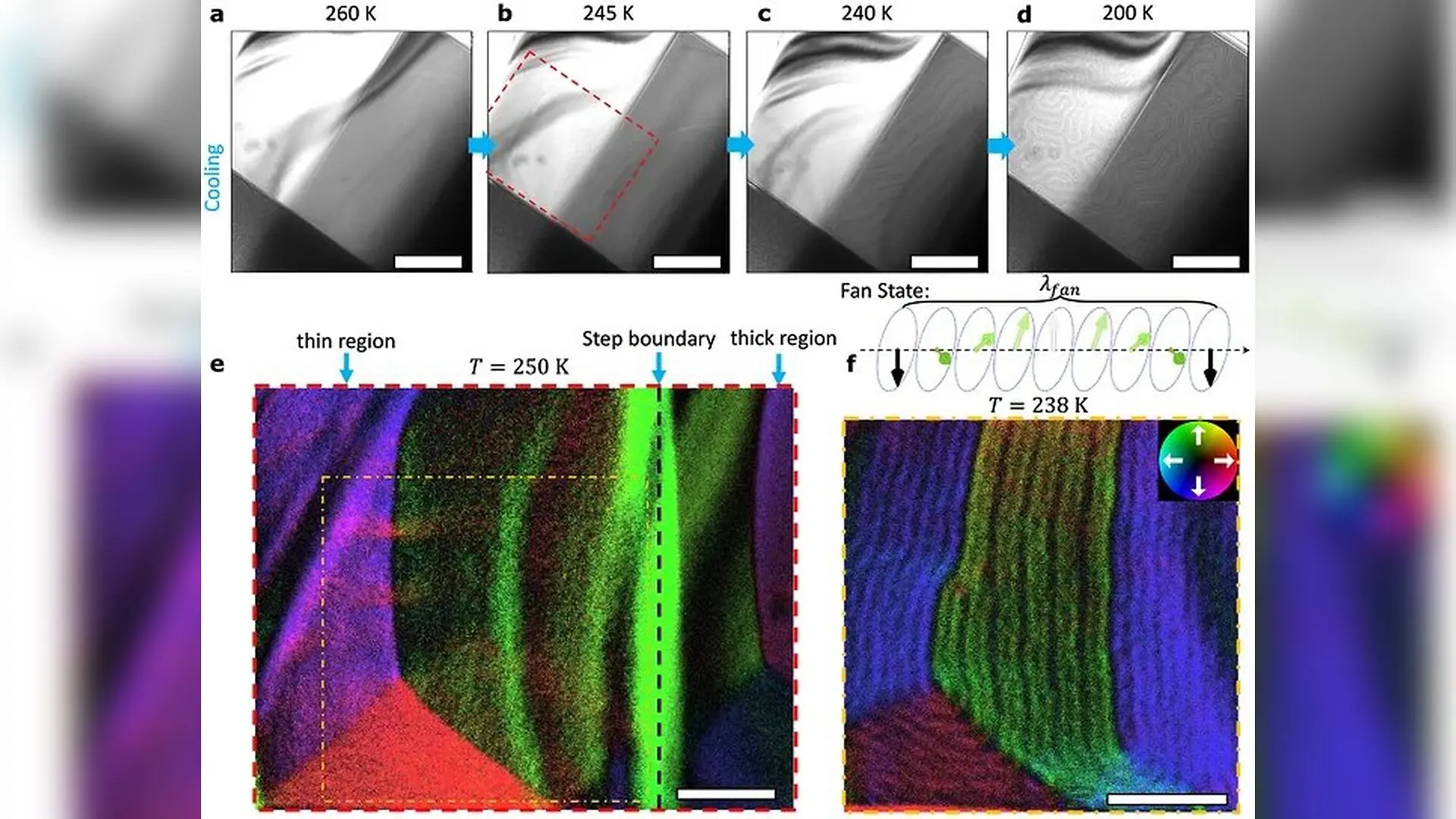
The quest to control nanoscale magnetic configurations has entered a new phase as researchers successfully engineered magnetic skyrmions inside a centrosymmetric bulk material. Traditionally, these whirlpool-like spin textures were thought to require crystal lattices that lack an inversion center. In those asymmetric systems, the Dzyaloshinskii-Moriya interaction dictates how atomic spins twist and lock into robust topological solitons. However, discovering that certain symmetric materials can also host skyrmions opened up broader material libraries, shifting the scientific focus toward active manipulation rather than passive observation.
The primary roadblock in designing these structures from scratch has been the precise control of magnetocrystalline anisotropy. Without structural asymmetry to force a twist, researchers must find alternative ways to balance competing magnetic interactions, exchange forces, and dipolar energies. Addressing this challenge, the detailed findings were published in Advanced Science, outlining how targeted chemical doping can artificially induce the exact conditions needed for topological phase formation in bulk crystals.
Tuning Anisotropy in Kagome Magnets
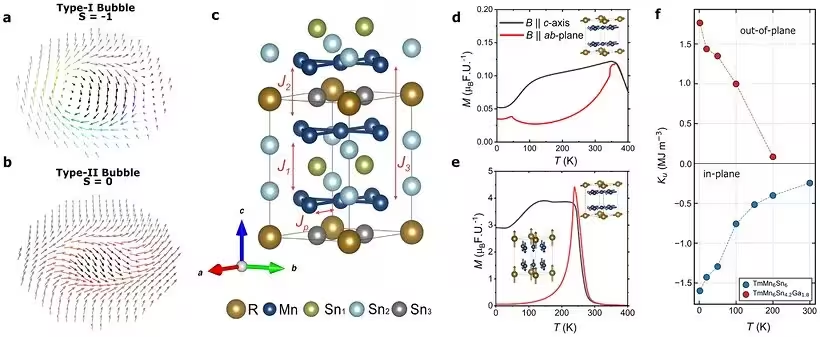
The research team focused on the hexagonal Kagome magnet family, specifically examining the compound TmMn6Sn6. In its native state, this material exhibits robust in-plane magnetic anisotropy across standard operating temperatures. The atomic architecture features alternating layers where rare-earth thulium atoms and transition-metal manganese atoms interact through complex exchange pathways. While the manganese sublattice prefers in-plane alignment, the thulium moments introduce an competing out-of-plane tendency that remains subdued at elevated thermal energies.
To tip this internal balance, the scientists introduced gallium into the crystal lattice, substituting it selectively into specific atomic sites within the thulium-containing layers. This substitution modifies the local crystal-field environment and enhances the thulium easy-axis on-site anisotropy. As the material cools, thermal fluctuations subside, allowing the enhanced thulium out-of-plane tendency to overcome the manganese sub-lattice’s in-plane preference. This precise intervention triggers a distinct spin reorientation transition, shifting the net magnetic easy axis toward the crystallographic c-axis and clearing the path for complex spin textures to emerge.
Direct Observation of Skyrmion Bubble Lattices
To map out the resulting magnetic landscape, the team employed high-resolution cryogenic Lorentz transmission electron microscopy alongside differential phase contrast scanning transmission electron microscopy. These advanced real-space imaging methods captured the exact thermal evolution of the domains. Just below the engineered spin reorientation temperature, the material transitions through an intermediate fan-like modulation state before settling into intricate labyrinth-like striped domains.
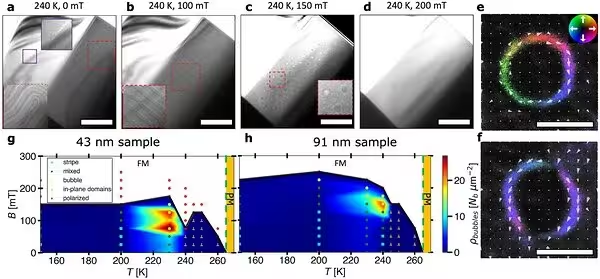
When an external magnetic field is applied parallel to the c-axis, these striped domains narrow, fragment, and eventually condense into a dense lattice of magnetic bubbles. The microscopy analyses confirmed the coexistence of two distinct bubble varieties. Type-I bubbles feature a complete 360-degree winding of their in-plane magnetization around a Bloch-type domain wall, giving them an integer topological charge that shields them against thermal collapse. Meanwhile, Type-II bubbles exhibit a non-topological structure sensitive to small in-plane field components, highlighting a tunable sensitivity that could prove useful for rapid switching applications.
Thickness-Dependent Dynamics and Helicity Switching
Further investigation into the thinned sample lamellae uncovered surprising dynamical behavior among the topological bubbles. While their integer topological charge remained protected, the chirality or helicity of their domain walls frequently flipped between left-handed and right-handed configurations. By tracking these changes across varying sample thicknesses, the researchers discovered that the switching rate scales dramatically in thinner regions, reaching up to several events per second.
Quantitative analysis suggests this phenomenon is thermally activated. Thinning the sample amplifies surface demagnetization effects and reduces the energy barrier required to nucleate microscopic defects like Bloch points and Bloch lines. This intimate link between lamella thickness, local volume, and magnetic flexibility demonstrates how physical dimensions can be used to tailor not only the static geometry of quantum textures but also their kinetic response to external stimuli.
Ultimately, this work demonstrates that chemical substitution can successfully bypass the traditional requirement for structural asymmetry in topological magnetism. By providing a reliable method to induce spin reorientation transitions and stabilize custom magnetic bubbles, the study establishes a powerful framework for developing next-generation spintronic devices, ultra-dense data storage solutions, and low-power computing components built on quantum materials.
The research was published in Advanced science (Weinheim, Baden-Wurttemberg, Germany) on October 20, 2026.
This article has been fact checked for accuracy, with information verified against reputable sources. Learn more about us and our editorial process.
Last reviewed on .
Article history
- Latest version
Reference(s)
- El Gazzah, Mohamed., et al. “Skyrmion Bubbles by Design in a Centrosymmetric Kagome Magnet.” Advanced Science, October 20, 2026 Wiley, doi: 10.1002/advs.78269. <https://doi.org/10.1002/advs.78269>.
Cite this page:
- Posted by John Williams