High-Pressure Ice Can Trap Essential Amino Acids on Distant Ocean Worlds
A novel study shows that building blocks of life can integrate into dense ice layers inside large ocean worlds, changing how nutrients travel from planetary cores.
Water-rich planetary bodies hosting hidden liquid water oceans have emerged as prime targets in the modern search for extraterrestrial habitability. Beyond Earth, our solar system features several icy moons with strong evidence of global subsurface oceans, including Europa, Ganymede, Callisto, and Enceladus. In the wider galaxy, astronomers have confirmed thousands of exoplanets, with a subset residing in habitable zones capable of maintaining liquid water surfaces or subsurface layers. As space agencies launch ambitious missions to explore these distant environments, a critical question centers on the availability of fundamental building blocks of life, particularly key biomolecules like amino acids and nucleotides.
While these organic compounds can be delivered by comets and meteorites or synthesized through hydrothermal water-rock interactions at planetary floors, their journey to upper liquid oceans faces a major physical hurdle. Large icy worlds and super-Earths often feature thick internal mantles composed of high-pressure ice phases, such as ice VI and ice VII, wedged between the rocky core and the upper ocean. Traditional thermodynamic expectations suggest that equilibrium freezing expels dissolved solutes with very low partition coefficients. However, recent investigations published in Science Advances reveal a more complex reality regarding how organic molecules interact with these extreme ice formations.
Observing Amino Acid Behavior Under Extreme Pressures
To determine whether amino acids can survive or incorporate into dense ice barriers, an international team of researchers conducted equilibrium freezing experiments using externally heated diamond-anvil cells. Focusing on glycine and alanine, the two simplest proteinogenic amino acids and abundant species in carbonaceous chondrites, the team subjected aqueous solutions to elevated temperatures up to 200 degrees Celsius and pressures reaching 3.3 gigapascals. These conditions closely simulate the extreme environments found at the boundaries between liquid water and deep icy mantles.
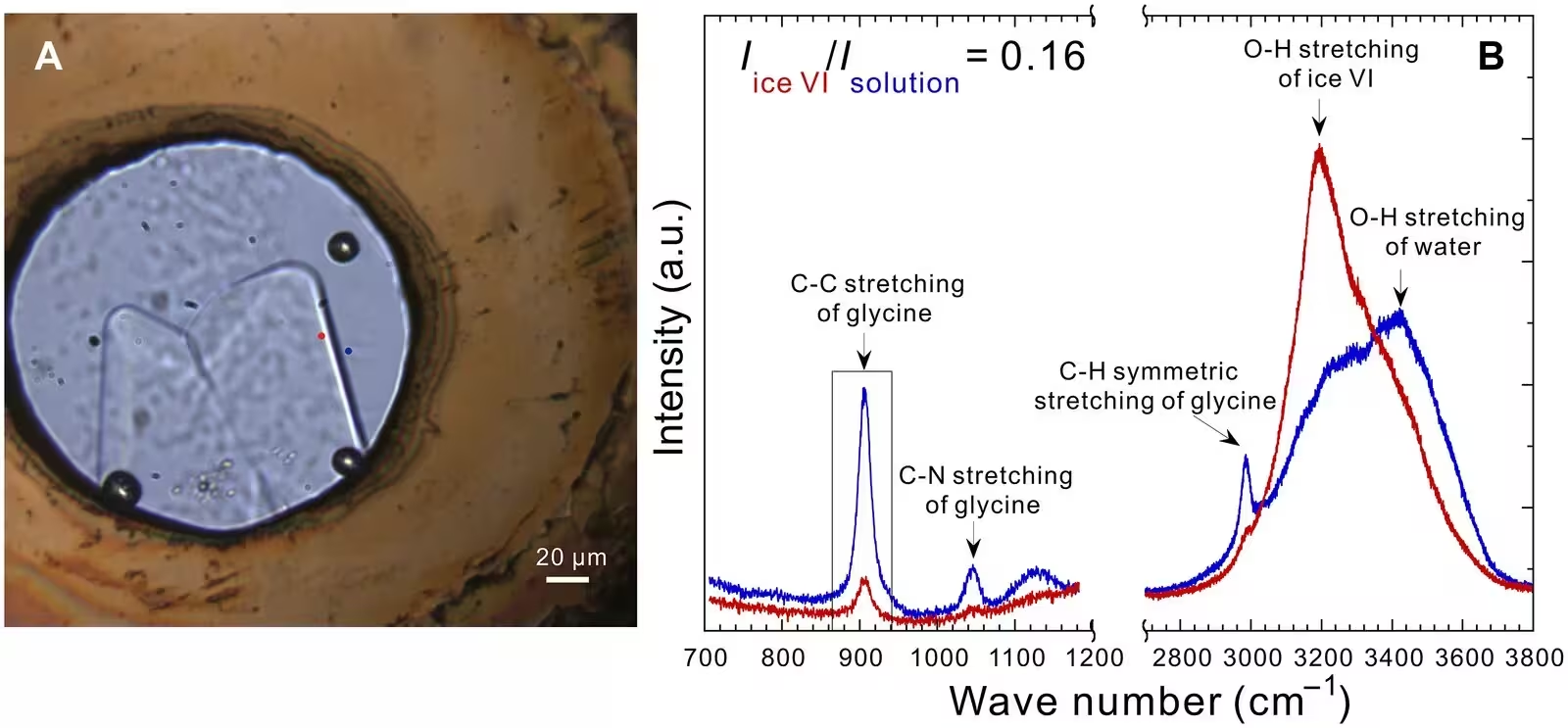
Using in situ Raman spectroscopy, the researchers measured the relative concentrations of amino acids in the high-pressure ice phases and their coexisting aqueous solutions near phase boundaries. The experiments showed no signs of precipitation or polymerization even when freezing exceeded eighty percent, qualitatively indicating that a substantial proportion of the amino acids must be incorporated directly into the crystal structures of ice VI and ice VII.
Partition Coefficients and Structural Integration
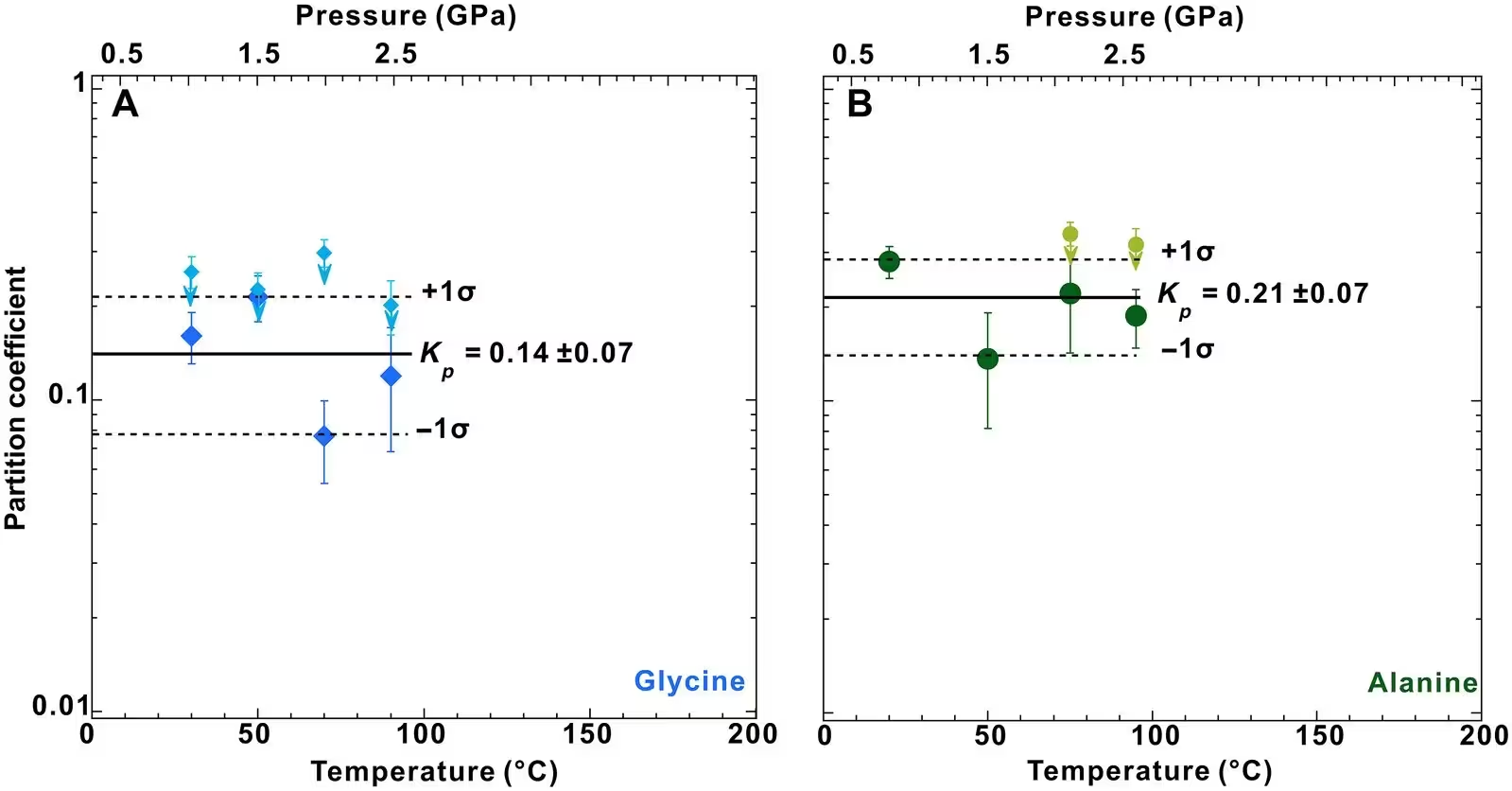
Quantitative analysis of the spectroscopic data yielded clear partition coefficients for both compounds. For ice VI, the measured partition coefficients were 0.14 for glycine and 0.21 for alanine. For the denser ice VII phase, the values increased to 0.40 for glycine and 0.35 for alanine. These measurements demonstrate that glycine and alanine are moderately compatible with high-pressure ices, meaning they are less heavily expelled during freezing than previously assumed for simpler solutes.
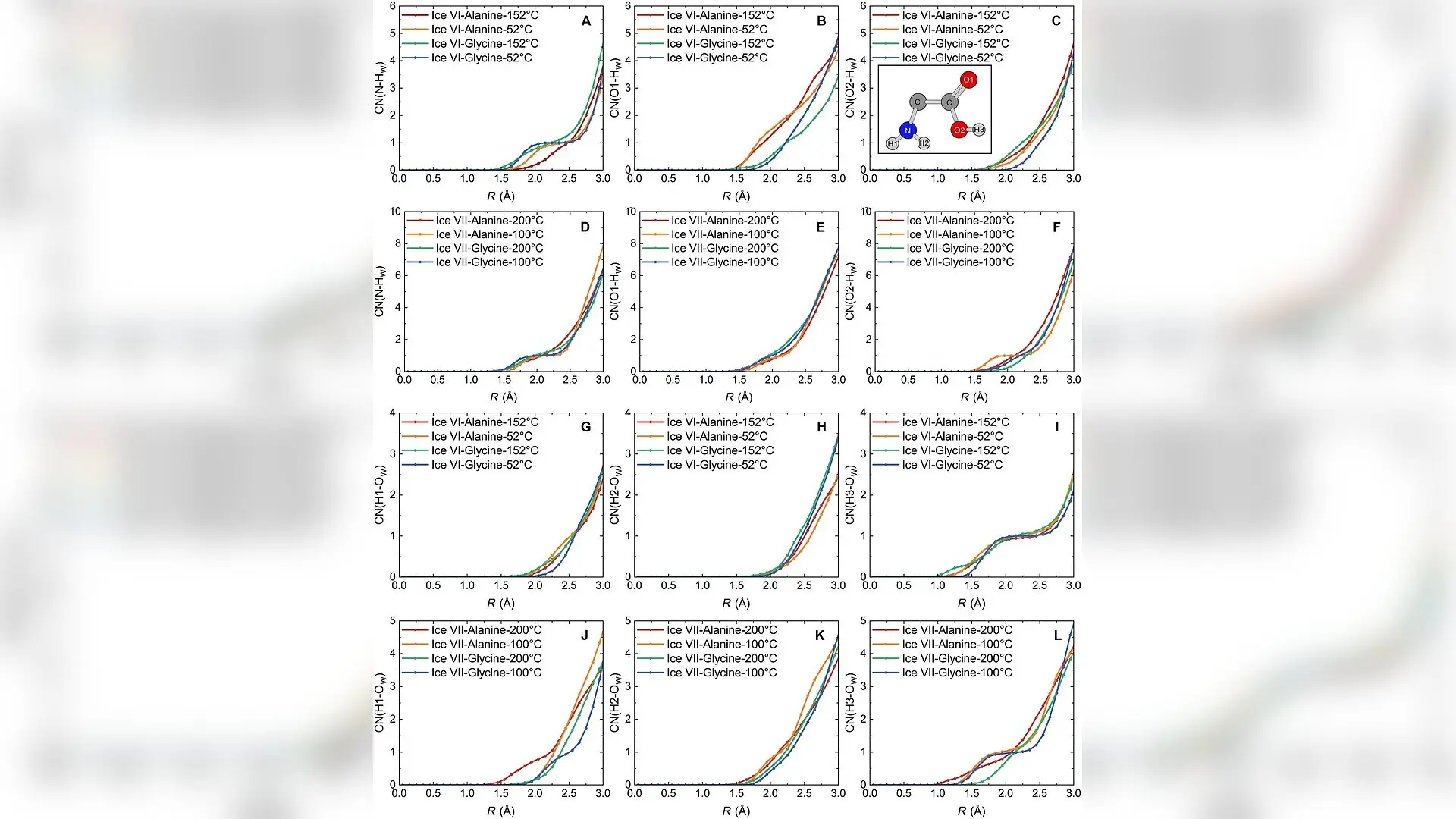
First-principles molecular dynamics simulations performed alongside the experiments helped clarify the underlying molecular mechanisms. The calculations showed that glycine and alanine form stable coordination environments by establishing hydrogen bonds through their amino, hydroxyl, and carbonyl groups with surrounding water molecules, while alkyl groups remain nonbonding. This integration occurs directly within the extended hydrogen-bond network of the ice lattice rather than through the occupancy of clathrate-like cages. Furthermore, ice VII exhibits a denser and more interconnected hydrogen-bond network compared to ice VI, which accounts for the slightly higher incorporation rates observed in the higher-pressure ice.
Implications for Extraterrestrial Habitability
These findings reshape our understanding of material transport inside large ocean worlds. Rather than acting as purely stagnant barriers that permanently seal off rocky interiors from liquid oceans, thick high-pressure ice layers can serve as dynamic reservoirs. Geodynamic models suggest that thermal plumes of deeply originated meltwater can upwell through two-phase convection, interacting continuously with surrounding high-pressure ices through repeated freezing and melting cycles.
If endogenous amino acids are incorporated into high-pressure ice via equilibrium partitioning or trapped within fluid inclusions near the ice-silicate boundary, they can be redistributed upward and released during subsequent remelting. This transport mechanism creates localized aqueous microenvironments with chemical gradients potentially favorable for biological activity. Accounting for this complex partitioning behavior is essential for accurately assessing the true habitability and nutrient availability of ocean worlds throughout the universe.
The research was published in Science advances on October 23, 2026.
This article has been fact checked for accuracy, with information verified against reputable sources. Learn more about us and our editorial process.
Last reviewed on .
Article history
- Latest version
Reference(s)
- Hao, Jihua., et al. “How high-pressure ices on large ocean worlds can support habitability: The compatibility of amino acids into ice VI and VII.” Science Advances, vol. 12, no. 43, October 23, 2026 American Association for the Advancement of Science (AAAS), doi: 10.1126/sciadv.aec2045. <https://doi.org/10.1126/sciadv.aec2045>.
Cite this page:
- Posted by John Williams