New Layered Weak Topological Insulator Features Mobile Silver Ions
Scientists discover an advanced crystalline material featuring mobile silver ions and tunable electronic properties.
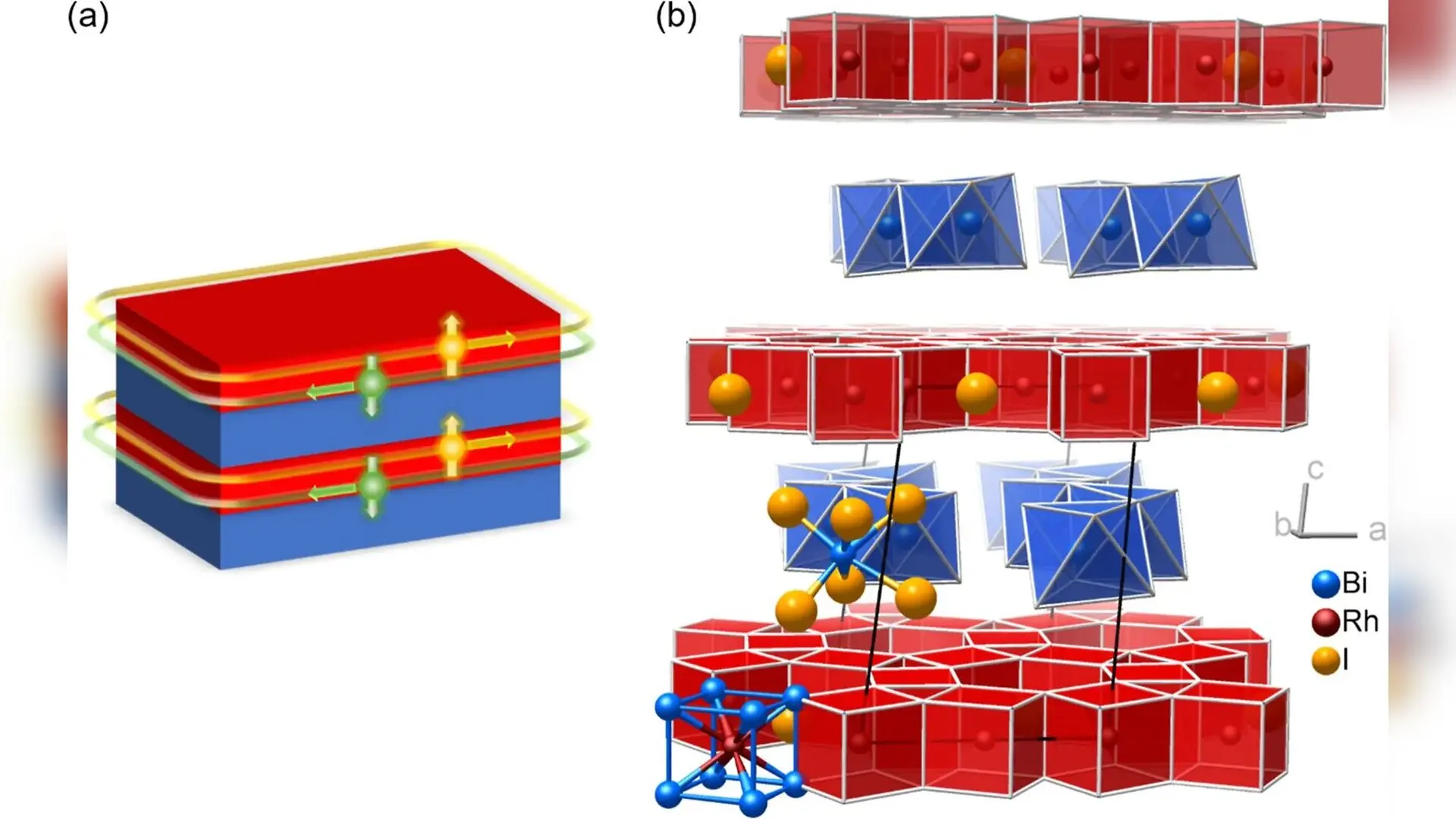
Materials scientists have synthesized a novel crystalline compound that redefines how researchers can manipulate electronic behavior in advanced quantum materials. The discovery centers on a layered bismuth-rich iodide that incorporates mobile silver ions within its atomic architecture, offering a chemical mechanism to tune electronic properties directly. This advancement provides a fresh avenue for isolating the elusive surface and edge states that make topological insulators so promising for next-generation electronics.
The Architecture of Layered Weak Topological Insulators
Topological insulators are extraordinary materials that behave as electrical insulators in their interior while conducting electricity flawlessly along their surfaces or edges. In weak topological insulators, these protected boundary channels emerge exclusively on specific crystal facets. Structurally, these materials are built by stacking two-dimensional quantum spin Hall layers separated by insulating spacer regions. This modular design allows scientists to modify the spacer components without disrupting the internal electronic motifs responsible for topological behavior.
Until now, however, controlling the bulk carrier density in these compounds remained a major hurdle. Crystal imperfections and vacuum-induced iodine loss typically introduce unwanted electron doping, masking the behavior of the protected boundary channels. To combat this issue, researchers turned to an innovative design strategy by engineering an ion-mobile spacer that acts as an internal dopant reservoir.
Synthesis and Structural Characteristics
The new compound, known scientifically as published in Inorganic Chemistry, was produced through high-temperature solid-state reactions. By combining bismuth, rhodium, silver, and bismuth triiodide using mechanical pre-activation via ball milling followed by controlled annealing between 345 and 460 degrees Celsius, the team successfully grew phase-packed powders and millimeter-sized platelet crystals.
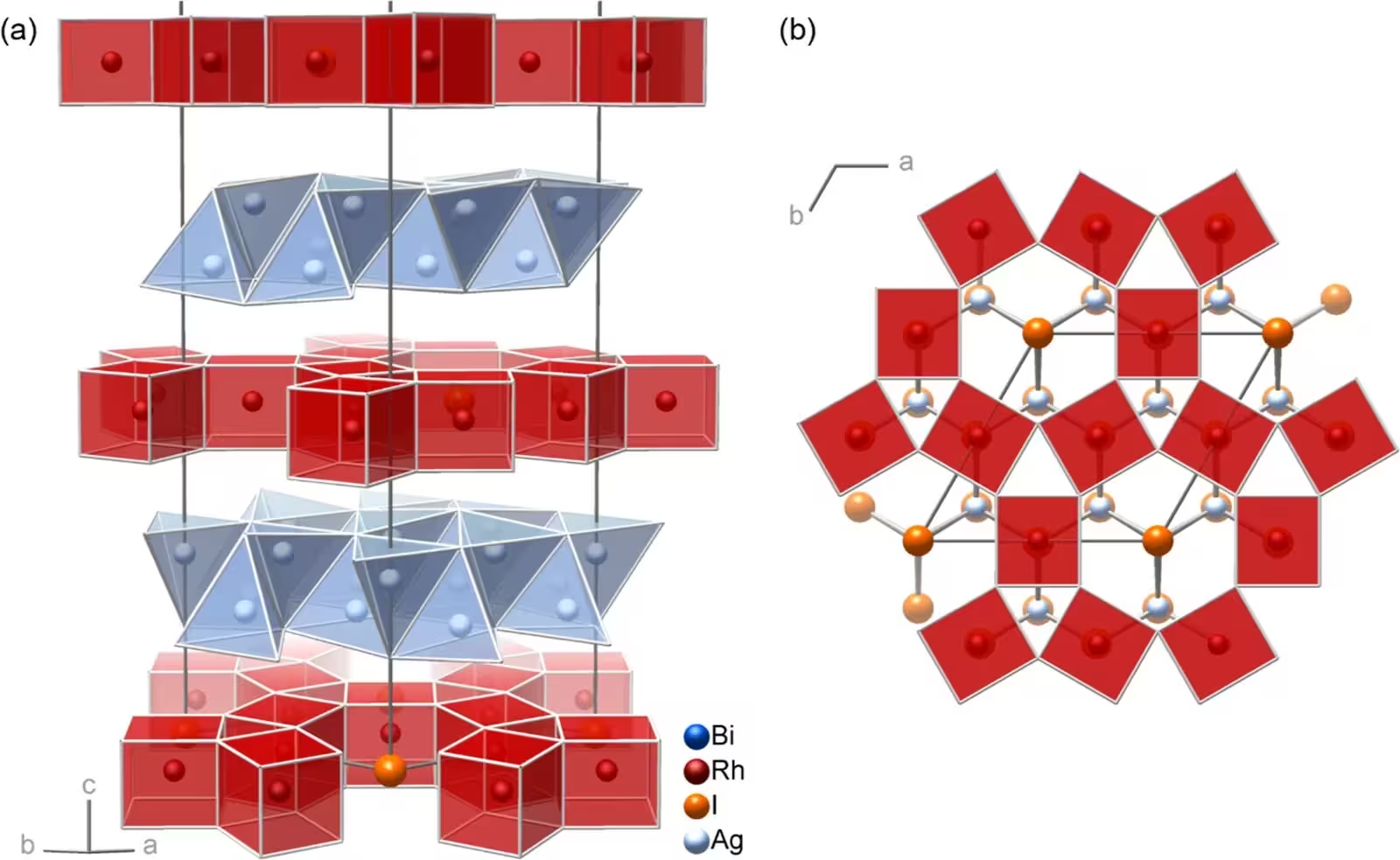
Single-crystal X-ray diffraction revealed a rhombohedral structure consisting of alternating layers. Intermetallic sheets built from rhodium-centered bismuth cubes carry the crucial quantum spin Hall band-inversion motif. Separating these conductive sheets are salt-like spacer layers where silver cations occupy roughly 75 percent of available tetrahedral voids within a double iodide framework. This specific arrangement gives rise to intrinsic two-dimensional cation disorder and notable ionic mobility.
Electronic Band Structure and Ion Mobility
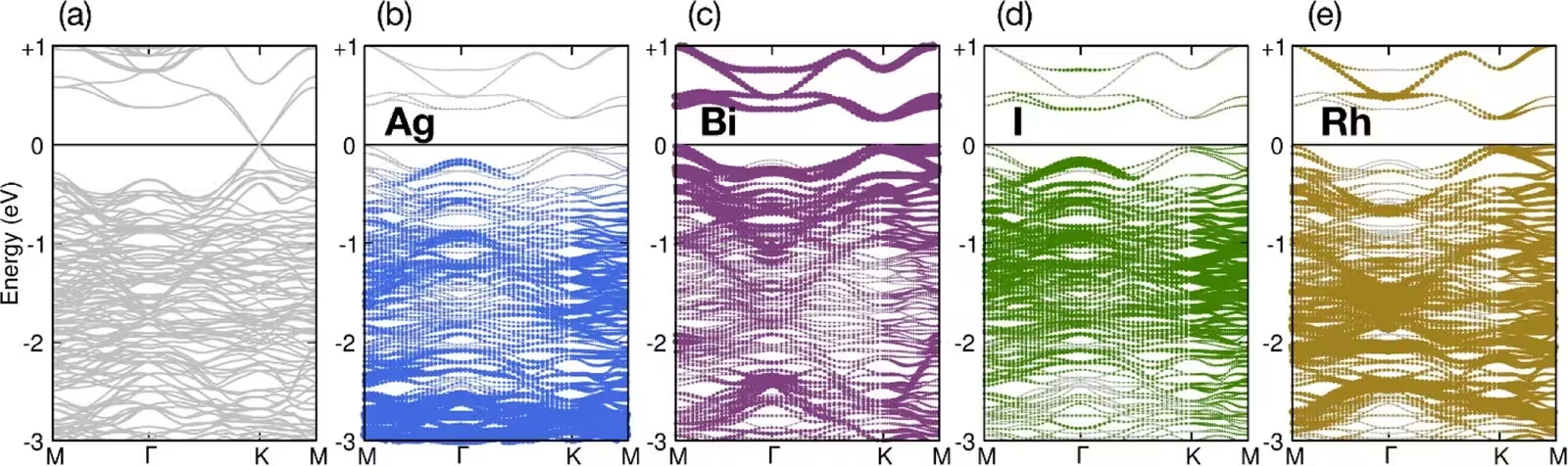
Advanced computational modeling utilizing density-functional theory, along with spectroscopic measurements via angle-resolved photoemission spectroscopy, confirmed that the material is a weak topological insulator. The analysis revealed an experimental bulk band gap of 286 meV, representing the widest gap recorded for this entire structural family to date. Electrochemical impedance spectroscopy further demonstrated a room-temperature ionic conductivity of approximately 10 to the power of negative six Siemens per centimeter.
Crucially, this ionic conductivity allows the mobile silver ions to undergo slow electrochemical migration under an applied electrical bias. When subjected to a modest current, the material acts as an internal deintercalation reservoir. This process effectively removes excess electrons from the conduction band, driving the crystal from an initially over-doped state toward a clean state of markedly reduced bulk conduction.
Implications for Quantum Materials
The successful development of this compound proves that spacer layers do not need to act as passive separators. Instead, they can function as active, designable components that give researchers precise control over defect chemistry, ion mobility, and surface band bending. By providing a reliable method to position the chemical potential precisely within the bulk band gap, this chemistry-led approach paves the way for deeper exploration of topological edge states and advanced electronic devices.
The research was published in Inorganic chemistry on October 19, 2026.
This article has been fact checked for accuracy, with information verified against reputable sources. Learn more about us and our editorial process.
Last reviewed on .
Article history
- Latest version
Reference(s)
- Carrillo-Aravena, Eduardo., et al. “Bi12Rh3Ag6I9: Mobile Silver Ions and Surface-Dominated Transport in a Layered Weak Topological Insulator.” Inorganic Chemistry, vol. 65, no. 41, October 6, 2026, pp. 24145-24154. American Chemical Society (ACS), doi: 10.1021/acs.inorgchem.6c02517. <https://doi.org/10.1021/acs.inorgchem.6c02517>.
Cite this page:
- Posted by John Williams