Scientists Just Discovered Mars’ Massive Canyon System Is Still Geologically Active
A rare marsquake has revealed that ancient faults beneath Mars’ largest canyon remain geologically active billions of years after the planet formed.
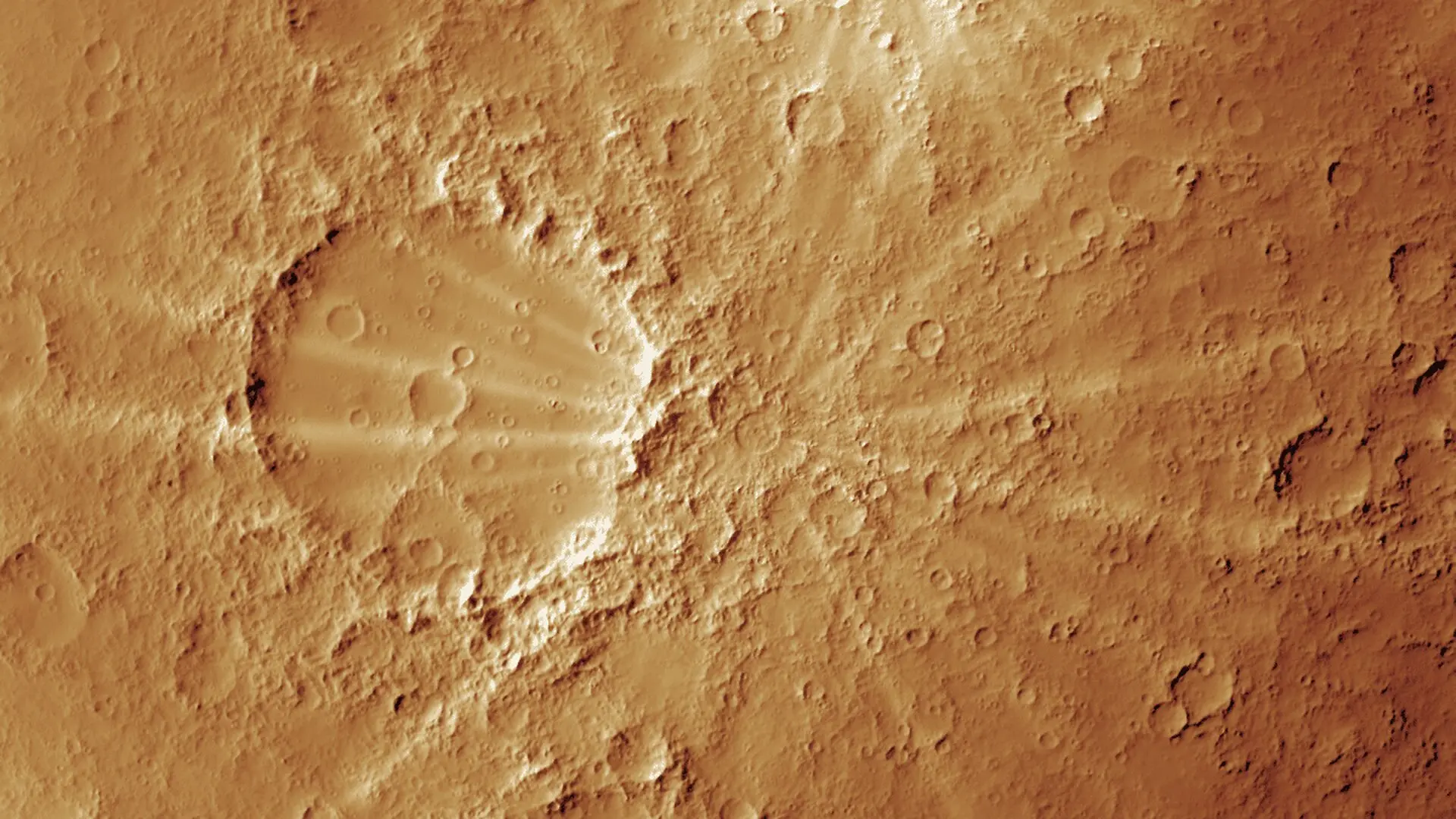
Mars is hiding a dynamic geological secret beneath the surface of its most iconic landscape. New research published in Nature Communications confirms that Valles Marineris, the solar system’s largest canyon system, is not merely a dormant relic of the past. Instead, scientists have identified active faulting deep beneath the canyon floor, proving that Mars remains seismically restless billions of years after the structures first emerged.
Spanning roughly 2,400 miles (3,900 kilometers) across the Martian surface, Valles Marineris dwarfs Earth’s Grand Canyon, reaching depths of over 5.6 miles (9 kilometers) and widths of up to 370 miles (600 kilometers). While the canyon was forged during Mars’ ancient geological evolution, its current level of activity has remained a subject of intense debate, largely because the planet lacks the active plate tectonics that drive seismic events on Earth.
Decoding a Rare Seismic Event
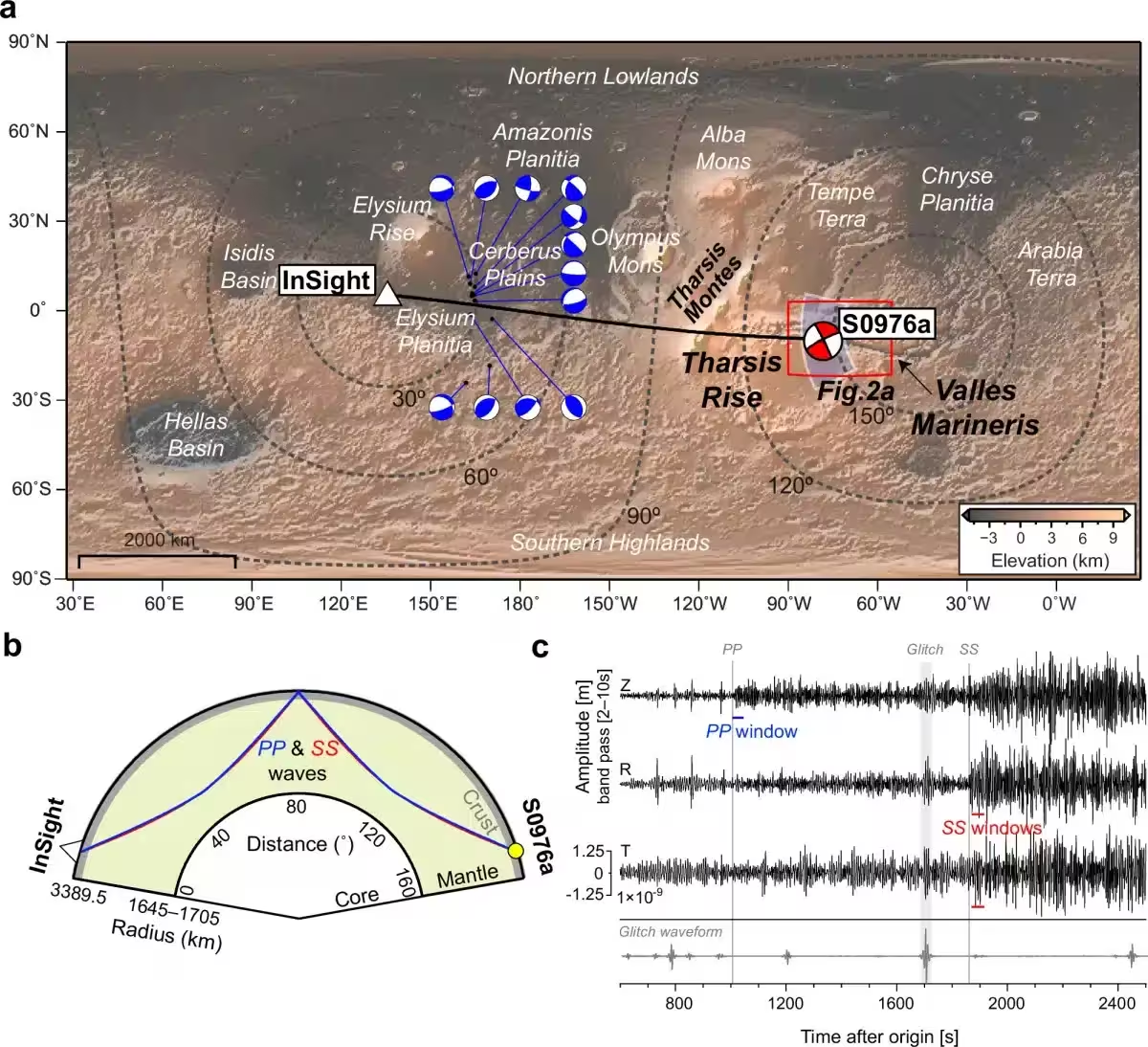
The breakthrough hinges on a singular, powerful seismic event captured by NASA’s InSight lander on August 25, 2021. Designated S0976a, the quake was an outlier for the mission, as it was the only one recorded in the planet’s western hemisphere. By analyzing the arrival directions and amplitudes of the seismic waves, researchers from Imperial College London and Columbia University were able to pinpoint the origin of the activity to the western reaches of Valles Marineris.
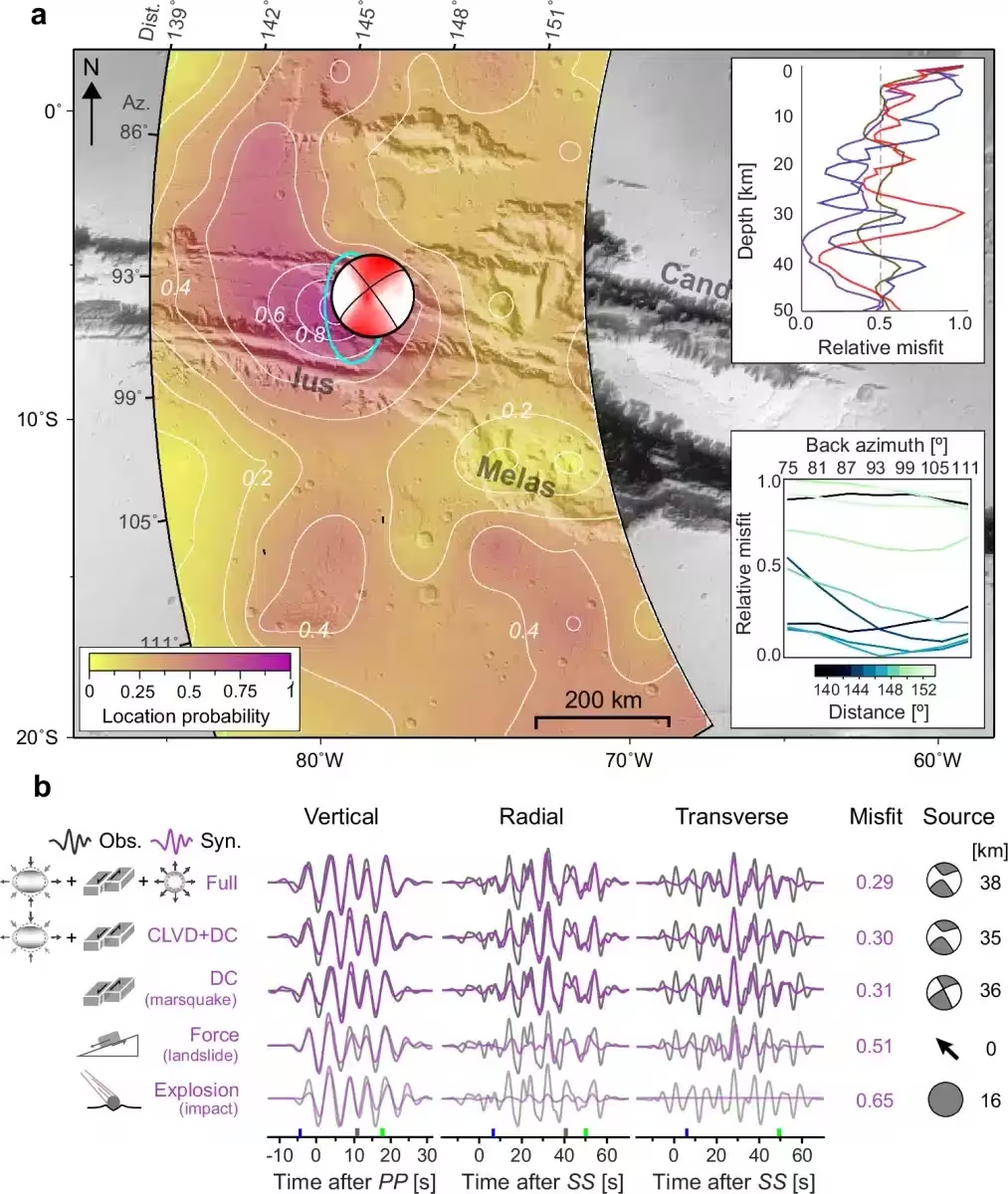
The team’s investigation determined that the shaking resulted from a strike-slip fault, where segments of the crust ground horizontally past one another. The rupture occurred at a depth of 12 to 25 miles (20 to 40 kilometers). Jung-Hun Song, lead author of the study, noted that the evidence aligns perfectly with orbital imagery, confirming that the canyon is far from a “dead” fossil landscape.
“What makes the result compelling is that several completely different types of evidence point in the same direction,” said Song. “The seismic waves tell us that there was a sideways sliding motion on a fault well below the surface, while the geology seen from orbit shows a region crossed by long-lived fault systems.”
After reviewing Nature Communications data, the researchers ruled out alternative triggers, such as meteorite impacts or large-scale surface landslides, as no fresh crater or evidence of shifting terrain was detected.
Resurrecting Ancient Stresses
The findings force a re-evaluation of how planets evolve. On a world like Mars, which lacks the heat-driven recycling of tectonic plates, ancient fractures are susceptible to the persistent stresses of planetary cooling and the massive weight of volcanic regions like Tharsis. As study co-author Folarin Kolawole, a geologist at Columbia University’s Lamont-Doherty Earth Observatory, explains, this “natural experiment” demonstrates that geological structures established in the deep past can continue to dictate the behavior of a planet’s crust into the modern era.
While NASA’s InSight mission officially concluded in 2022, the treasure trove of seismic data it left behind continues to yield insights into the Martian interior. Doyeon Kim, an assistant professor at Imperial College London and senior author of the paper, notes that S0976a has been a remarkably productive event. “From a single marsquake, we can learn both about the center of the planet and about an active fault beneath one of its most remarkable landscapes,” Kim said.
This discovery provides a blueprint for studying other rocky worlds in the solar system, suggesting that seismic activity may be far more common in “geologically dead” bodies than previously imagined. For Mars, the lesson is clear: even without active plates, the planet is still finding ways to shift, settle, and break.
This article has been fact checked for accuracy, with information verified against reputable sources. Learn more about us and our editorial process.
Last reviewed on .
Article history
- Latest version
Reference(s)
- “Fig. 1: Location and seismic waveforms of event S0976a. | Nature Communications | Nature Communications.” <https://www.nature.com/articles/s41467-026-78193-6/figures/1>.
Cite this page:
- Posted by William Moore