Scientists Are Turning Locusts Into Cyborg Chemical Detectors Using Nanotechnology
By merging advanced biology with precision engineering, researchers have developed a superior new sensing system that pushes the boundaries of technology.
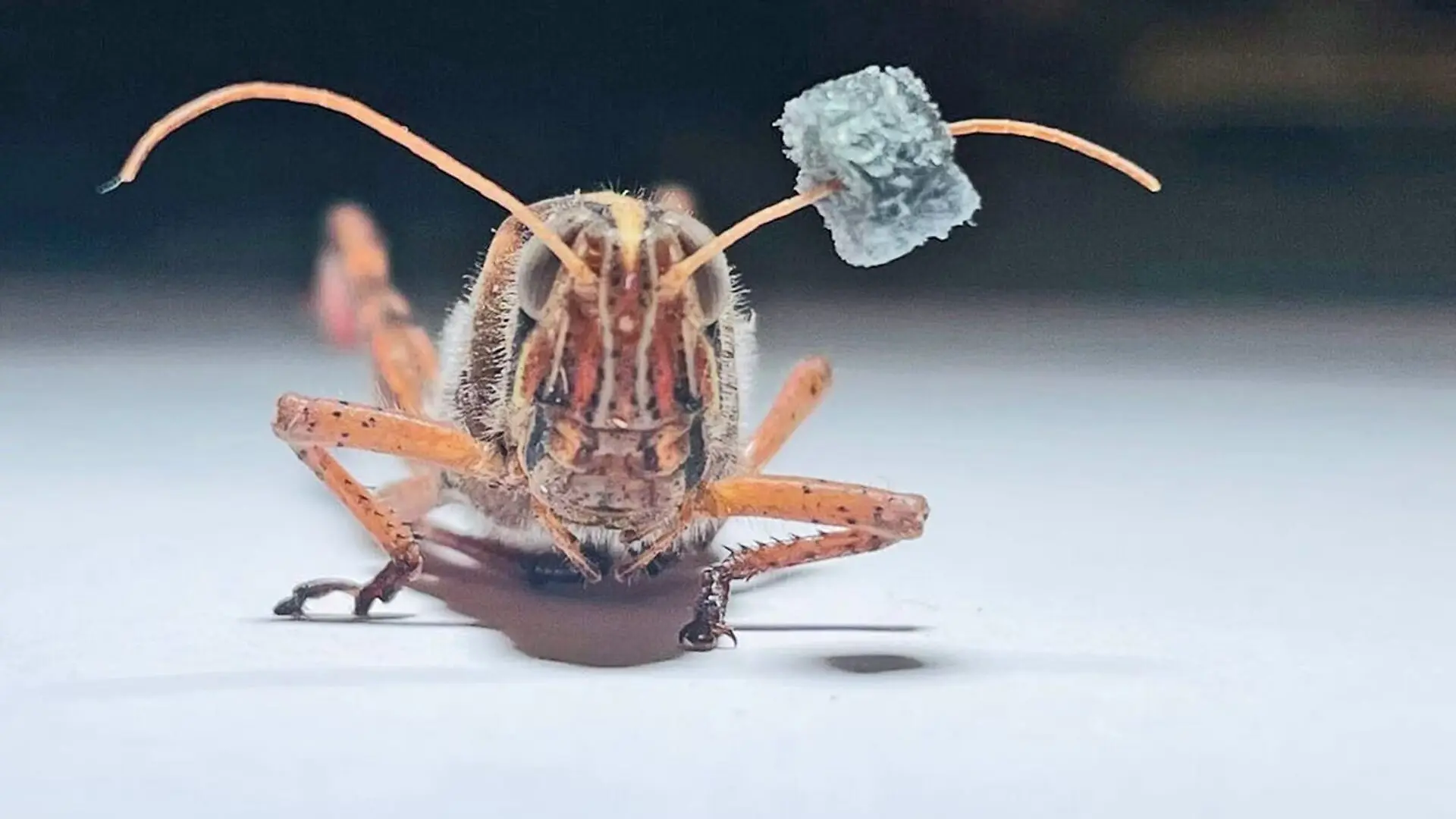
Bio-Hybrid Locusts Enhanced with Nanomaterials Could Become the Future of Disaster Response
In the aftermath of a catastrophic earthquake or within the perimeter of a volatile chemical spill, human first responders often face insurmountable physical constraints. To overcome these barriers, researchers are increasingly looking toward the natural world, aiming to repurpose the biological sensory systems of insects for search-and-rescue missions and threat detection. A new study from Washington University in St. Louis suggests that by merging insect biology with advanced engineering, we may soon deploy locusts as highly sophisticated, mobile environmental sensors.
The research, published in the journal Advanced Materials, outlines a novel method for upgrading the olfactory capabilities of locusts. By applying an ultralight, porous nanomaterial coating to the insects’ antennae, the team successfully created a hybrid system capable of identifying chemical signatures that neither biological nor synthetic sensors could reliably detect on their own.
“We marry the best biology has to offer with engineering principles to create a superior sensing system,” explains Barani Raman, a professor in biomedical engineering at the university’s McKelvey School of Engineering.
Merging Nature with Nanotechnology
For years, the scientific community has grappled with the inherent limitations of chemical sensing technology. While locusts possess an incredibly sensitive olfactory system equipped with 50,000 receptor neurons in each antenna, their natural range for identifying distinct chemical compounds is relatively narrow. Conversely, artificial sensors are often highly accurate but lack the maneuverability and biological efficiency of living organisms.
To bridge this gap, researchers integrated a surface-enhanced Raman scattering (SERS) substrate—a specialized nanomaterial coating—directly onto the insects. This technique acts as a signal amplifier, boosting the detection of trace molecules near metallic nanostructures. The team utilized a biocompatible collagen foam that allows the locusts to maintain their natural behavior and mobility while functioning as sophisticated biological detectors.
Srikanth Singamaneni, a professor in mechanical engineering and materials science who co-led the research, emphasized that this hybrid approach allows scientists to “cast a broader net” when surveying hazardous environments. Because the nanomaterial is both lightweight and highly porous, it does not hinder the locust’s ability to navigate or interact with its surroundings.
Proven Performance in Detecting Hazards
In laboratory testing, these bio-hybrid locusts significantly outperformed their non-augmented counterparts and traditional synthetic sensors. The team observed improved odor-detection performance across a variety of chemical agents, including the specific chemical signatures associated with TNT. By pairing the insect’s innate biological responses with the identification capabilities of the SERS foam, the researchers were able to pinpoint specific chemical species that previously went undetected.
This integration addresses a fundamental hurdle in the field: the difficulty of identifying unknown chemical threats in complex environments. By combining the natural sensory processing of the locust with the diagnostic precision of the nanomaterial, the system creates a comprehensive, real-time feedback loop. According to Raman, the project serves as a clear demonstration that merging these two disparate fields can yield a result greater than the sum of its parts.
The research was conducted with support from the Air Force Office of Scientific Research and the National Science Foundation, marking a significant step toward practical applications in mapping disaster zones and identifying chemical weapons in inaccessible terrain.
This article has been fact checked for accuracy, with information verified against reputable sources. Learn more about us and our editorial process.
Last reviewed on .
Article history
- Latest version
Reference(s)
- Debnath, Avishek., et al. “Plasmonic Foam‐Enabled Dual‐Modal Biohybrid Chemical Sensor.” Advanced Materials, September 23, 2026 Wiley, doi: 10.1002/adma.75082. <https://doi.org/10.1002/adma.75082>.
Cite this page:
- Posted by Rohan Kumar