Scientists Use AI to Build a Tiny RNA Logic Gate That Lets Cells Compute
Researchers have engineered a compact RNA device inside living cells that behaves like a digital NAND logic gate. Designed with AI and tested in yeast, the molecular switch could help build more complex genetic circuits for future biotechnology.
For decades, engineers have built computers from electronic components that perform simple logical operations. At the heart of those systems are logic gates, tiny circuits that process inputs and produce predictable outputs.
Biologists have long wondered whether living cells could be programmed in a similar way.
Cells already process enormous amounts of information. They monitor nutrients, chemical signals, and internal metabolic states, adjusting gene activity in response. But building synthetic systems that mimic digital logic inside cells has remained a difficult challenge.
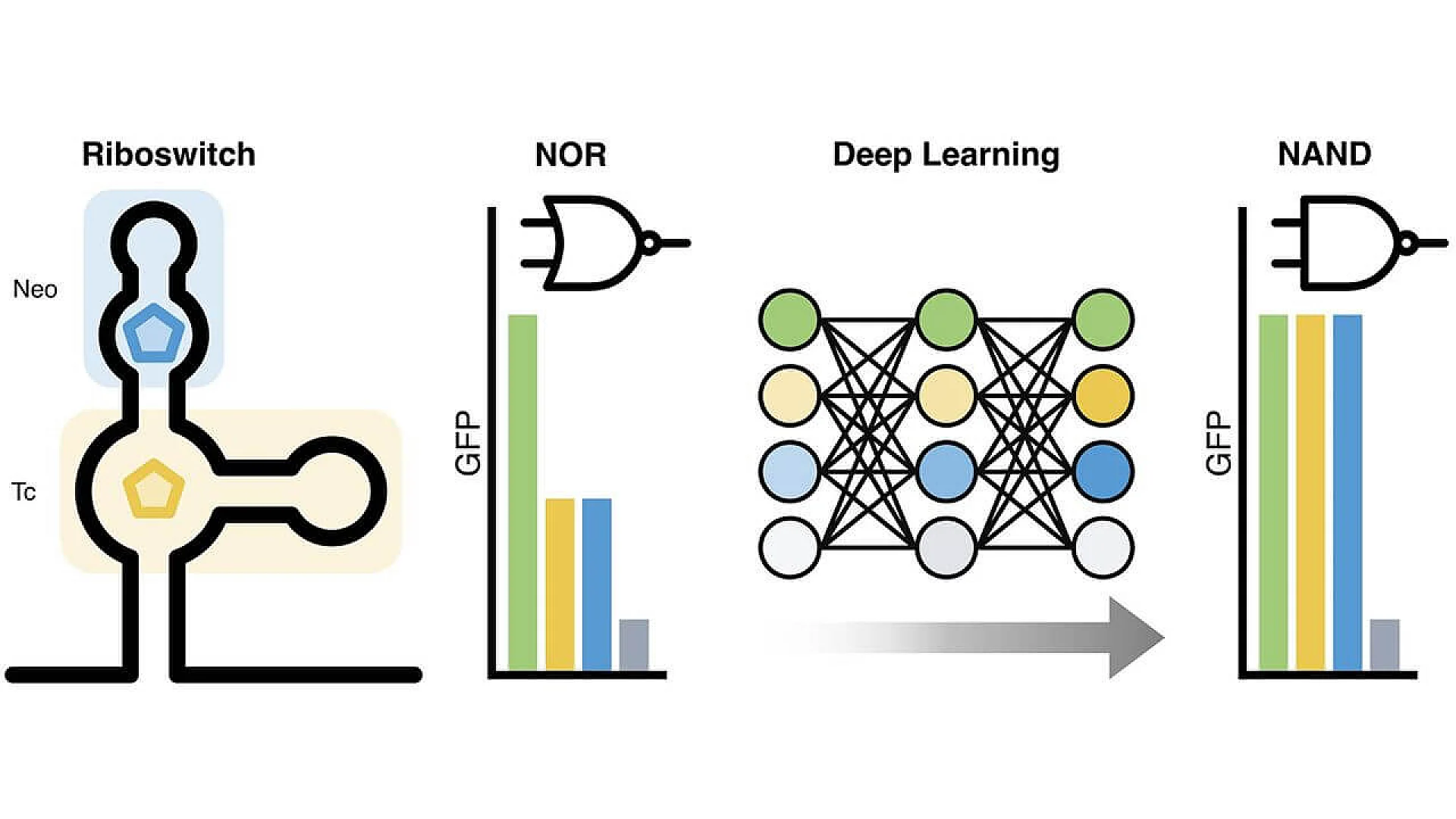
A new study now demonstrates a promising solution. Researchers have engineered a synthetic RNA device that behaves like a NAND gate, one of the most fundamental building blocks in digital computation.
The molecular switch operates inside living yeast cells and can detect two different molecules. Depending on which signals are present, it regulates whether a gene is translated into a protein.
The work suggests that programmable biological circuits may become far more compact and efficient than previously possible.
Turning RNA Into a Molecular Logic Device
The new system is built from a type of RNA element known as a riboswitch.
Riboswitches are segments of RNA that can directly sense specific small molecules. When a target molecule binds to the RNA structure, the shape of the molecule changes. That structural shift can alter how the cell reads the RNA, often switching protein production on or off.
Because riboswitches operate without additional proteins, they are remarkably efficient. They are typically fewer than 100 nucleotides long and impose only a minimal metabolic burden on the cell.
These characteristics make them attractive components for synthetic biology.
Scientists have previously explored riboswitches as regulatory elements that respond to single chemical signals. However, building systems that can integrate multiple inputs and perform logical operations has proven far more complicated.
The new study focused on creating a hybrid riboswitch capable of processing two inputs simultaneously.
Why the NAND Gate Matters
Among all logical operations, the NAND gate holds a special place in computer science.
A NAND gate produces an output that is false only when both inputs are true. In every other situation, the output remains true.
While this rule seems simple, NAND gates are extraordinarily powerful. In fact, any digital computation can be built entirely from combinations of NAND gates.
For synthetic biologists, reproducing this operation inside cells represents an important milestone. If reliable NAND logic can be implemented biologically, it opens the possibility of constructing much more complex genetic circuits.
These circuits could eventually allow cells to perform decision-making tasks, responding to multiple chemical signals with precise genetic actions.
Designing the Switch With Machine Learning
Creating such a device, however, is not straightforward.
RNA molecules fold into complex three-dimensional structures, and small sequence changes can dramatically alter how they behave. Designing a functional riboswitch that responds correctly to two different ligands therefore requires navigating a huge number of possible RNA configurations.
To tackle this challenge, the research team turned to machine learning.
They developed a design framework that combines experimental screening with a technique known as deep batch Bayesian optimization. This approach allows algorithms to guide the search for improved designs by predicting which RNA sequences are most likely to perform well.
The process begins with a diverse library of candidate riboswitches. These sequences are experimentally tested in living cells to measure their regulatory behavior.
The resulting data then train a machine learning model that predicts how changes in sequence might influence performance. The algorithm proposes new designs expected to improve the desired function, which are then tested in another experimental round.
With each cycle, the system learns more about which RNA structures produce the intended logical behavior.
Finding a Hybrid Riboswitch
During the initial screening stage, the researchers identified a promising hybrid riboswitch capable of binding two different small molecules.
The device was inserted into the 5′ untranslated region of a messenger RNA molecule. This location is crucial because it controls the initiation of translation, the process through which ribosomes read the RNA and produce a protein.
When the riboswitch senses specific ligand combinations, its structure rearranges in ways that influence ribosome access. In some conditions, the ribosome can proceed normally and the protein is produced. In others, the RNA structure forms a barrier that blocks translation.
By carefully tuning these structural changes, the researchers were able to approximate the behavior of a NAND gate.
Still, the initial design was not perfect. The challenge then became improving its performance.
Iterative Optimization in Living Cells
Using their machine learning framework, the team conducted multiple cycles of optimization.
Each round involved constructing new riboswitch variants, inserting them into yeast cells, and measuring how accurately they performed the desired logic operation.
The algorithm used these results to predict which new sequences should be tested next.
Over successive rounds, the riboswitch designs improved. The final versions showed clearer NAND-like behavior, responding reliably to combinations of the two molecular inputs.
The iterative process demonstrated how computational guidance can dramatically accelerate the design of functional RNA devices.
Instead of relying solely on intuition or trial and error, researchers could explore the vast landscape of RNA structures in a more systematic way.
Why RNA Circuits Are Appealing
Many previous attempts to build genetic logic circuits have relied on proteins.
Protein-based regulators can perform sophisticated tasks, but they often require complex gene networks. Producing and maintaining these components also consumes cellular resources.
RNA devices offer several advantages.
Because they are small and do not require additional translation into proteins, they can operate with minimal energy cost. Their compact size also makes them easier to integrate into larger genetic systems.
Hybrid riboswitches are particularly attractive because they can sense multiple chemical signals simultaneously.
This ability allows them to act as information-processing units that combine inputs and control downstream gene expression accordingly.
The new study shows that such RNA elements can perform logic operations previously associated mainly with protein-based circuits.
Why This Matters
Programming cells to respond intelligently to complex chemical environments is a major goal of synthetic biology.
Potential applications range from environmental sensing to industrial biotechnology and medicine.
For example, engineered cells might one day detect combinations of disease markers and activate therapeutic responses only when specific molecular conditions are met.
Similarly, microbes used in manufacturing could adjust metabolic pathways based on multiple environmental signals, improving efficiency and stability.
To achieve these goals, researchers need reliable biological components that can integrate information from several inputs.
RNA-based logic gates provide a promising path toward that capability.
Expanding the Toolkit of Synthetic Biology
The study also highlights a broader trend in modern biotechnology: the increasing role of machine learning in biological design.
Biological molecules operate in enormously complex sequence spaces. Even small RNA devices can theoretically exist in astronomical numbers of configurations.
Traditional experimental approaches often explore only a tiny fraction of these possibilities.
Machine learning techniques allow scientists to navigate these spaces more efficiently. By learning patterns from experimental data, algorithms can guide researchers toward promising designs that might otherwise remain undiscovered.
In this case, deep Bayesian optimization helped refine riboswitch sequences that produced the desired logical behavior.
Such methods are likely to become increasingly important as synthetic biology attempts to build more sophisticated genetic systems.
Remaining Challenges
Despite the progress, the work also highlights limitations that researchers still need to address.
Biological systems are inherently noisy and variable. Even carefully engineered genetic circuits can behave differently depending on cellular conditions.
Ensuring that RNA logic devices perform reliably across diverse environments remains an ongoing challenge.
Scaling up from single gates to larger circuits will also require careful design. As additional components are introduced, interactions between them can produce unexpected effects.
Future research will therefore focus on integrating multiple RNA devices while maintaining predictable behavior.
Nevertheless, the demonstration of a functional RNA-based NAND gate represents an important step forward.
A Glimpse of Cellular Computation
The idea that living cells could perform computational tasks once seemed purely theoretical.
Yet advances in synthetic biology are steadily bringing that vision closer to reality.
By combining molecular biology with machine learning, the new research shows how tiny RNA structures can be engineered to behave like digital logic components.
These devices are far smaller and simpler than traditional genetic circuits, yet capable of sophisticated information processing.
As scientists continue refining these tools, the possibility of programmable biological systems becomes increasingly plausible.
Cells may never resemble silicon computers, but they may soon be able to execute carefully designed molecular programs of their own.
The research was published in Nucleic Acids Research on February 27, 2026.
This content has been reviewed by subject-matter experts to ensure scientific accuracy. Learn more about us and our editorial process.
Last reviewed on .
Article history
- Latest version
Reference(s)
- Kelvin, Daniel., et al. “Iterative design of a NAND hybrid riboswitch by deep batch Bayesian optimization.” Nucleic Acids Research, vol. 54, no. 5, 27 February 2026, doi: 10.1093/nar/gkag145. <https://doi.org/10.1093/nar/gkag145>.
Cite this page:
- Posted by Hassan Raza