Scientists Capture Elusive Infrared Spectra of Small Carbon Ring Cations
New laboratory measurements of monocyclic carbon ring cations shed light on elusive molecular structures and potential interstellar detection.
Carbon has long captivated chemists and physicists with its ability to form diverse allotropes and nanostructures. Beyond macroscopic networks like diamond and graphite, laser ablation of graphite targets yields an assortment of chains, rings, and fullerenes. While larger carbon clusters and fullerenes have been thoroughly investigated, understanding the precise geometric configurations of smaller monocyclic carbon rings has proven exceptionally difficult. These cyclocarbons can theoretically adopt several configurations, including cumulenic or polyynic bonding arrangements, accompanied by varying degrees of bond length and bond angle alterations driven by Jahn-Teller or Peierls-type distortions.
To bridge the gap between theoretical models and experimental reality, researchers have turned to messenger-tagging spectroscopy combined with cryogenic ion trapping. In a new study published in Physical Chemistry Chemical Physics, scientists have successfully recorded the gas-phase infrared spectra of $C_{4n}^+$ monocyclic carbon ring cations with $n$ ranging from 2 to 7, including the first reported infrared spectra for $C_{16}^+$, $C_{12}^+$, and $C_{8}^+$. This breakthrough provides vital empirical data on molecular systems that were previously challenging to probe due to experimental limitations and complex open-shell electronic structures.
Unraveling Size-Dependent Spectroscopic Trends
The experimental setup involved generating carbon cations via laser ablation of a rotating graphite rod inside a custom aluminum block, promoted by a pulsed helium gas valve. The resulting plasma underwent free-jet expansion into a vacuum chamber, where ions were mass-selected and guided into a cryogenic linear quadrupole ion trap maintained at roughly 4.5 Kelvin. At these ultracold temperatures, a fraction of the stored ions formed weakly bound ion-helium complexes. These messenger complexes readily dissociate upon absorbing a single infrared photon owing to the low binding energy of helium.
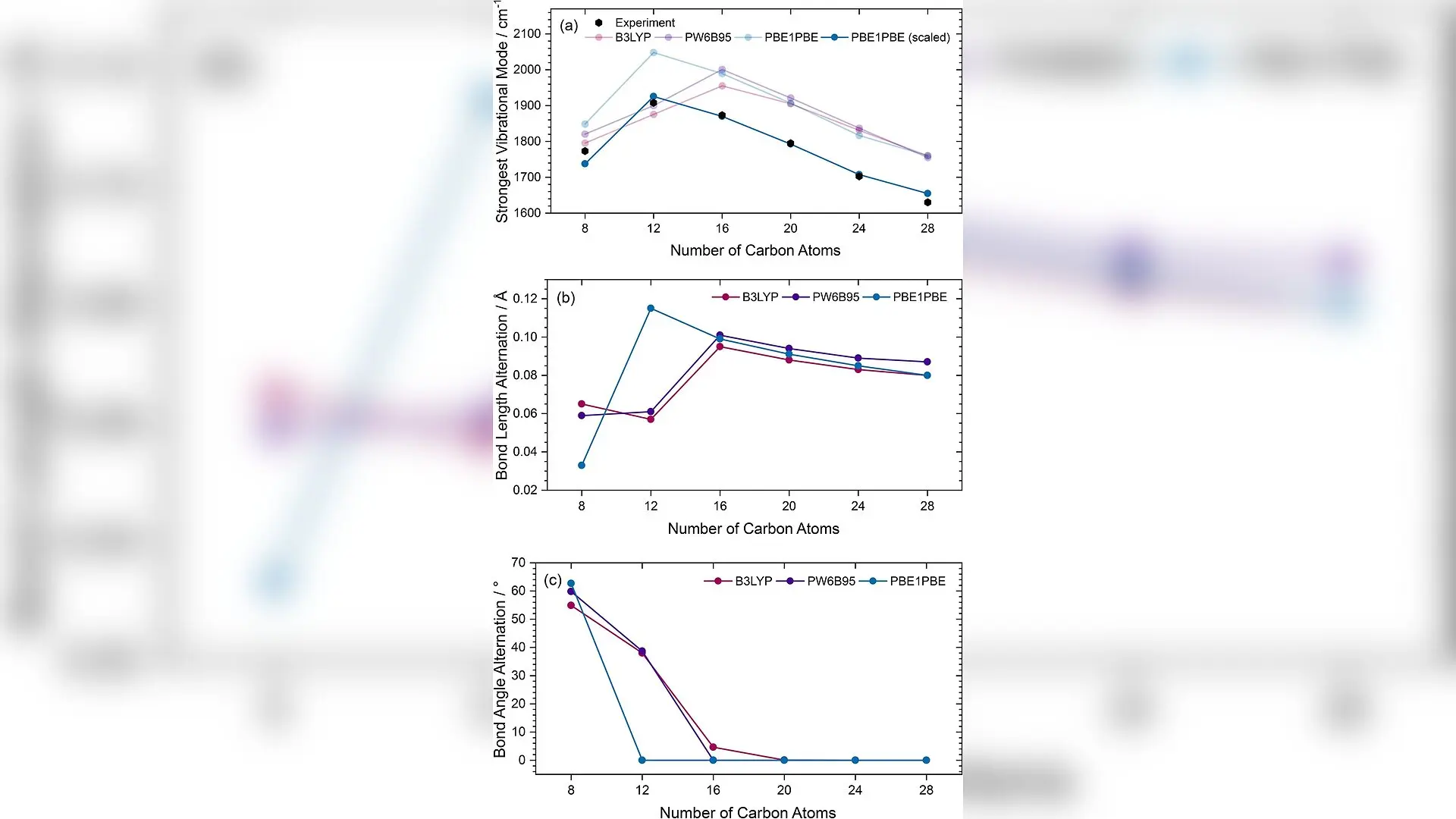
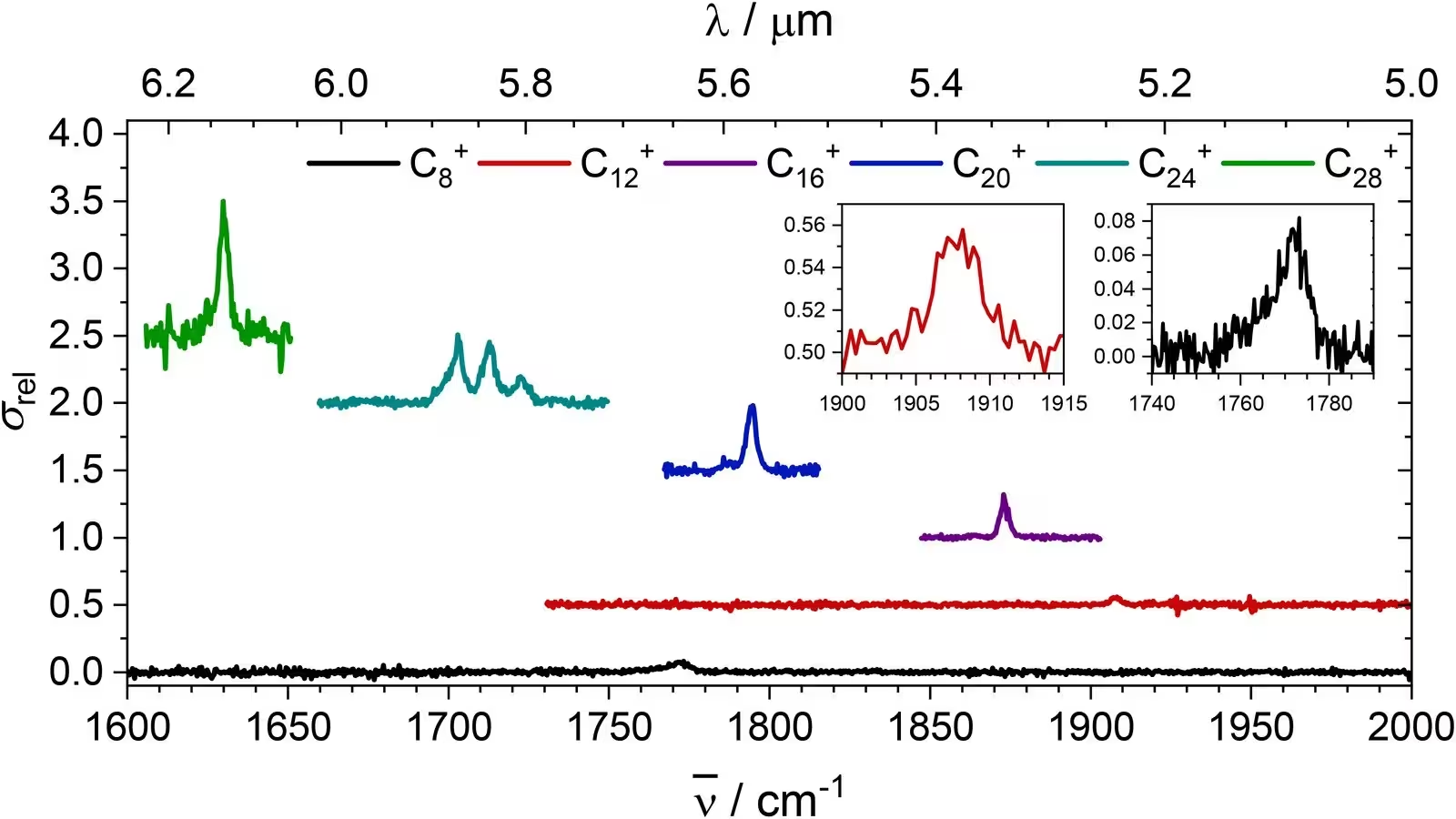
Analysis of the resulting photofragmentation spectra revealed two prominent trends across the series from $C_{28}^+$ down to $C_{16}^+$. First, the infrared intensity diminishes rapidly as the ring size decreases. This behavior stems from two primary factors, namely the smaller physical displacement of oscillating charge in smaller rings and the widening energy gap between frontier orbitals, which weakens the coupling between electronic and vibrational motions. Second, the strongest infrared-active vibrational mode exhibits a clear, linear blueshift as the number of carbon atoms decreases, with an average shift of approximately 80 wavenumbers between successive four-carbon increments.
However, this linear trend breaks down at $C_{12}^+$ and vanishes entirely for $C_{8}^+$. The $C_{12}^+$ cation displays a blueshift that deviates from the established progression, while the $C_{8}^+$ ion exhibits a much broader, asymmetric absorption profile centered around 1,774 wavenumbers. Additional structure in the spectra of larger rings, such as $C_{24}^+$, revealed multiple peaks attributed to Fermi resonances interacting with the dominant Kekule-type vibrational mode.
Theoretical Modeling and Structural Shifts
To interpret these spectral features, the research team performed extensive density functional theory calculations using various functionals, including B3LYP, PW6B95, and PBE1PBE, paired with the def2-TZVP basis set. For larger rings containing 16 or more carbon atoms, the calculations consistently point toward symmetric, polyynic structures with uniform bond angles belonging to high-symmetry point groups. These configurations exhibit a bond length alternation of roughly 0.08 to 0.09 angstroms.
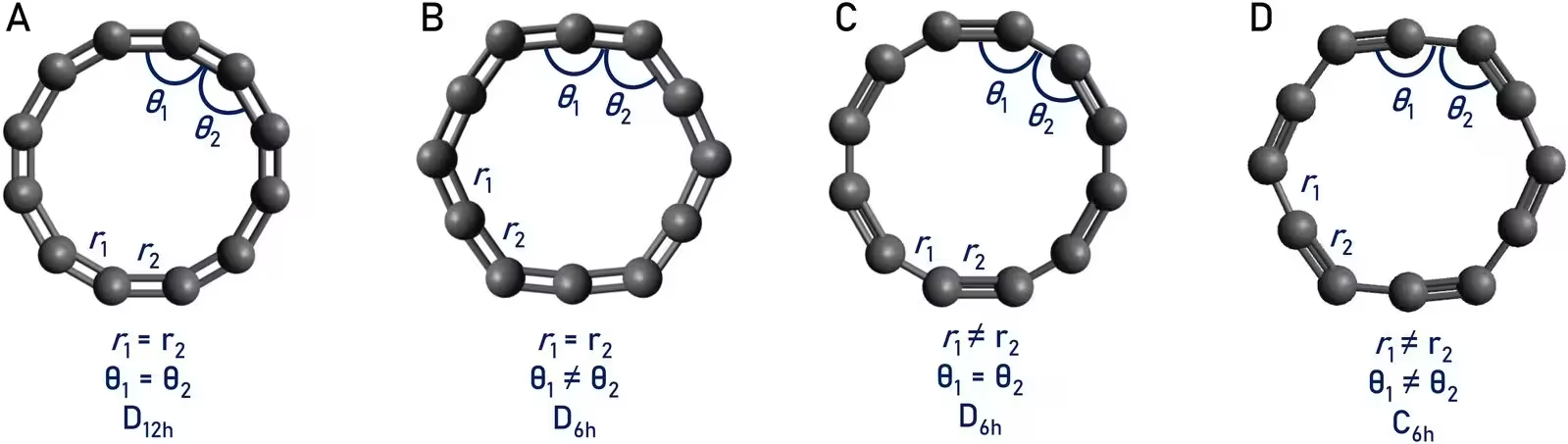
The smaller rings, however, present significant computational hurdles. For $C_{12}^+$, different functionals yielded conflicting structural predictions, but single-point energy calculations at the coupled-cluster CCSD(T) level indicated that a $D_{6h}$ symmetric structure derived from PBE1PBE calculations represents the true ground state more accurately than alternative geometries. Meanwhile, the $C_{8}^+$ cation undergoes a profound structural rearrangement, losing degeneracy and distorting into a lower-symmetry arrangement that explains its broader, asymmetric experimental profile.
Astrochemical Implications
Beyond fundamental physical chemistry, these findings hold relevance for astrochemistry. Because pure carbon clusters lack a permanent dipole moment, they escape detection via traditional radio astronomy. Nevertheless, their exceptionally strong infrared absorptions make them prime candidates for detection in the infrared and visible spectra of carbon-rich, hydrogen-poor astrophysical environments. Potential observation sites include planetary nebulae and reflection nebulae like NGC 7023, where fullerenes have already been identified.
Searching for these molecules in space remains challenging because each monocyclic ring possesses a single dominant infrared active mode, raising the possibility of accidental spectral overlap. The authors suggest that future astronomical searches should look for correlated distributions of multiple ring sizes to secure definitive identifications. Such discoveries could ultimately clarify the formation and destruction networks of larger carbon allotropes across the interstellar medium.
The research was published in Physical chemistry chemical physics : PCCP on October 21, 2026.
This article has been fact checked for accuracy, with information verified against reputable sources. Learn more about us and our editorial process.
Last reviewed on .
Article history
- Latest version
Reference(s)
- Douglas-Walker, Thomas E.., et al. “Unravelling the structure of monocyclic carbon ring cations using vibrational spectroscopy.” Physical Chemistry Chemical Physics, vol. 28, no. 40, January 1, 2026, pp. 24796-24807. Royal Society of Chemistry (RSC), doi: 10.1039/d6cp03280j. <https://doi.org/10.1039/d6cp03280j>.
Cite this page:
- Posted by John Williams