A Major African Continent Is Stretching and Thinning Faster Than We Thought
Deep beneath Earth’s surface, the crust is stretching and thinning at an accelerating rate, according to new research into tectonic processes.
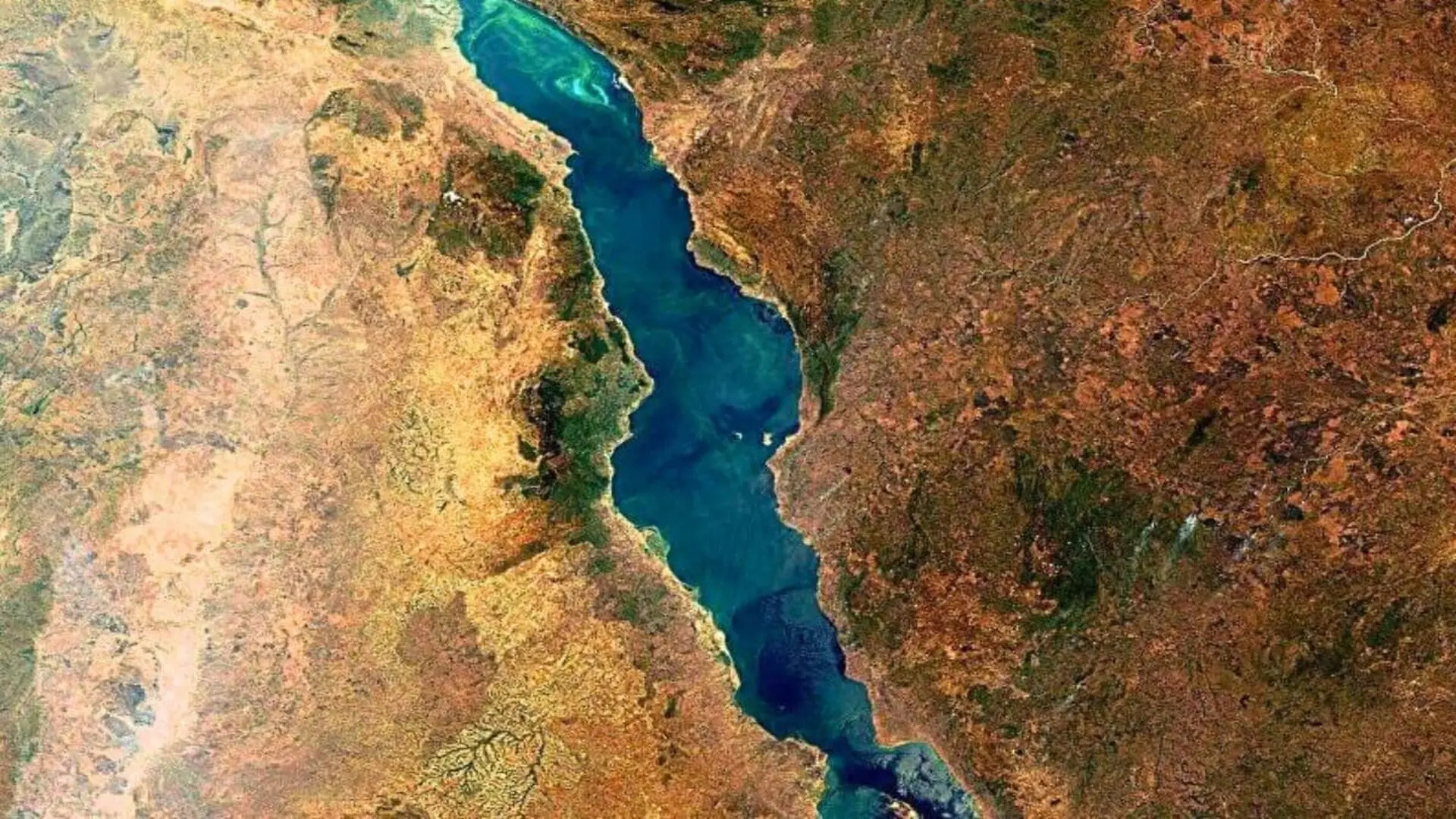
The crust beneath Kenya’s Lake Turkana has been measured at a remarkably thin 13 kilometers, roughly 8 miles. While typical continental crust averages 35 kilometers in thickness, the Turkana Rift has seen two-thirds of that mass vanish, a phenomenon that geologists now suggest is a definitive sign of advanced continental fragmentation.
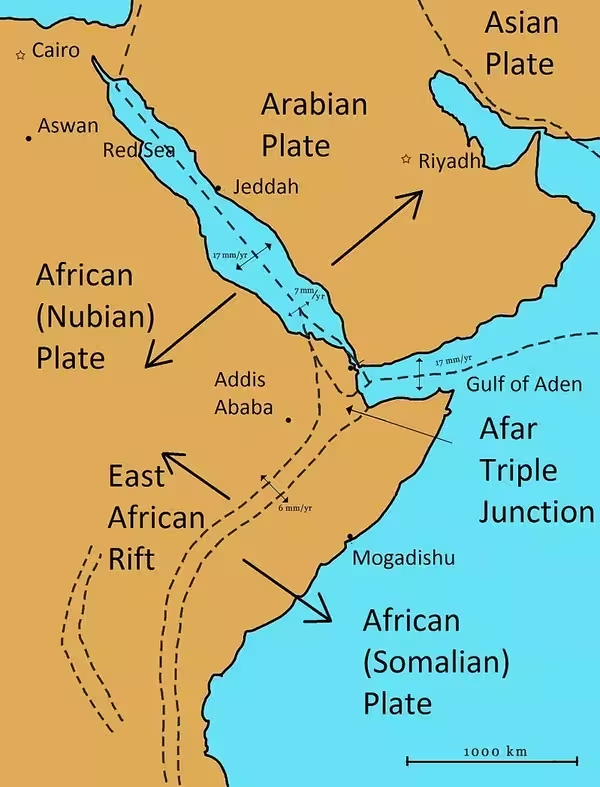
Research recently published in Nature Communications highlights the Turkana region as a critical indicator that parts of eastern Africa are undergoing a significant tectonic transition. Stretching 500 kilometers across Kenya and Ethiopia, the Turkana Rift serves as a key segment of the larger East African Rift System, which carves a path from the Afar Depression down toward Mozambique.
In this zone, the African and Somali plates are drifting apart at a rate of approximately 4.7 millimeters per year. This persistent divergence is fracturing and weakening the crust, creating pathways for magma to ascend from the mantle. While not every rift leads to the total separation of a landmass, evidence suggests the Turkana region is on a trajectory toward eventual breakup.
Evidence of Tectonic Necking
Christian Rowan, a researcher at Columbia University’s Lamont-Doherty Earth Observatory, utilized seismic reflection data to map the subsurface, allowing his team to estimate crustal thickness across the rift. The findings reveal that while the rift flanks remain at standard depths of 35 kilometers, the axis has thinned to an average of just 12.7 kilometers.
Geologists refer to this localized narrowing as “necking.” Rowan likens the behavior of the crust to stretching saltwater taffy: the middle section thins and elongates as it is pulled from both ends, while the outer margins remain relatively stable. Anne Bécel, a geophysicist and study co-author, notes that this thinning creates a feedback loop. As the crust weakens, it becomes increasingly susceptible to further stretching, pushing the region past a critical threshold of structural integrity.
Inherited Geological Weakness
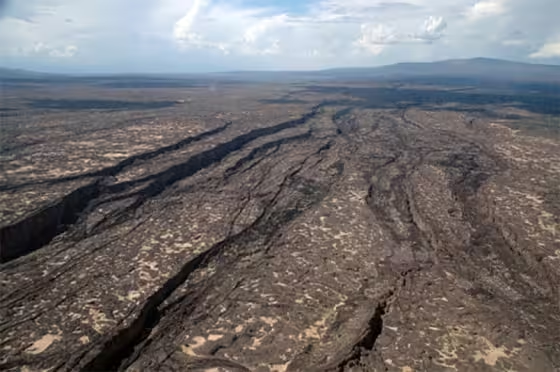
While the broader East African Rift System began its activity roughly 45 million years ago, the team believes the specific necking process in Turkana commenced approximately 4 million years ago. This timeline is accelerated compared to typical models, a mystery the researchers believe is solved by the region’s complex history.
The Turkana region contains evidence of two overlapping rifting events: an ancient Mesozoic system and the modern East African Rift. The team discovered that the modern phase exploited structural scars left behind by the older event. Because the crust did not have sufficient time to recover its strength between these two tectonic episodes, the current rifting has progressed with greater speed and efficiency than in neighboring zones where the crust remains more than 25 kilometers thick.
Rethinking the Fossil Archive
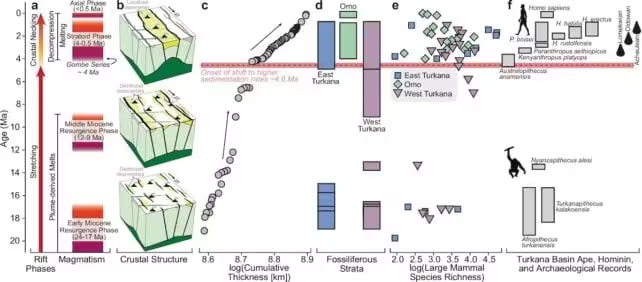
The Turkana Basin is world-renowned for housing over 1,200 hominin fossils from the last 4 million years, a cache that has long been viewed as evidence of a “cradle of humankind.” However, the new geological data offers a different perspective on why the region is so fossil-rich.
The researchers propose that the onset of necking 4 million years ago caused the basin to subside significantly. This created a perfect sedimentary environment for the rapid burial and preservation of biological remains. It is possible that the density of hominin fossils in Turkana is not necessarily a reflection of higher population densities, but rather a testament to the superior geological conditions that allowed for a consistent, high-quality fossil record to be archived.
Future Implications
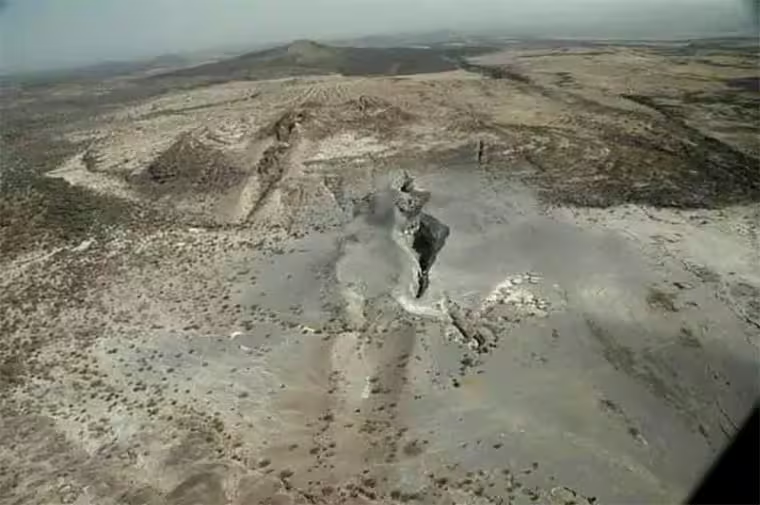
The Turkana Rift has now joined the Afar region as a prime site for observing the mechanics of continental breakup. While the process of turning this rift into a future ocean basin remains a timescale of millions of years, the identification of active necking provides a rare, real-time look at how continents tear apart.
Co-author Folarin Kolawole emphasizes that understanding these deep-crustal shifts is essential for reconstructing ancient environments. By linking the geodynamics of the rift to surface changes, scientists can better interpret the climate and vegetation shifts that influenced early hominin habitats. This geological work ultimately serves as a window into the long-term evolution of the planet, providing insight into the forces that continue to reshape the African continent.
This article has been fact checked for accuracy, with information verified against reputable sources. Learn more about us and our editorial process.
Last reviewed on .
Article history
- Latest version
Reference(s)
- Rowan, Christian. “Necking of the active Turkana Rift Zone and the priming of eastern Africa for continental breakup - Nature Communications.”, vol. 17, no. 1, April 23, 2026, pp. 3585 Nature, doi: 10.1038/s41467-026-71663-x. <https://www.nature.com/articles/s41467-026-71663-x>.
Cite this page:
- Posted by William Moore