Scientists Just Discovered a Meteorite Mineral That Defies the Laws of Physics
Scientists have discovered a strange material inside an ancient meteorite that defies the traditional classification of crystals and glass.
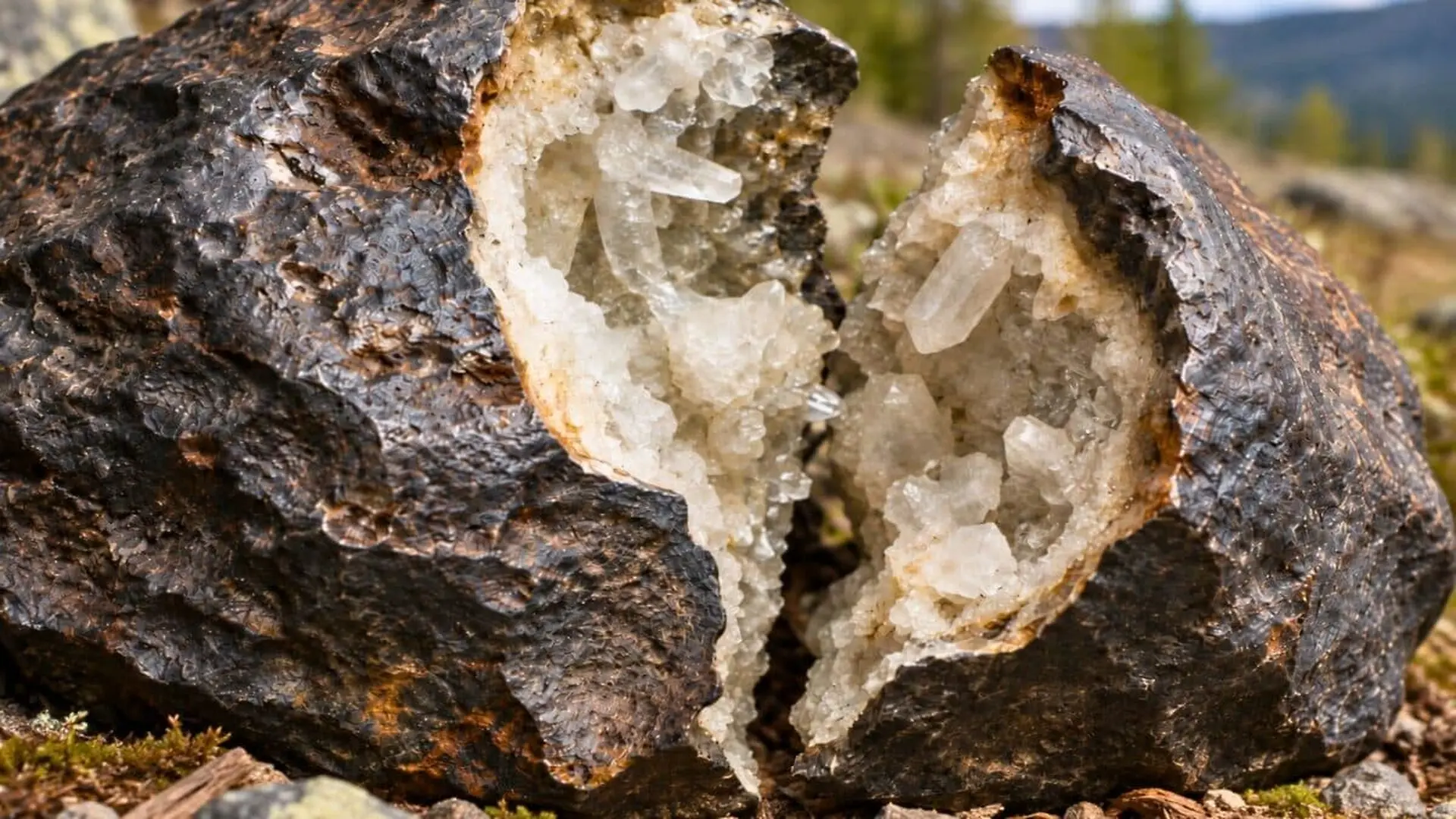
A fragment of a meteorite that plummeted to Earth in 1724 has revealed a bizarre physical phenomenon, challenging the long-standing scientific understanding of how heat moves through solids. For three centuries, this piece of the Steinbach meteorite sat in a Paris museum, unknowingly holding the key to a thermal mystery that had eluded researchers.
According to findings published in the Proceedings of the National Academy of Sciences, scientists have identified a material that defies the fundamental rules of thermal conduction. The mineral, known as silica tridymite, was found to maintain a virtually constant rate of heat conductivity across a temperature range of 80 K to 380 K. This flat thermal profile is unheard of for traditional solid materials.
Thermal Laws Defied
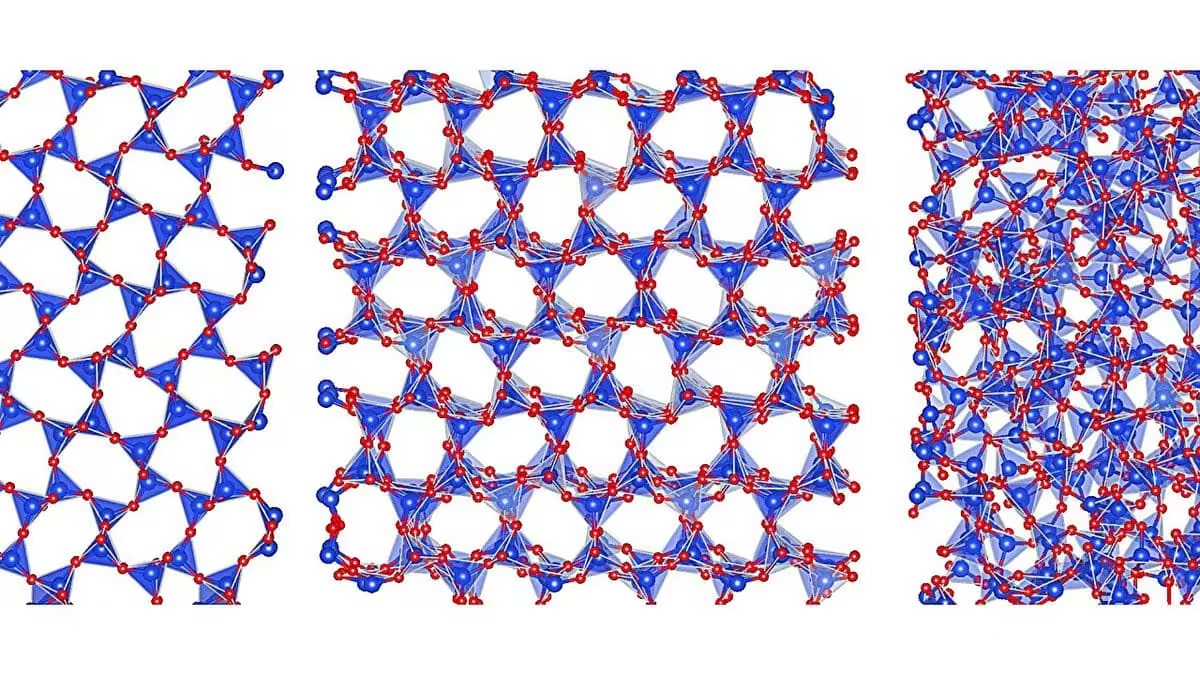
In standard materials science, heat conduction is dictated by atomic arrangement. Crystals, characterized by a repeating, orderly lattice, typically see their thermal conductivity decrease as temperatures climb. Conversely, amorphous materials like glass, which lack such a structured backbone, exhibit rising thermal conductivity as they get hotter. These two categories represent the standard thermal playbook.
Tridymite, however, occupies an impossible middle ground. It possesses the ordered atomic bonds of a crystal yet retains the structural irregularity typically found in glass. This unique hybrid structure forces thermal conductivity to remain steady, an observation the research team likens to the famous invar effect in thermal expansion.
From Theoretical Math to Cosmic Evidence
The discovery is the culmination of a theoretical framework developed in 2019 by Michele Simoncelli, now of Columbia Engineering, alongside Nicola Marzari of the Swiss Federal Technology Institute of Lausanne and Francesco Mauri of Sapienza University of Rome. Their equation was the first to bridge the gap between perfect crystals and amorphous glasses in a single mathematical model.
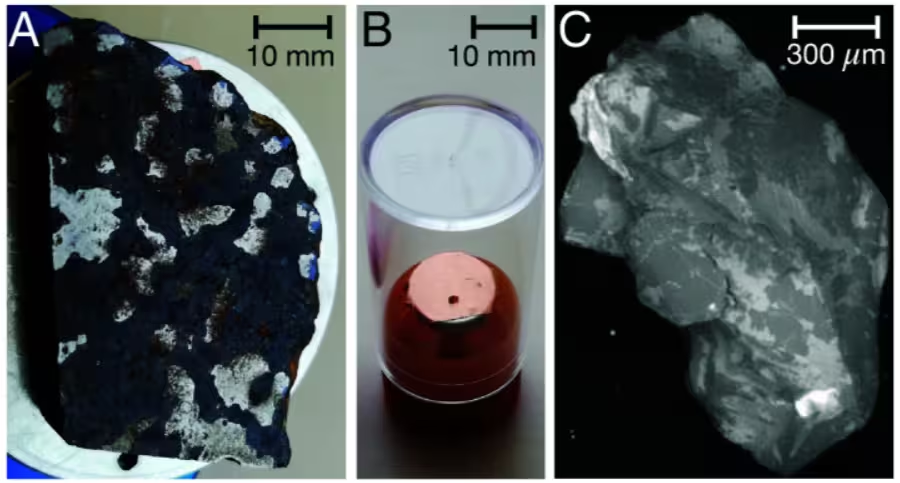
To put the theory to the test, researchers from Sorbonne University gained access to the rare Steinbach meteorite specimen held by the National Museum of Natural History in Paris. By cutting a small sample, they provided the experimental proof needed to confirm the team’s predictions.
The implications of this discovery extend far beyond space rock. Tridymite can form within the refractory bricks of industrial steel furnaces. Because the material offers predictable heat management regardless of temperature fluctuations, it could lead to more efficient furnace designs. Given that steel production is responsible for roughly 7% of carbon emissions in the United States, improvements in thermal efficiency could have a significant environmental impact.
Computational Breakthroughs
Validating the findings required sophisticated machine-learning methods capable of solving quantum mechanical equations that remain out of reach for traditional first-principles computation. This computational power allowed the team to simulate complex atomic interactions with enough precision to predict thermal properties without relying on experimental calibration.
Experts suggest this quantum framework could be applied to other areas of physics, such as the behavior of electrons and magnons in solids. Such research is vital for the development of next-generation technologies, including neuromorphic computing, thermoelectric wearables, and spintronic devices. Furthermore, because the mineral’s thermal conductivity is a reflection of its history, scientists hope this discovery will help them better map the thermal evolution of planets, including Mars.
This article has been fact checked for accuracy, with information verified against reputable sources. Learn more about us and our editorial process.
Last reviewed on .
Article history
- Latest version
Reference(s)
- Simoncelli, Michele., et al. “Temperature-invariant crystal–glass heat conduction: From meteorites to refractories.” Proceedings of the National Academy of Sciences, vol. 122, no. 28, July 11, 2025 National Academy of Sciences, doi: 10.1073/pnas.2422763122. <https://www.pnas.org/doi/10.1073/pnas.2422763122>.
Cite this page:
- Posted by William Moore