New Evidence Challenges Everything We Thought We Knew About Why Neanderthals Went Extinct
New research challenges the theory that climate change caused Neanderthal extinction, revealing their habitats remained stable and widespread.

Popular imagination often paints Neanderthals as rugged survivors forged in the unforgiving chill of Ice Age Eurasia. However, new research suggests that this image of the cold-hardy specialist may be incomplete. A comprehensive analysis of their ancient habitats reveals that Neanderthals favored temperate environments and maintained stable, connected territories throughout periods of significant climate flux, casting doubt on the long-held theory that environmental fragmentation triggered their extinction 40,000 years ago.
The findings, published in the journal Communications Earth & Environment, suggest that while cooling climates likely exerted pressure on these hominin populations, the primary catalyst for their decline may have been the rising presence of Homo sapiens. By reconstructing habitat suitability across three distinct climatic stages—from the Last Interglacial period roughly 130,000 years ago to the period surrounding their eventual disappearance—a team led by Masoud Yousefi has provided a more nuanced look at how our ancient cousins occupied the landscape.
Beyond the Ice: Rethinking Neanderthal Ecology
To map where Neanderthals thrived, the researchers employed advanced species distribution models, incorporating data from 683 fossil and archaeological sites. By evaluating variables including terrain, precipitation, and, crucially, winter temperatures, the team identified a clear preference for milder climates. Contrary to the assumption that they were built exclusively for extreme cold, the data indicates that warmer winters were the strongest predictor of high-quality Neanderthal habitat.
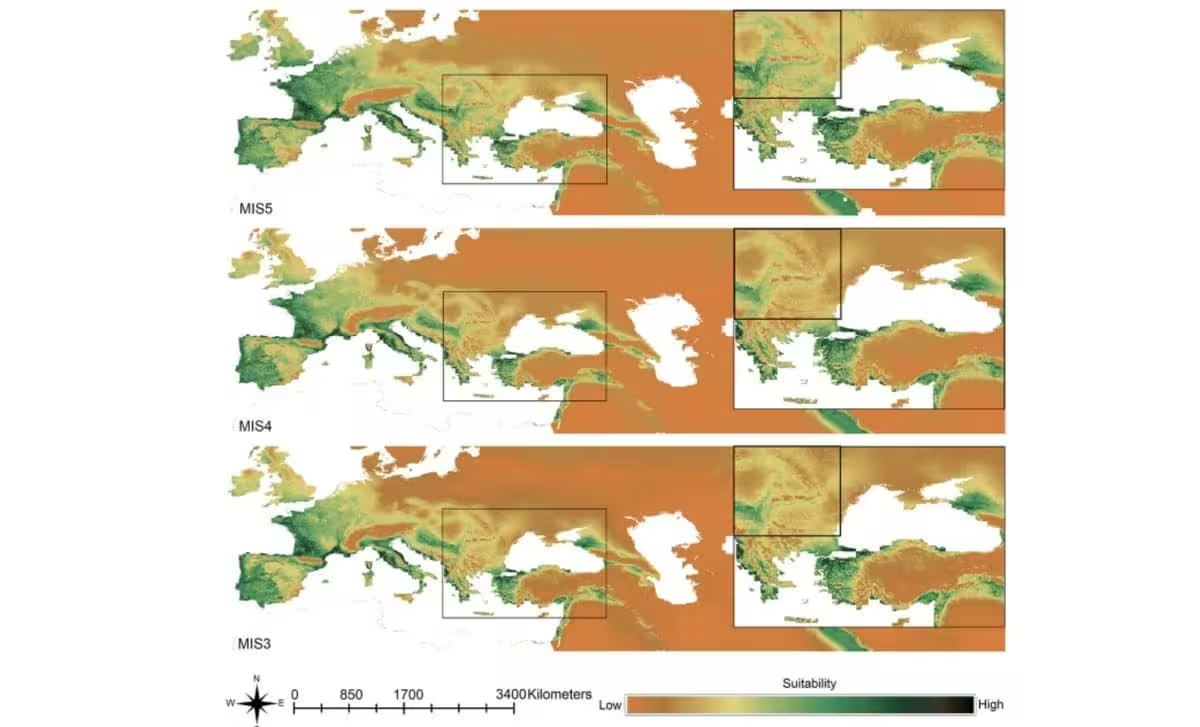
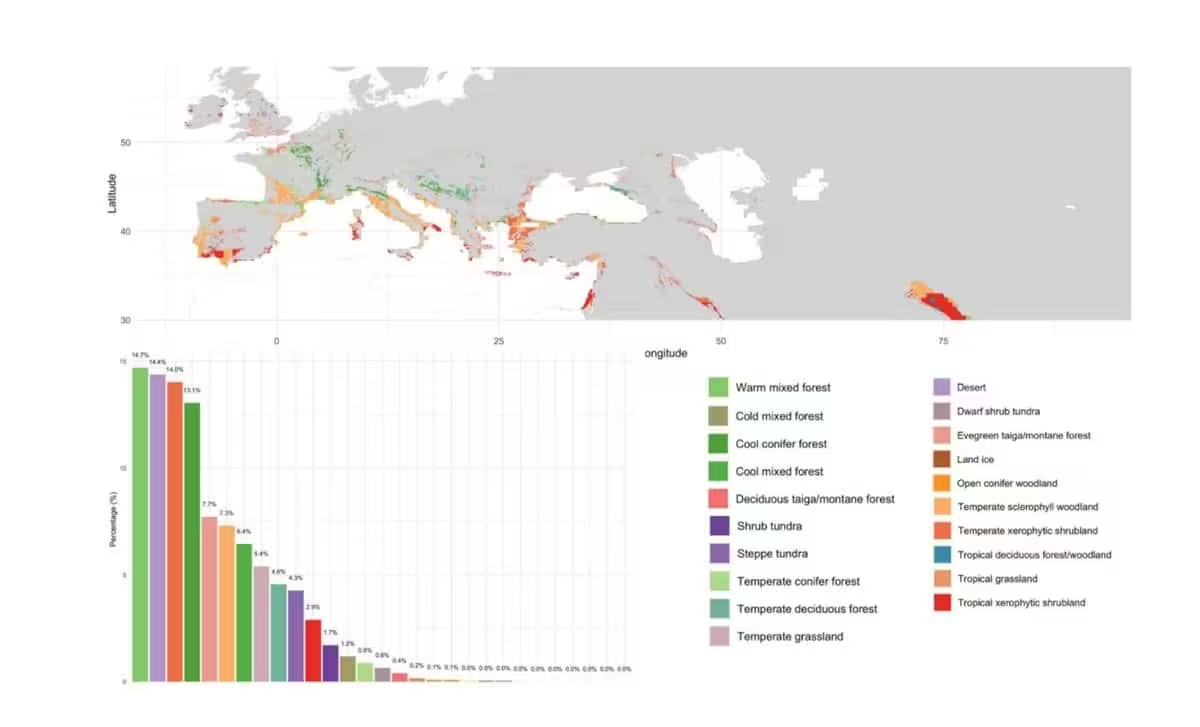
Their range was surprisingly diverse, spanning 19 distinct biomes, including arid deserts, temperate shrublands, and dense forests. Prime locations for settlement typically included the Mediterranean basin, the Caspian Sea, and the coastal stretches of Western Europe. Conversely, high-altitude mountain ranges and continental regions plagued by harsh winters were notably less suitable, suggesting that Neanderthals were not strictly tied to glacial environments.
The research also reconstructed vast corridors for movement, including a 6,000-kilometer route stretching from Eastern Europe into Siberia. These pathways, which largely hugged coastal zones and lower-elevation terrain, suggest a highly mobile population capable of traversing significant portions of the continent.
The Case Against Climate-Driven Isolation
A key focus of the study was determining whether shifting climates physically partitioned Neanderthal populations into isolated, unsustainable pockets. When the researchers modeled the connectivity and landscape resilience, they found no evidence of a dramatic decline in habitat integration. Even as the climate cooled toward the end of their tenure, connectivity levels remained comparable to those of earlier, warmer eras.
While environmental cooling may have reduced the overall availability of resources or decreased population density, the study asserts that it did not destroy the network of habitats required for survival. This leads the authors to look toward external pressures, specifically the arrival of Homo sapiens.
The temporal overlap between the expansion of modern humans, the decline of megafauna, and the shrinking range of Neanderthals points toward heightened competition for the same ecological niches. Whether through direct conflict or the indirect squeeze on food sources, the emergence of Homo sapiens likely pushed an already environmentally stressed population toward the brink.
By identifying regions that were theoretically habitable but show no signs of Neanderthal occupation, the researchers have also mapped a roadmap for future archaeological discovery. These “ghost” ranges, particularly along the ancient Siberian and Iranian corridors, may hold the key to understanding exactly how Neanderthals interacted with their modern human counterparts during the twilight of their species.
This article has been fact checked for accuracy, with information verified against reputable sources. Learn more about us and our editorial process.
Last reviewed on .
Article history
- Latest version
Reference(s)
- Yousefi, Masoud. “No evidence for climate-driven fragmentation of Neanderthal habitats prior to their extinction - Communications Earth & Environment.”, August 25, 2026 Nature, doi: 10.1038/s43247-026-03960-8. <https://www.nature.com/articles/s43247-026-03960-8>.
Cite this page:
- Posted by William Moore