Archaeologists Found a 476,000 Year Old Wooden Structure Built Long Before Humans Existed
Archaeologists have uncovered evidence of wood-working by ancient human ancestors from 500,000 years ago, revealing unexpected structural engineering skills.

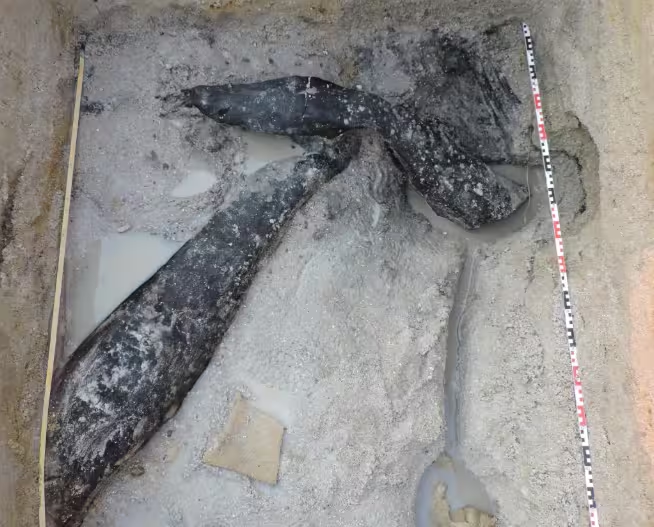
Archaeological evidence unearthed at Kalambo Falls in northern Zambia has pushed the timeline of human craftsmanship back by nearly a quarter-million years. Excavations in waterlogged sediments near a river gorge have revealed two logs that were intentionally cut and notched to interlock, a discovery that predates the emergence of Homo sapiens by approximately 240,000 years.
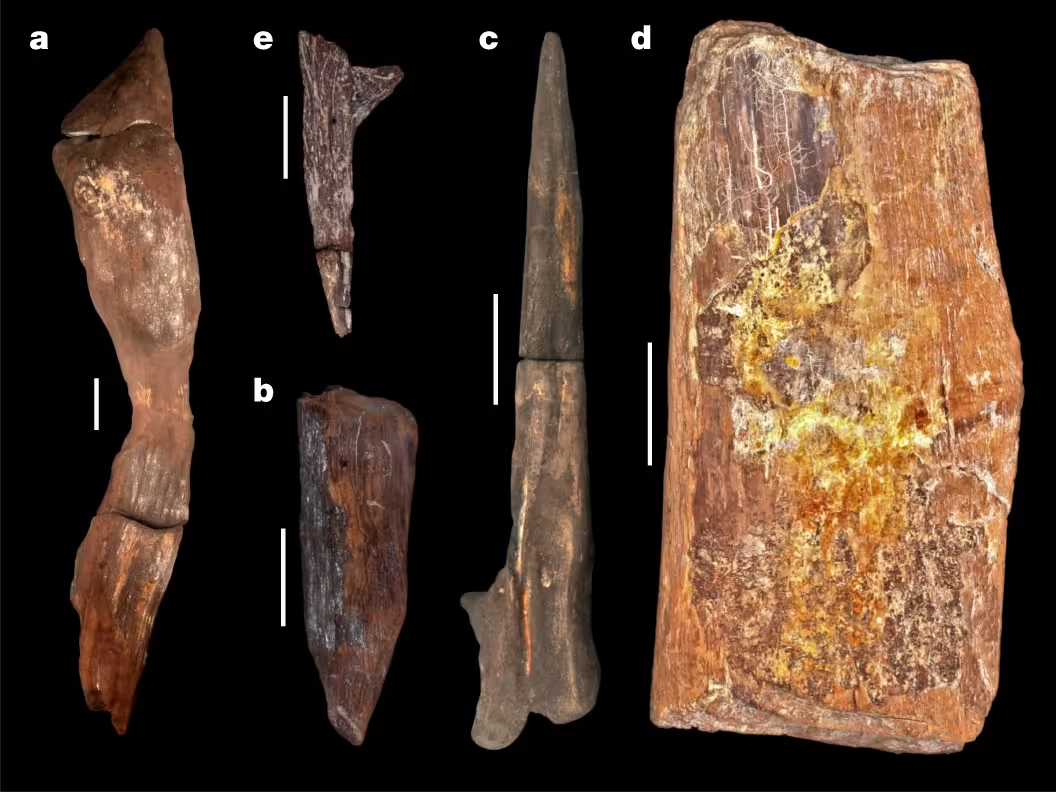
The findings, detailed in the journal Nature, were spearheaded by L. Barham of the University of Liverpool. By employing luminescence dating on the surrounding soil, researchers determined the logs to be at least 476,000 years old. In addition to the interlocking timber, the team recovered a collection of specialized wood tools, including a digging stick, a wedge, and various notched branches, documenting a sophisticated tradition of woodworking that spanned from roughly 390,000 to 324,000 years ago.

Evidence of Advanced Structural Engineering
The primary find consists of an upper log, identified as Combretum zeyheri, spanning 141 centimeters. It features a U-shaped notch meticulously carved via stone tools, allowing it to sit securely over a larger trunk. Examination of the wood surface reveals clear evidence of intentional modification, including scraping marks and chopping facets that indicate a high degree of purposeful labor.
This construction represents the earliest known example of joined timber in the global Palaeolithic record. While the exact purpose of the assembly remains a subject of study, researchers propose it could have served as an elevated platform, a walkway, or a foundational element for a structure, providing a stable surface above the seasonally flooded river floodplain.
Preservation Through Rare Hydrological Conditions
The survival of these wooden artifacts for half a million years is an anomaly, as organic materials typically decay rapidly. The site at Kalambo Falls provided a rare, oxygen-free environment due to a high, stable water table, which effectively stalled the decomposition process. This preservation allowed for detailed Scanning Electron Microscopy (SEM) analysis, which confirmed the wood species and verified that the items were not intrusive to the geological layers.
To establish the chronology, the team utilized luminescence dating on sixteen separate sediment samples, measuring the accumulated radiation within individual mineral grains. The data consistently placed the oldest artifacts at approximately 476,000 years, providing a robust timeline for these early engineering efforts.
Rethinking Early Hominin Cognitive Abilities
The identity of the architects remains an open question. Given the age of the site, the tools were likely crafted by ancestral hominins that predated the divergence of modern humans and Neanderthals. The complexity of the design—joining two distinct parts to create a unified, functional structure—suggests a level of technical cognition previously thought to be absent from this era.
This discovery challenges the long-standing reliance on stone tools as the sole indicator of early human ingenuity. Because stone persists while organic materials vanish, the archaeological record has historically favored lithic technology, potentially obscuring a much deeper and more varied history of wooden tool construction. The site at Kalambo Falls serves as a rare, illuminating exception, suggesting that our ancestors possessed a sophisticated, sustained, and adaptive relationship with the environment that has remained largely invisible to science until now.
This article has been fact checked for accuracy, with information verified against reputable sources. Learn more about us and our editorial process.
Last reviewed on .
Article history
- Latest version
Reference(s)
- Barham, L.. “Evidence for the earliest structural use of wood at least 476,000 years ago - Nature.”, vol. 622, no. 7981, pp. 107-111. Nature, doi: 10.1038/s41586-023-06557-9. <https://www.nature.com/articles/s41586-023-06557-9>.
- <https://whc.unesco.org/en/tentativelists/6993/>.
Cite this page:
- Posted by Vikram Desai