New Mathematical Framework Validates Quantum Resistance Standards Without Internal Wiring
Researchers use rotational symmetry and probability theory to confirm quantum Hall array integrity through outer terminal measurements alone.
Physicists have developed a self-verifying mathematical framework that tests quantum electrical resistance standards using only external measurements, bypassing the need for complex internal wiring. The approach addresses a long-standing bottleneck in quantum metrology, where scaling up multi-element resistance arrays makes checking every individual component practically impossible.
By arranging resistance elements in rotationally symmetric patterns, researchers can validate the entire device through simple terminal checks. The study was published on the arXiv preprint server by a multi-institutional team including scientists from the National Institute of Standards and Technology (NIST) and several universities.
How Quantum Resistance Standards Work
Since the 2019 redefinition of the International System of Units, electrical resistance has been anchored directly to fundamental physical constants. National laboratories frequently realize the ohm using the quantum Hall effect in epitaxial graphene, a single atomic layer of carbon grown on silicon carbide substrates. This effect ties electrical resistance to the ratio of the Planck constant and the square of the elementary charge, yielding a fundamental value known as the von Klitzing constant.
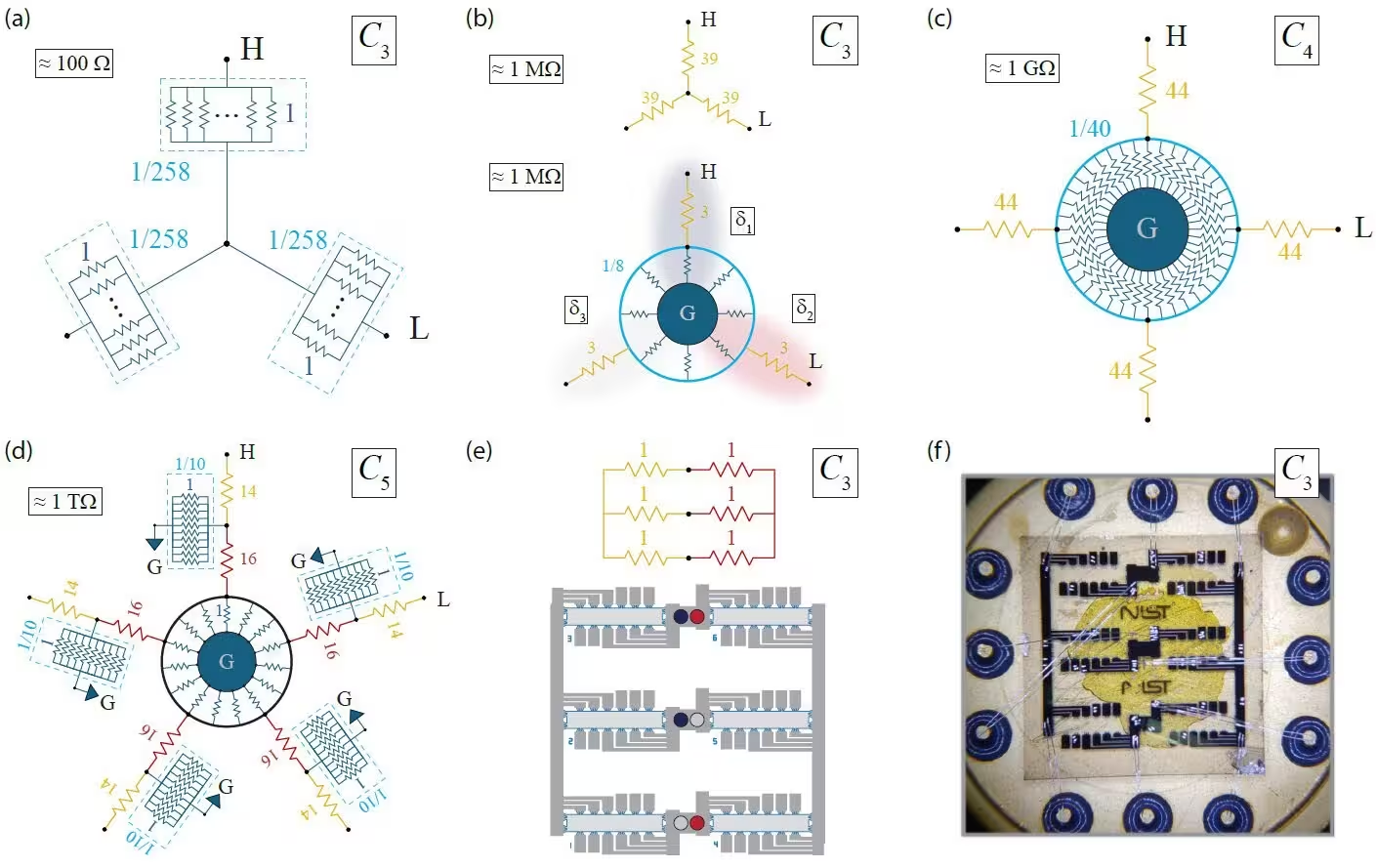
To produce different resistance values without intermediate calibration steps, laboratories build quantized Hall array resistance standards. These networks interconnect multiple individual Hall elements in series, parallel, or complex star-mesh geometries to generate specific decadic or arbitrary resistance targets. However, if a single internal element undergoes a quantum phase transition and loses its quantized state, the overall resistance output becomes corrupted without necessarily showing an obvious warning sign.
What Is the Symmetric Precision Quantization Reliability Criterion
Checking every single element inside a large array requires a prohibitive number of voltage and current contacts, turning complex hardware designs into an engineering nightmare. To solve this, the researchers introduced the Symmetric Precision Quantization Reliability criterion, abbreviated as SPQR. This mathematical framework assigns a rigorous statistical confidence level to an entire array strictly by analyzing measurements taken from the outer terminals of rotationally symmetric layouts.
The statistical model treats unobservable internal defects using a Laplace probability distribution rather than a Gaussian curve. Because catastrophic quantum breakdown events are rare and cause sharp resistance jumps rather than smooth statistical variations, the Laplace distribution accommodates heavier mathematical tails. This choice provides a conservative upper bound for the probability of hidden defects.
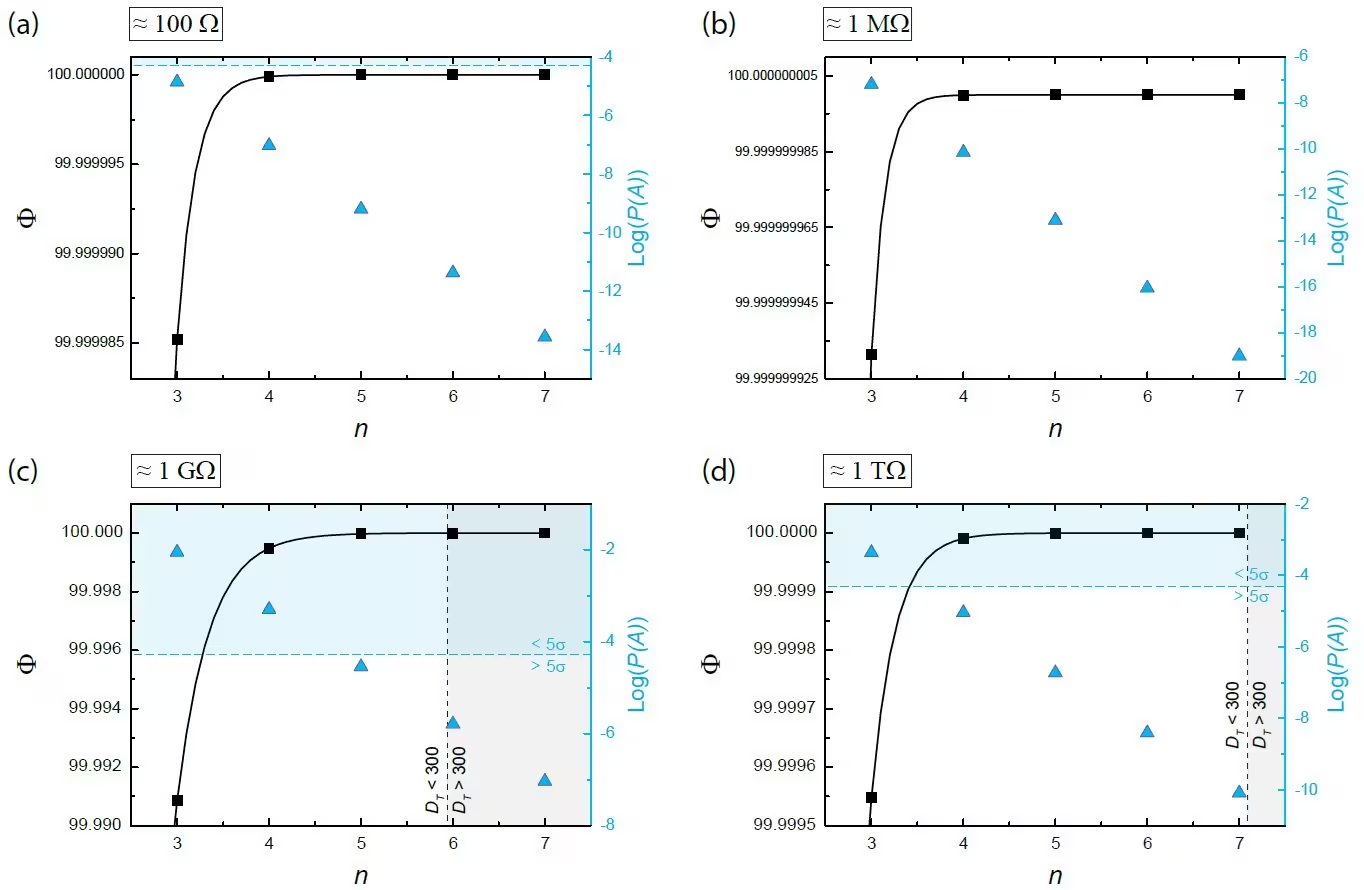
The framework maps internal component deviations through a sensitivity matrix and evaluates them against an observation window defined by the measurement noise floor. If the terminal measurements show strong agreement across rotationally symmetric configurations, the SPQR criterion calculates a high statistical confidence that no internal breakdown has occurred.
Testing the Framework on Graphene Arrays
To demonstrate proof of principle, the team fabricated an experimental device utilizing monolayer epitaxial graphene grown on semi-insulating 4H-SiC substrates via polymer-assisted sublimation and face-to-graphite thermal annealing at 1900 degrees Celsius in an argon atmosphere. The device featured six interconnected graphene Hall elements joined by niobium titanium nitride superconducting leads, with charge carrier densities tuned through covalent chromium tricarbonyl functionalization.
The researchers tested the array at a cryogenic temperature of 1.5 kelvin under a magnetic flux density of 9 tesla using Stanford Research Systems SR830 lock-in amplifiers, alongside direct current comparator and cryogenic current comparator bridges. Evaluating the cyclic terminal measurements yielded an SPQR criterion confidence value exceeding 0.999999991, which significantly surpasses the conventional five-sigma threshold often used in particle physics for high-confidence discoveries.
Why Star-Mesh Topologies Improve Efficiency
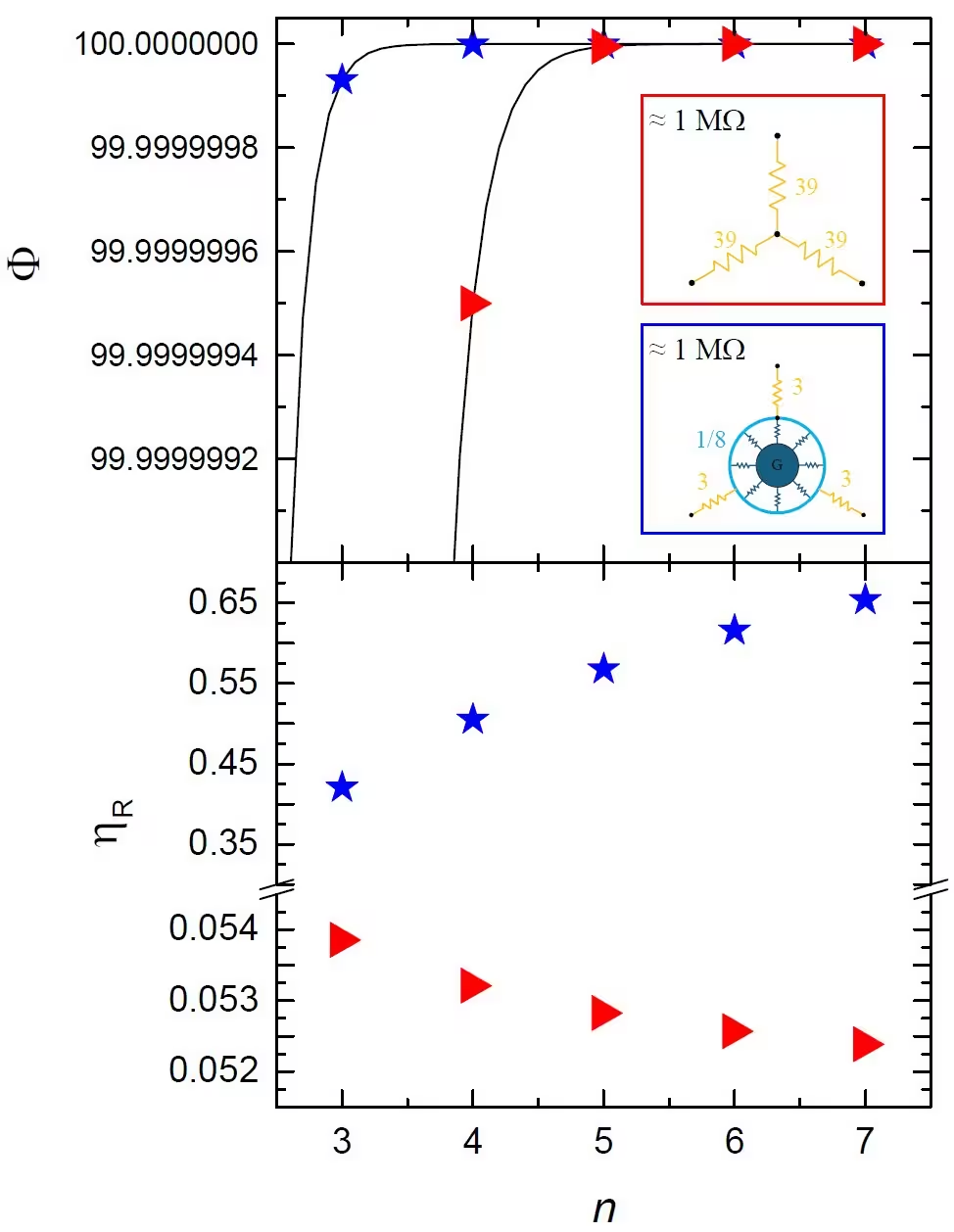
The team also evaluated several simulated designs targeting various resistance outputs, ranging from 100 ohms to 1 teraohm, utilizing different orders of rotational symmetry from three-fold to five-fold configurations. Their analysis revealed that incorporating star-mesh transformations drastically reduces the total number of physical elements required compared to traditional series-only arrangements.
For instance, achieving a 1-megaohm resistance standard required 117 elements in a conventional series-only layout, whereas a corresponding star-mesh topology achieved the same target with only 17 elements while maintaining rapid mathematical convergence. The authors note that while the current framework successfully bounds localized quantization breakdown using terminal data, future refinements could combine cyclic measurements with a small number of targeted internal probes to further constrain common-mode contributions.
The study was posted to the arXiv preprint server on November 19, 2026.
This article has been fact checked for accuracy, with information verified against reputable sources. Learn more about us and our editorial process.
Last reviewed on .
Article history
- Latest version
Reference(s)
- Henry, DaVonne. “Topology-Enabled Self-Verification of Quantum Hall Resistance Standards.” arXiv.org <http://arxiv.org/abs/2611.26016v1>.
Cite this page:
- Posted by Bilal Abbasi