Hidden Crystal Strain May Explain Record Efficiency in Heat-Harvesting Alloys
High-pressure laser spectroscopy reveals that mixing bismuth and antimony creates unexpected atomic bond distortions that peak precisely at top-performing alloy ratios.
A specific alloy composition of bismuth, antimony, and tellurium long celebrated for turning waste heat into electricity harbors a unique atomic vibration signature that may explain its record-breaking efficiency. Researchers probing the microscopic inner workings of these thermoelectric materials found that mixing heavy bismuth atoms with lighter antimony atoms creates unexpected mechanical tensions within the crystal lattice rather than a simple, predictable average of the two pure elements.
Thermoelectric materials are vital components designed to capture lost industrial heat and convert it directly into usable electrical power. Their overall performance relies on a delicate tug-of-war, requiring high electrical conductivity to move charge carriers efficiently while simultaneously blocking the transfer of heat through atomic vibrations known as phonons. Optimizing this balance usually involves alloying benchmark substances such as bismuth telluride and antimony telluride to create solid solutions denoted as (Bi1-xSbx)2Te3.
Unraveling Atomic Vibrations Through Laser Spectroscopy
To understand how substituting antimony alters the internal framework, the research team performed a comprehensive series of laboratory measurements using advanced laser techniques. As detailed in a study published on the arXiv preprint server, the scientists utilized a custom-made confocal micro-Raman system with a 660 nanometer solid-state laser to track how light scatters off vibrating atomic planes across various alloy concentrations under both ambient conditions and high-pressure diamond anvil cell compression up to 8 gigapascals.
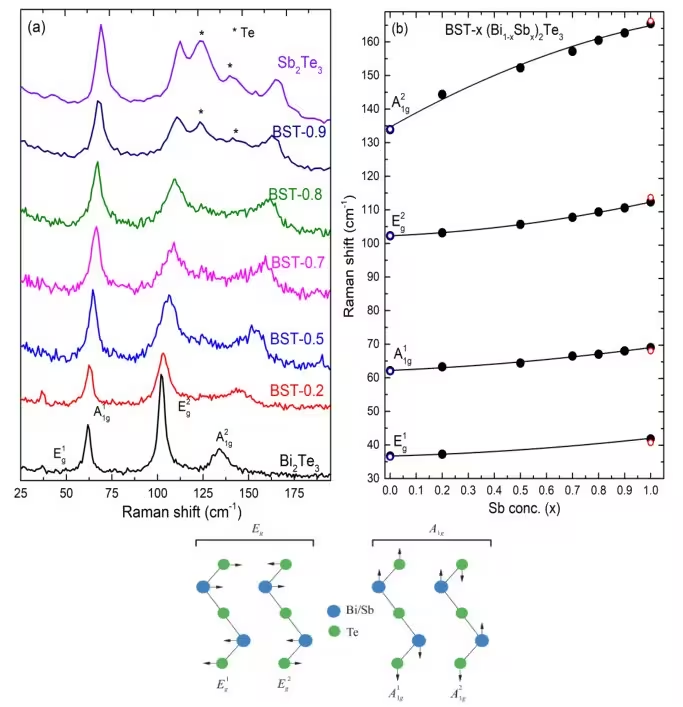
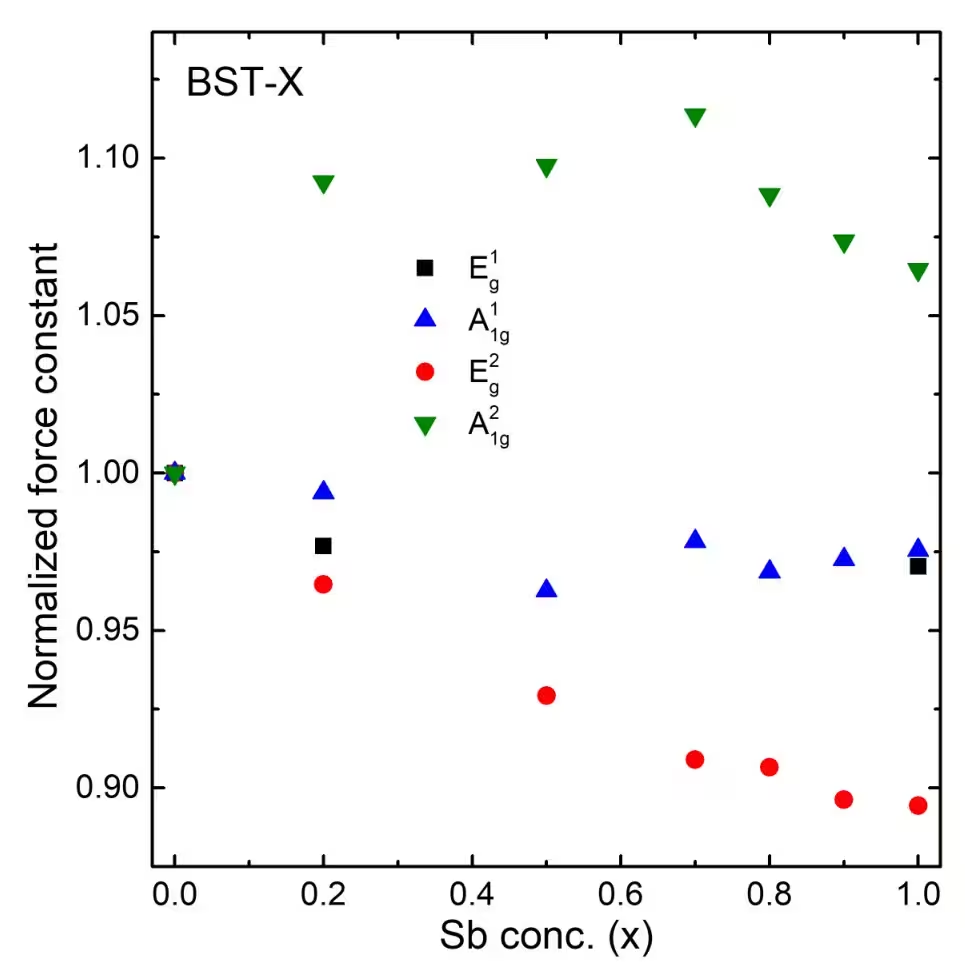
By observing four distinct zone-center Raman-active modes designated as E1g, A11g, E2g, and A21g, the investigators mapped out how individual atomic bonds respond to compositional changes. Although all observed modes undergo a progressive blue shift toward higher frequencies as the concentration of lighter antimony increases, calculating the underlying force constants revealed a surprising divergence in how different parts of the crystal stretch and resist.
Why Certain Atomic Bonds Soften While Others Stiffening
Under a harmonic approximation model, the force constants for lower-frequency modes below 100 reciprocal centimeters remained remarkably composition-independent, matching previous predictions based entirely on mass reduction. However, the higher-frequency modes told a very different story. The E2g mode experienced a pronounced softening, dropping by roughly 10 percent in stiffness across the solid solution series, whereas the A21g mode displayed a sharp, non-monotonic stiffening that peaked near an antimony concentration of 0.7.
The authors suggest that these contrasting trends stem from localized structural modifications, including the contraction of intralayer bond lengths and changes in weak van der Waals gaps between atomic layers. These localized distortions mean that substituting atoms does not merely change the inertial mass of the lattice, but actively reshapes the restoring forces governing atomic motion in specific directions.
Connecting Crystal Anharmonicity to High Thermoelectric Performance
When the team compressed the alloy powders under high pressure to extract isothermal Grüneisen parameters, which measure how strongly vibrational frequencies respond to volume changes, another clear trend emerged. The average Grüneisen parameter exhibited a pronounced maximum precisely around the composition where $x = 0.7$, corresponding to the formula (Bi0.3Sb0.7)2Te3. This specific formulation has long been recognized as a top-tier p-type thermoelectric material.
According to classical equations relating atomic anharmonicity to thermal conductivity, an elevated Grüneisen parameter correlates directly with enhanced phonon scattering and reduced lattice thermal conductivity. While the researchers emphasize that lattice dynamics alone do not dictate the entire figure of merit, the findings indicate that intrinsic phonon anharmonicity plays a crucial, previously underappreciated role in optimizing high-performance thermoelectric energy conversion.
The study was posted to the arXiv preprint server on November 19, 2026.
This article has been fact checked for accuracy, with information verified against reputable sources. Learn more about us and our editorial process.
Last reviewed on .
Article history
- Latest version
Reference(s)
- Sun, Baihong. “Lattice dynamics study of (Bi1-xSbx)2Te3 compounds: Comparative compositional study of force constants and Grüneisen parameters.” arXiv.org <http://arxiv.org/abs/2611.26010v1>.
Cite this page:
- Posted by Anjali Singh