Earth Is Forming Its Next Supercontinent And The Results Could Be Catastrophic For Life
Scientists have modeled four potential visions for Earth’s distant future, each promising to reshape our climate, oceans, and the survival of all life.
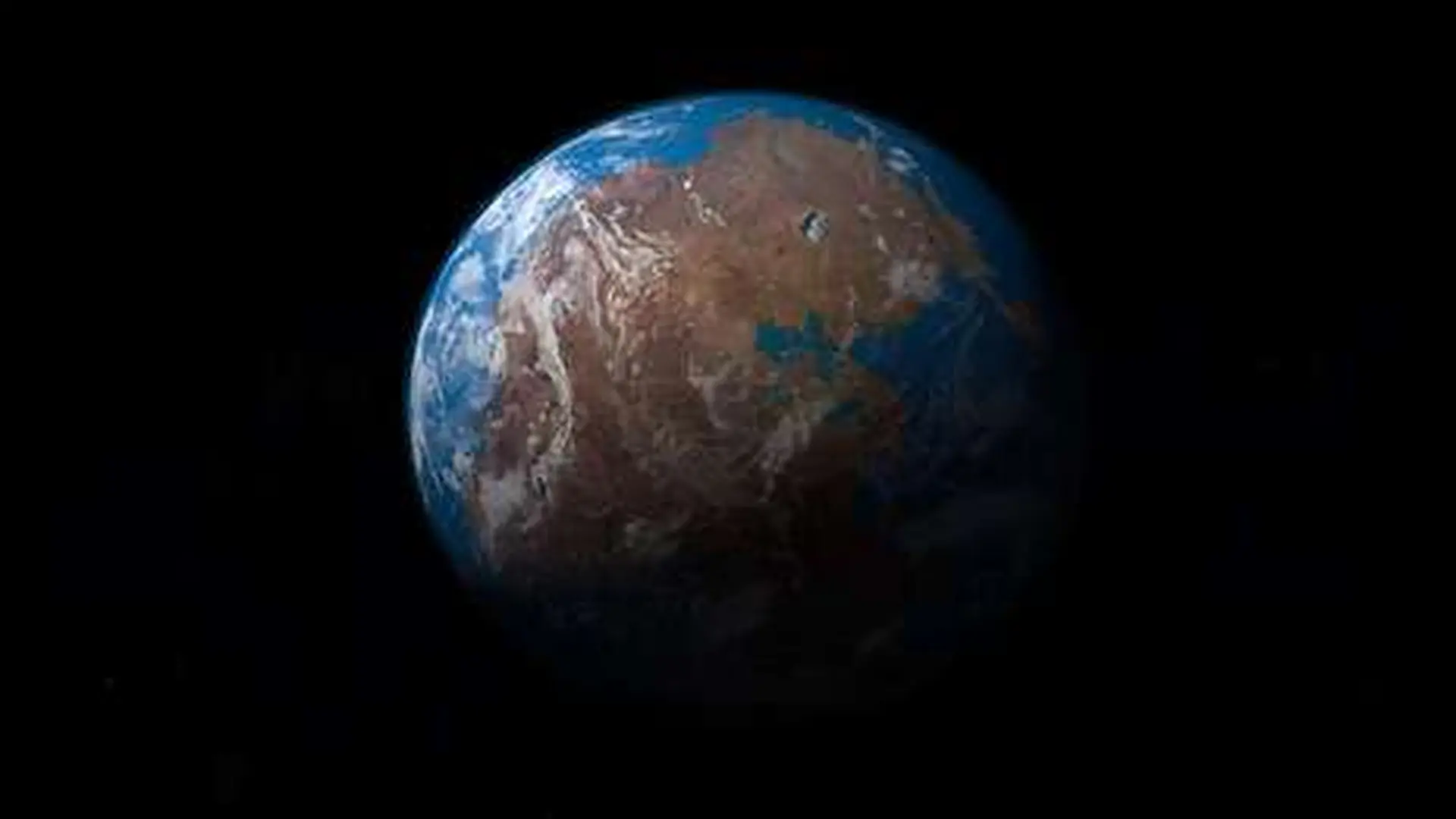
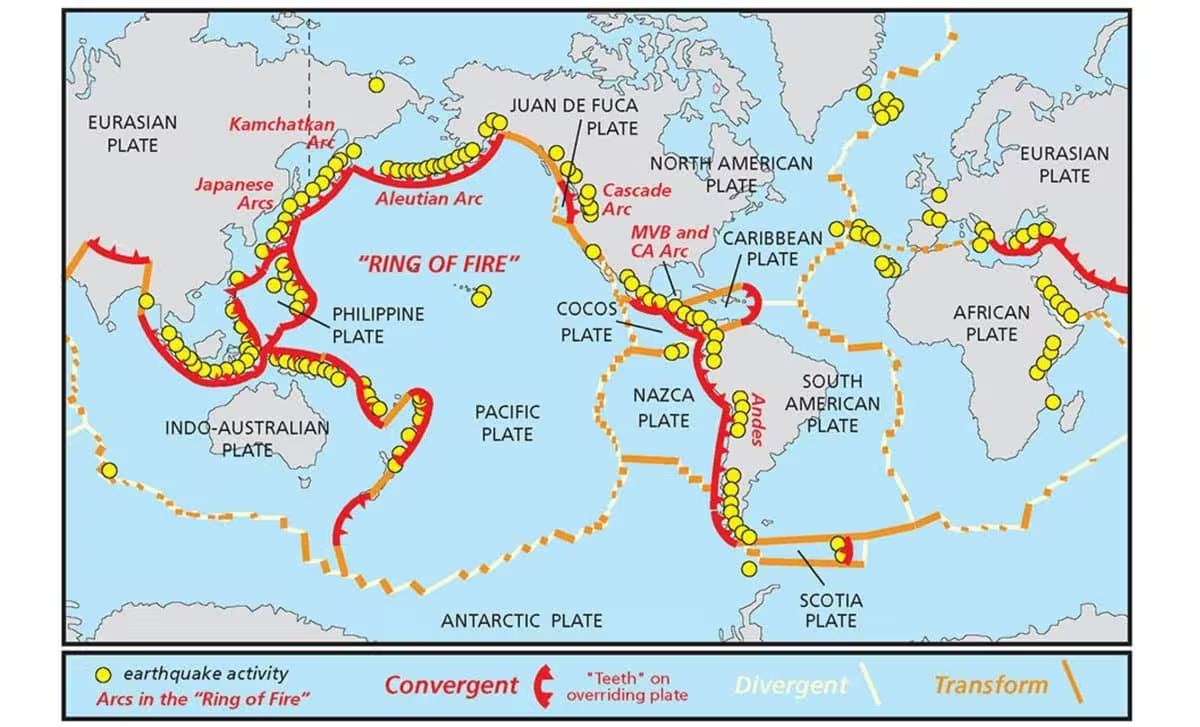
While the map of the world appears fixed, the surface of the Earth is in a constant state of flux. Driven by the relentless mechanics of plate tectonics, the massive slabs of crust that form our continents are continuously shifting over the planet’s hotter, more fluid interior. This slow-motion migration is responsible for the rise of mountain ranges, the birth of volcanoes, and the opening and closing of ocean basins. Over a timeline spanning hundreds of millions of years, these forces inevitably drag landmasses together, setting the stage for the formation of the next global supercontinent.
History offers a precedent for this cycle: Pangea, the most famous of these ancient supercontinents, began its fragmentation approximately 200 million years ago, eventually yielding the geography we recognize today. However, the process remains active. Evidence of this ongoing reconfiguration is visible in regions like the East African Rift, where a 25-mile-long fracture formed in 2005, providing a rare window into how continental crust is gradually torn apart.
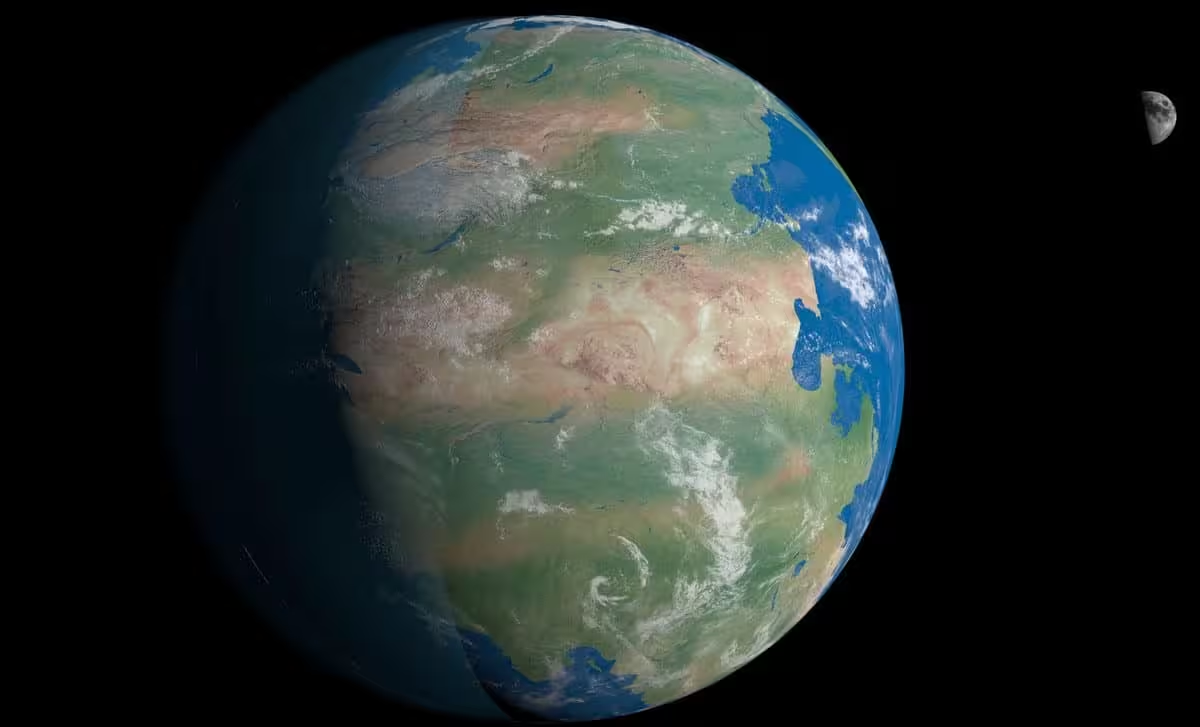
Four Potential Futures for the Planet’s Landmasses
- Novopangea: This scenario suggests the Atlantic Ocean continues to widen while the Pacific closes, causing the Americas to merge with other continents and Australia to migrate toward East Asia.
- Pangea Proxima: Here, new subduction zones trigger the closure of major oceans, pulling all continents back together around a central, smaller body of water.
- Aurica: If both the Atlantic and Pacific close while the Indian Ocean widens, a new supercontinent could form, centered around the equator. University of Lisbon researcher João C. Duarte notes that because the Atlantic and Pacific are aging basins, this is considered a highly plausible outcome.
- Amasia: In this configuration, the Arctic Ocean vanishes as landmasses migrate northward, clustering around the North Pole while leaving Antarctica in isolation.
Climatic Consequences of Continental Realignment
The positioning of these landmasses would dictate Earth’s climate by altering ocean circulation and solar energy absorption. A 2021 investigation published in Geochemistry, Geophysics, Geosystems utilized climate modeling to test the extremes of the Amasia and Aurica scenarios.
Amasia presents a chilling prospect. By concentrating land at high northern latitudes, the world would likely experience significant cooling as snow and ice cover expand across the supercontinent. This reflective ice cover would further lower temperatures, while the shift could disrupt global ocean currents that currently redistribute tropical heat toward the poles, according to Michael Way of the NASA Goddard Institute for Space Studies.
Conversely, Aurica paints a portrait of a much warmer planet. Simulations suggest global temperatures could rise by approximately 3 degrees Celsius, characterized by vast tropical coastlines and hot, arid inland regions.
The Resilience of Life in a Changing World
Regardless of whether the planet faces a deep freeze or a warming trend, the transition poses significant risks to global biodiversity. The collision of continents would dismantle long-standing ecosystems, forcing species into intense competition and challenging them with rapid environmental shifts. Duarte has noted that such massive upheavals often correlate with significant extinction events.
Predicting the biological outcome is inherently difficult, as it depends on variables ranging from atmospheric carbon dioxide levels to the nature of future volcanic activity. Similarly, the role of humanity in this distant future remains entirely speculative. Given that our species has existed for only a blink of an eye in geological time, it is unlikely that modern humans will witness this transformation. Nevertheless, the mechanisms of our planet remain in motion, ensuring that Earth will eventually look nothing like the world we know today.
This article has been fact checked for accuracy, with information verified against reputable sources. Learn more about us and our editorial process.
Last reviewed on .
Article history
- Latest version
Reference(s)
- “Plate Tectonics—The Unifying Theory of Geology - Geology (U.S. National Park Service).” <https://www.nps.gov/subjects/geology/plate-tectonics-the-unifying-theory-of-geology.htm>.
- “Supercontinent Pangea - Fossils and Paleontology (U.S. National Park Service).” <https://www.nps.gov/subjects/fossils/supercontinent-pangea.htm>.
- Way, M. J.., et al. “The Climates of Earth’s Next Supercontinent: Effects of Tectonics, Rotation Rate, and Insolation.” Geochemistry, Geophysics, Geosystems, vol. 22, no. 8, July 29, 2021 American Geophysical Union (AGU), doi: 10.1029/2021GC009983. <https://agupubs.onlinelibrary.wiley.com/doi/10.1029/2021GC009983>.
Cite this page:
- Posted by Bilal Abbasi