Scientists Just Discovered a Simple Way to Turn Plastic Waste Into Fuel
Scientists have discovered a promising new method to recycle a common plastic that has long been considered nearly impossible to process.
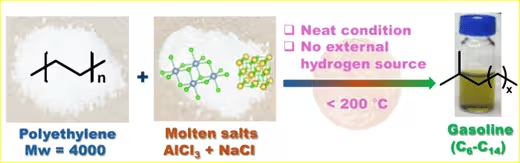
Researchers at the Oak Ridge National Laboratory have unveiled a chemical process capable of converting common polyethylene plastic waste into fuel-grade hydrocarbons. By utilizing molten salt chemistry, the team has successfully bypassed the extreme heat requirements that have historically hindered plastic recycling efforts.
Polyethylene, the ubiquitous material found in everything from food packaging to durable household goods, consists of dense chains of carbon and hydrogen. Breaking these bonds typically necessitates intensive energy input and complex chemical infrastructure. Traditional pyrolysis methods, for instance, often demand temperatures exceeding 450 to 500 degrees Celsius. In contrast, this new technique operates effectively at temperatures below 200 degrees Celsius.
Streamlined Chemical Transformation
The innovation centers on a mixture of aluminum chloride-based molten salts, which serve as both the reaction environment and the catalyst. This approach eliminates the need for expensive noble-metal catalysts, volatile organic solvents, or supplemental hydrogen. According to findings published in the Journal of the American Chemical Society, the process achieves a conversion efficiency of approximately 60 percent for gasoline-like compounds.
Zhenzhen Yang, a staff scientist at ORNL and co-corresponding author of the study, emphasized the streamlined nature of the reaction, noting that it relies on readily available inorganic salts rather than specialized industrial additives. Postdoctoral researcher Liqi Qiu, who led the experimental work, characterized the process as a highly selective method for transforming polymers into fuel.
Analyzing Molecular Chain Reactions
To understand the mechanisms driving this breakdown, the team employed neutron scattering at Oak Ridge’s Spallation Neutron Source. By using deuterium as a tracer, researchers were able to map how hydrogen isotopes rearranged during the conversion. The acidity provided by the aluminum sites within the salt mixture plays a critical role in shearing the long polymer chains into smaller, fuel-compatible molecules.
ORNL Corporate Fellow and co-corresponding author Sheng Dai noted that the team’s ability to observe light elements, such as hydrogen, was pivotal in tracking the transformation. The resulting fuel profiles vary based on the initial structure of the plastic, with simpler chains favoring gasoline production and more complex structures yielding diesel-like compounds.
Pathways Toward Industrial Scalability
While the results are promising, the research team is currently addressing a practical hurdle: the sensitivity of aluminum-based salts to moisture, which can compromise system stability. Future work aims to stabilize the catalyst environment, potentially through the use of carbon-based materials or halogen integration.
Building on decades of expertise in molten salt technology, the researchers believe this approach holds significant commercial potential given the low cost of the materials involved. A patent application for the technology has already been filed, marking a step toward transitioning this lab-scale discovery into a viable industrial solution for the global plastic crisis.
This article has been fact checked for accuracy, with information verified against reputable sources. Learn more about us and our editorial process.
Last reviewed on .
Article history
- Latest version
Reference(s)
- Qiu, Liqi., et al. “Polyethylene Upcycling to Liquid Alkanes in Molten Salts under Neat and External Hydrogen Source-Free Conditions.” Journal of the American Chemical Society, vol. 147, no. 19, April 7, 2025, pp. 16207-16216. American Chemical Society (ACS), doi: 10.1021/jacs.5c01107. <https://pubs.acs.org/doi/10.1021/jacs.5c01107>.
Cite this page:
- Posted by Bilal Abbasi