Astronomers Just Found An Astrochemical Twin To The Milky Way’s Most Mysterious Gas Cloud
A mysterious chemical discovery within a giant cloud near the Milky Way’s core is challenging current theories about how distant regions of space evolve.
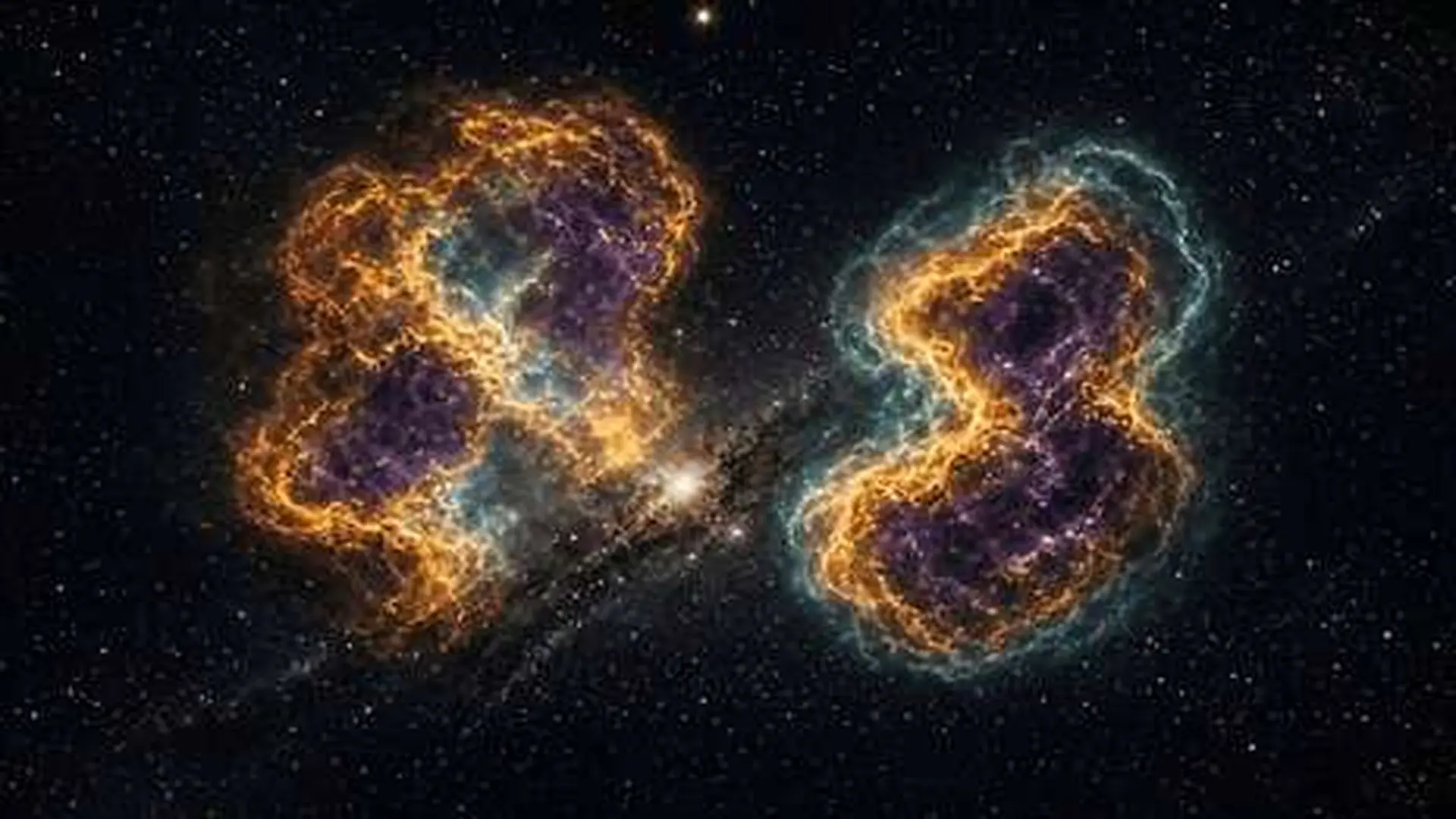
Astronomers have uncovered a massive, chemically diverse gas cloud near the galactic center that challenges our understanding of interstellar chemistry. The discovery of the region, designated G+0.633-0.0604, confirms that the complex organic environments previously observed in the Milky Way are not isolated anomalies, but potentially recurring features of our galaxy.
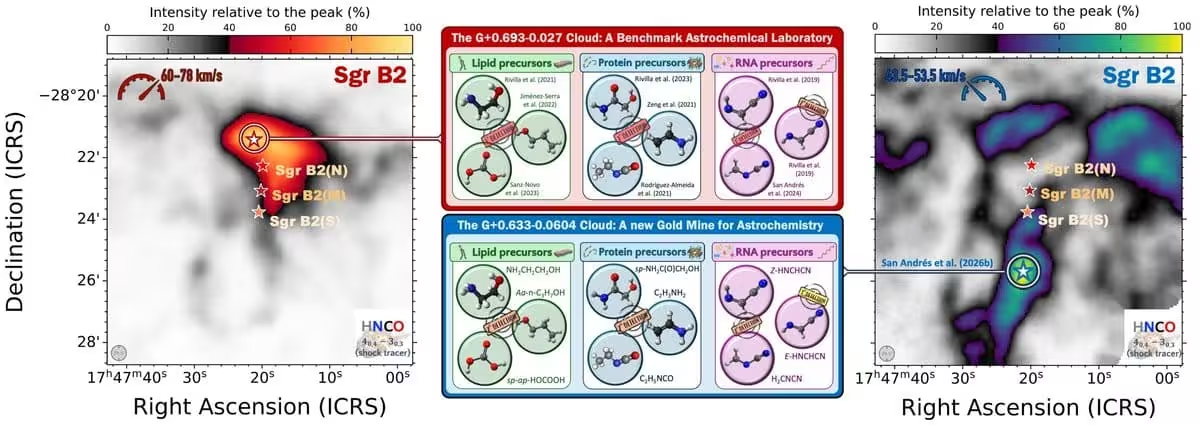
Located within the highly active Sgr B2 complex, G+0.633-0.0604 contains more than 120 distinct molecular species. The findings, detailed in a study published on the arXivpreprint server on August 14, 2026, were led by David San Andrés of the Center for Astrobiology in Spain. The research team noted that the cloud’s chemical composition mirrors that of G+0.693-0.027, a well-studied region famous for holding approximately 40 percent of all molecules currently identified in interstellar space.
A Deep Reservoir of Cosmic Chemistry
While space is known to host nearly 350 different molecules, only a select few regions exhibit the high degree of chemical complexity found in the Sgr B2 complex. G+0.633-0.0604 is particularly noteworthy because it appears to be a hotbed of organic synthesis despite a lack of active star formation.
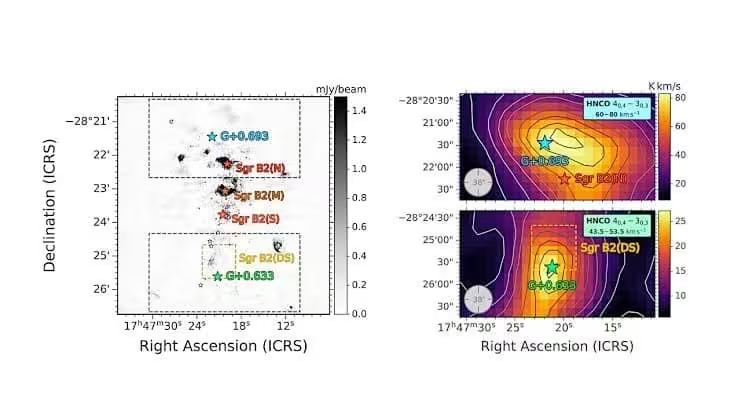
Scientists attribute this chemical richness to the cloud’s unique environment. Thermal conditions within the cloud, combined with energetic shock waves resulting from cloud collisions, are believed to release molecules from the icy mantles of dust grains. This process effectively seeds the surrounding gas with a variety of compounds, making them accessible for observation by ground-based telescopes. Situated roughly 32 light-years from its cousin, G+0.693, the new cloud exhibits the same shock-dominated characteristics and temperature profiles, suggesting a shared evolutionary pathway.
Prebiotic Building Blocks in the Interstellar Medium
The inventory of molecules identified in G+0.633-0.0604 includes the six fundamental elements required for life: carbon, hydrogen, oxygen, nitrogen, phosphorus, and sulfur. Among the specific detections are compounds with significant biological implications, including ethanolamine, a key structural component of cell membranes. This marks only the second known detection of ethanolamine in space.
The team also identified sp-glycolamide, which shares a structural resemblance to glycine, the simplest protein-building amino acid. Furthermore, the presence of cyanomethanimine—a precursor to adenine, one of the fundamental components of DNA and RNA—reinforces the idea that complex organic chemistry can flourish in the harsh conditions of deep space.
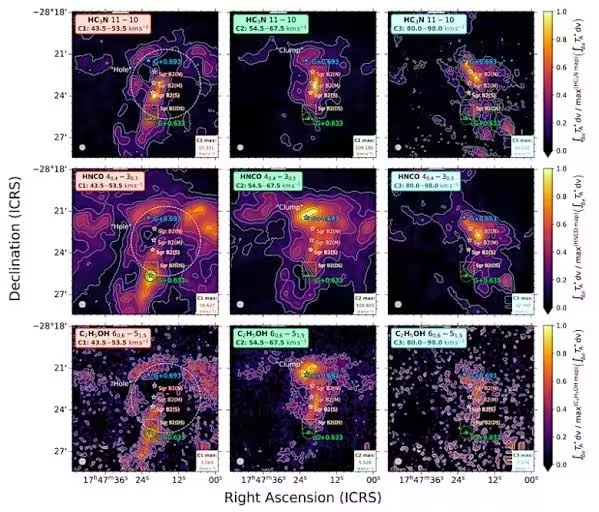
“This survey has revealed over 120 molecular species containing all six essential biogenic elements (C, H, O, N, P and S), including the aromatic cycle benzonitrile, immediately placing G+0.633 among the richest molecular reservoirs in the galaxy,” the researchers wrote.
Confirming the First Astrochemical Twin
The study marks a significant milestone in astrochemistry by establishing G+0.633-0.0604 as the first confirmed “astrochemical twin” of G+0.693-0.027. By demonstrating that the extreme molecular diversity found in the galactic center is reproducible, researchers now have a comparative framework to investigate how such environments influence the broader chemical evolution of the galaxy.
“These detections, together with the remarkable similarity of the overall molecular inventory, establish G+0.633 as the first confirmed astrochemical twin of G+0.693,” the researchers concluded.
While these clouds are not themselves evidence of extraterrestrial life, they provide vital evidence that the chemical prerequisites for biology are manufactured naturally and abundantly in the interstellar medium, long before the formation of planetary systems.
This article has been fact checked for accuracy, with information verified against reputable sources. Learn more about us and our editorial process.
Last reviewed on .
Article history
- Latest version
Reference(s)
- Andrés, D.. “The Galactic Centre G+0.633-0.0604 Molecular Cloud: A New Gold Mine for Astrochemistry.” arXiv.org <https://arxiv.org/abs/2608.14381>.
Cite this page:
- Posted by Bilal Abbasi