Twin Stone Lions Guard a 2,700-Year-Old Phrygian Tomb Shrouded in Mystery
Explore Aslantaş, an 11‑metre volcanic tuff tomb in western Anatolia with twin lion carvings guarding its entrance—a striking rock‑cut funerary site.
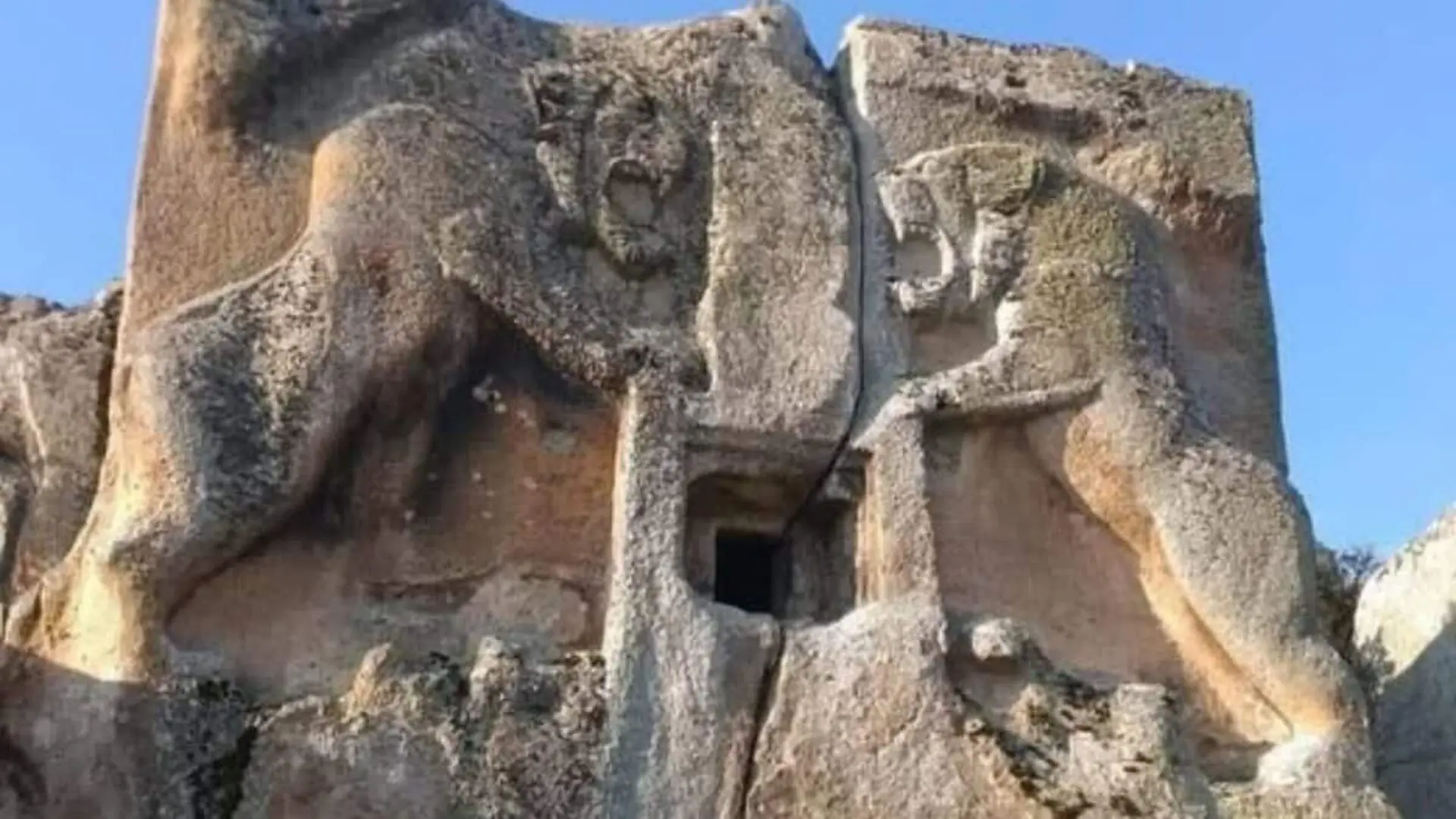
Located in the Göynüş Valley about 30 kilometres north of Afyonkarahisar, the monument rises amid eroded rock outcrops, Byzantine chapels and dozens of ancient graves. While scholars commonly link it to the Phrygians, its exact chronology and cultural affiliation continue to be debated.
Rock‑Cut Tomb Carved from Soft Volcanic Tuff
The Aslantaş structure was hewn directly from a solitary block of volcanic tuff. Its façade and side walls were planed flat, and a modest burial chamber was excavated halfway up the stone. Flanking the entrance, two large lions stand on their hind legs, mouths open toward one another, while each animal once cradled a smaller cub—now barely visible due to weathering.
Above the doorway a raised motif that resembles a tree of life is topped by a pair of winged solar discs. Steps cut into the upper portion of the rock suggest a platform that may have supported ritual activities performed around the tomb.
The valley hosts roughly 40 catalogued graves, representing the largest necropolis of its type known in the area. The soft geology has also produced formations similar to those of Cappadocia, including wind‑sculpted ridges and chimney‑like pillars.
Approximately 70 metres west of Aslantaş lies the stone known as Yılantaş, or “snake stone”. Its name appears to stem from a misinterpretation after the monument’s larger decorated façade collapsed—perhaps in an earthquake—leaving the lion claws to be mistaken for serpent heads by locals.
In 1882, Scottish archaeologist William Mitchell Ramsay, together with J. R. S. Sterrett, recorded the site while mapping ancient Phrygia. Their observations, published in the Journal of Hellenic Studies, include notes on Aslantaş and the nearby sanctuary of Maltaş.
Decades later, Caroline Henriette Emilie Haspels surveyed the valley in the mid‑20th century. Her work, presented in the monograph Highlands of Phrygia, identified additional rock‑cut monuments scattered across the rugged terrain surrounding the Aslankayalar and Akkuş Yuvası massifs.
The Aslantaş Monument: Phrygia’s “Lionstone” tomb
— History Content (@HistContent) June 27, 2026
Carved into an 11-meter monolith in Türkiye’s Phrygian Valley, this rock-cut tomb is flanked by two rearing lions facing each other, with faint, eroded lion cubs between their paws.
Likely built for nobility, the lions stood as… pic.twitter.com/3oQ2f1pJpX
Chronology and Cultural Attribution Still Uncertain
A number of scholars date Aslantaş to the early 8th century BC, a period when Phrygian authority spread across central Anatolia. Architectural elements inside the tomb—such as its narrow entrance, flat ceiling and absence of rock‑cut funerary beds—support an early placement.
Conversely, the elaborate façade, especially the lion motif, has been associated with later artistic currents, and some researchers argue for a 6th century BC date, citing possible Ionian influence on the animal treatment.
Turkish archaeologist Ekrem Akurgal favored the later chronology based on stylistic analysis. The lack of an inscription naming an owner or a construction date leaves the debate unresolved.
The monument’s identification as strictly Phrygian has also been challenged. In a 1995 article in Archivum Anatolicum, Turkish scholar M. Çetin Şahin suggested that Aslantaş may represent a lingering Hittite tradition that persisted after the Hittite Empire’s collapse and before Phrygian culture became dominant.
Şahin highlighted the twin lions, the absence of typical Phrygian geometric patterns, and the missing triangular pediment as evidence for a hybrid origin. The unusually small burial chamber further distinguishes the tomb from later Phrygian funerary examples.
One plausible scenario envisions a local ruler commissioning the monument within a cultural borderland that blended Hittite and Phrygian elements. Its size implies a person of considerable status, yet no material evidence confirms the individual’s identity.
Archaeological work initiated by Turkish authorities in 2021 uncovered a 300 square‑metre area in front of the façade, revealing foundations that may have supported ritual structures linked to the tomb’s ceremonial use.
Today, Aslantaş is integrated into the Phrygian Valley and the Phrygian Way, a cultural route launched in 2013. Over 500 kilometres of marked trails weave through Eskişehir, Kütahya and Afyonkarahisar, guiding visitors across a landscape where the origins of this lion‑guarded tomb remain open to interpretation.
This article has been fact checked for accuracy, with information verified against reputable sources. Learn more about us and our editorial process.
Last reviewed on .
Article history
- Latest version
Reference(s)
- <https://www.jstor.org/journal/jhellenicstudies>.
- Nizette-Godfroid, Jeanine. “C. H. Emilie Haspels, The Highlands of Phrygia. Sites and Monuments.”, vol. 43, no. 1, January 1, 1974, pp. 592-594. <https://www.persee.fr/doc/antiq_0770-2817_1974_num_43_1_1758_t1_0592_0000_2>.
- “https://twitter.com/HistContent/status/2070912540561854832/video/1.” <https://t.co/3oQ2f1pJpX>.
- “Prof. Dr. Mehmet Cetin Sahin.” <https://www.humboldt-foundation.de/vernetzen/recherche-im-humboldt-netzwerk/einzelansicht/1024239/prof-dr-mehmet-cetin-sahin>.
Cite this page:
- Posted by Hassan Raza