Stunning New 4K Footage Reveals The Bizarre Transparent Head Of A Rare Deep Sea Fish
Researchers made an accidental discovery of a bizarre, alien-like deep-sea fish that left the entire crew stunned after appearing on their monitors.
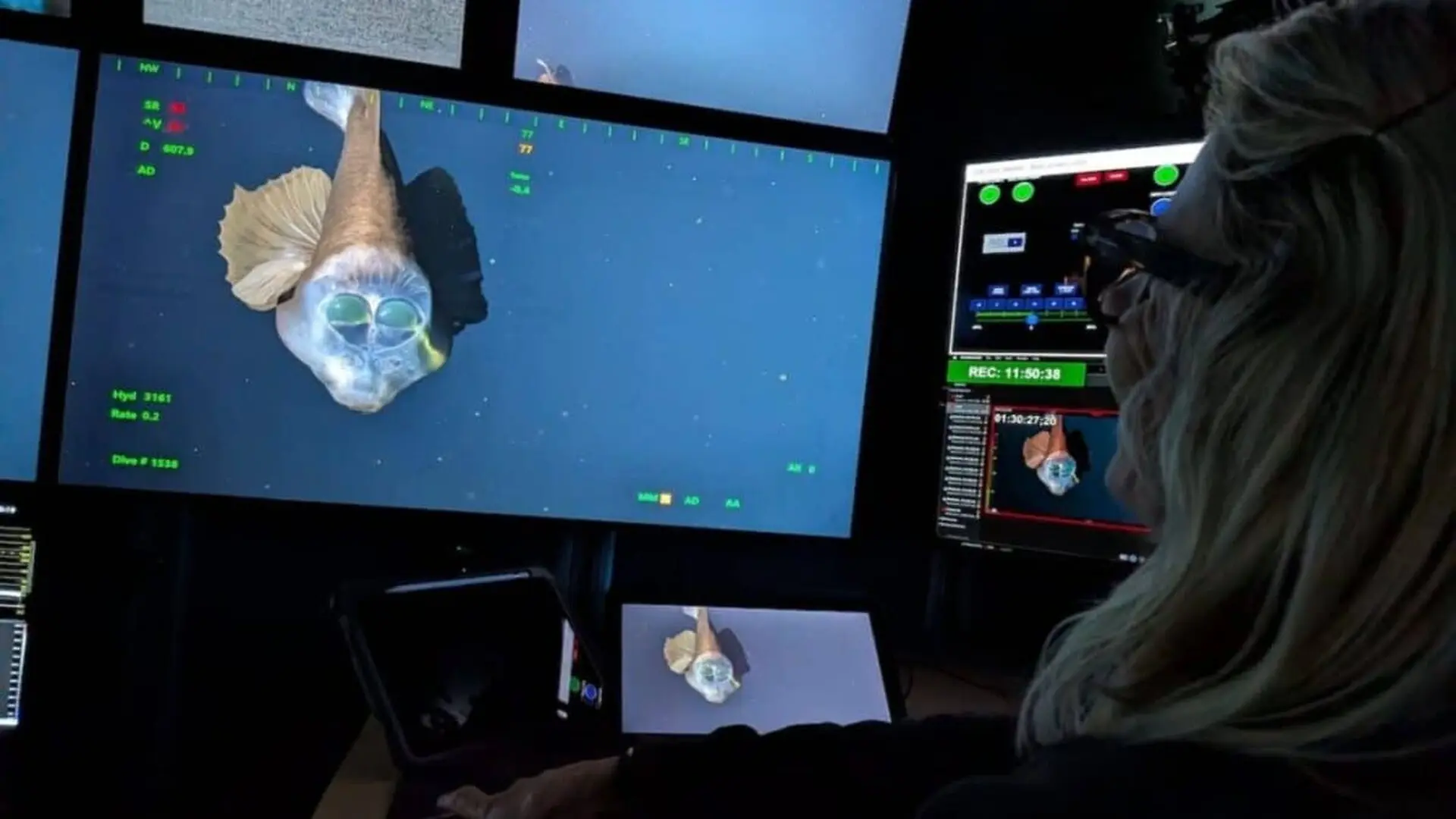
Marine biologists have captured extraordinary 4K footage of the Macropinna microstoma, a deep-sea fish characterized by a transparent, fluid-filled dome encasing its head. Measuring only six inches in length, this elusive species—commonly known as the barreleye—was filmed at a depth of nearly 2,000 feet within the Pacific Ocean’s twilight zone.
The encounter was facilitated by the Monterey Bay Aquarium Research Institute (MBARI) during an expedition approximately 55 miles off the California coast. While the research vessel David Packard was surveying gelatinous organisms, the team’s remotely operated vehicle (ROV), Doc Ricketts, identified the rare specimen. Despite completing roughly 7,000 robotic dives over four decades, MBARI researchers have documented the barreleye only 11 times.
An Evolutionary Marvel of the Abyss
The visual appearance of the barreleye is often described as otherworldly. The dark, forward-facing structures on its head are not eyes but olfactory organs. The true eyes are two large, emerald-green, barrel-shaped structures housed within the transparent, fluid-filled shield. According to MBARI senior scientist Steven Haddock, who led the expedition, the creature resembles a design one might expect from an imaginative child.
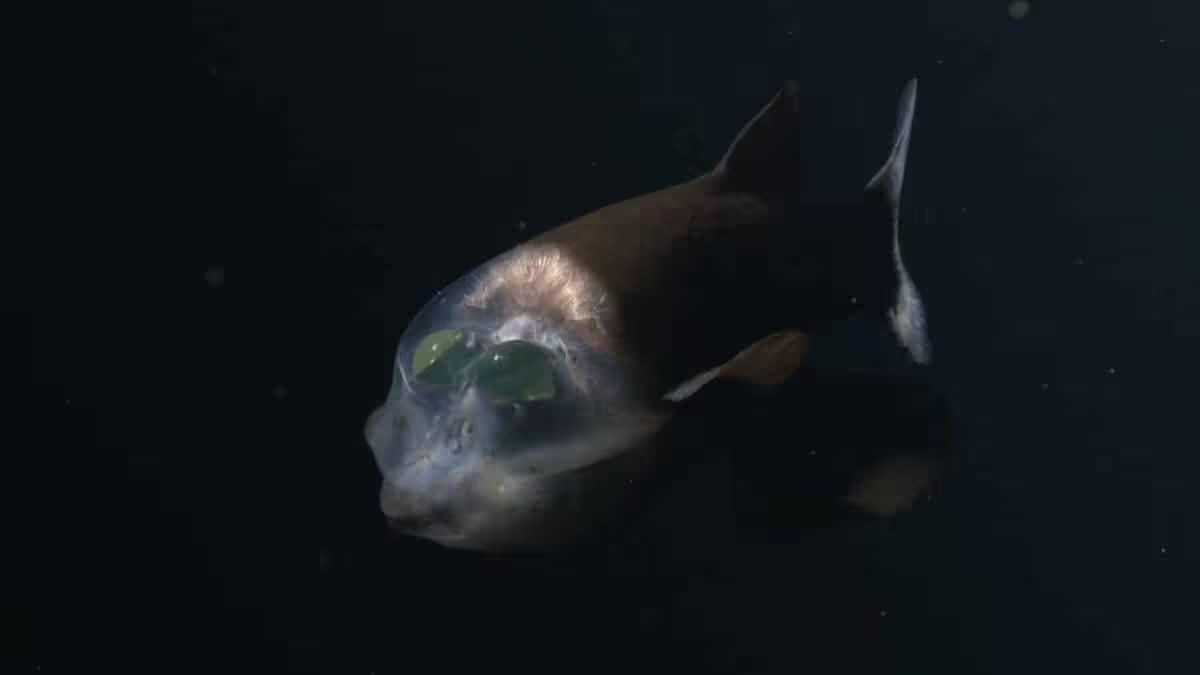
For decades, scientific consensus held that these tubular eyes were fixed in an upward orientation to detect silhouettes of prey above. However, a 2008 study published in the journal Copeia demonstrated that the organs are capable of rotating up to 75 degrees, allowing the fish to shift its gaze forward. Researchers believe the green pigmentation in the eyes serves as a filter to differentiate between down-welling sunlight and the bioluminescence used by other deep-sea inhabitants for camouflage.
Adapting to the Twilight Zone
First formally described in 1939, the barreleye remained poorly understood for years because traditional sampling methods, such as deep-sea trawling, shattered the animal’s delicate transparent dome. Consequently, early preserved specimens appeared vastly different from their living counterparts.
The adoption of advanced underwater robotics has allowed scientists to observe the fish in its native environment without causing physical harm. Current theories suggest the transparent, fluid-filled structure may offer protection for the eyes when the fish engages in kleptoparasitism—stealing prey captured by siphonophore tentacles. During the most recent observation, the MBARI team captured stereoscopic 3D footage, further refining our understanding of this specialized deep-sea predator.
This article has been fact checked for accuracy, with information verified against reputable sources. Learn more about us and our editorial process.
Last reviewed on .
Article history
- Latest version
Reference(s)
- “About David Packard • MBARI.”, May 2, 2022 MBARI <https://www.mbari.org/about/history/about-david-packard/>.
- “Steven Haddock • MBARI.”, May 17, 2022 MBARI <https://www.mbari.org/person/steven-haddock/>.
- Robison, Bruce H.., et al. “Macropinna microstoma and the Paradox of Its Tubular Eyes.” Copeia, vol. 2008, no. 4, December 18, 2008, pp. 780-784. American Society of Ichthyologists and Herpetologists (ASIH), doi: 10.1643/CG-07-082. <https://doi.org/10.1643/CG-07-082>.
Cite this page:
- Posted by Priya Sharma