Scientists May Have Found a 175,000-Year-Old Kneeprint Deep Inside a French Cave, and It Wasn’t Made by an Animal
Researchers are exploring a renowned Neanderthal cave in France, closely examining a single, well-preserved kneeprint found in the cavern’s depths to determine its origin.
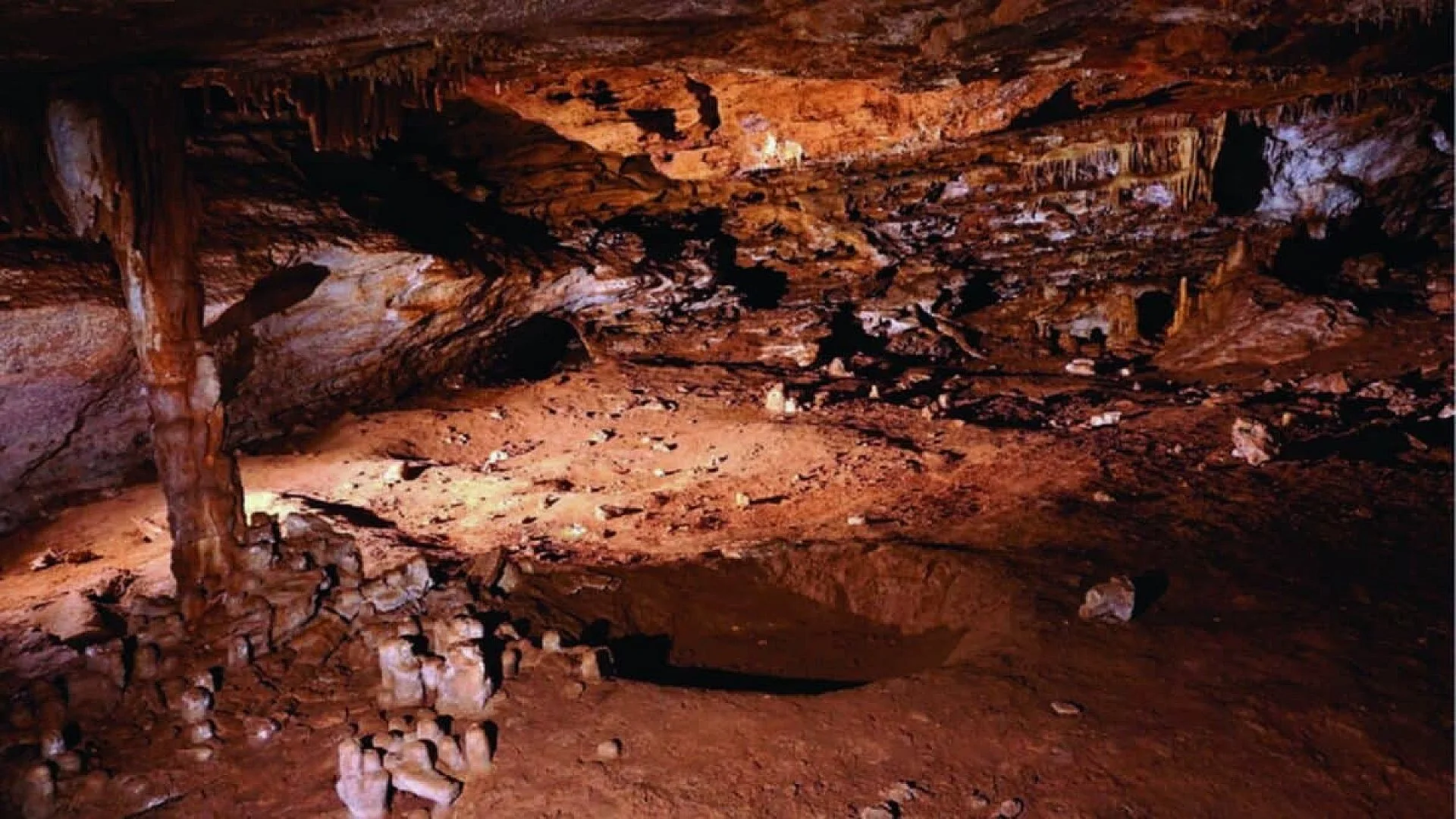
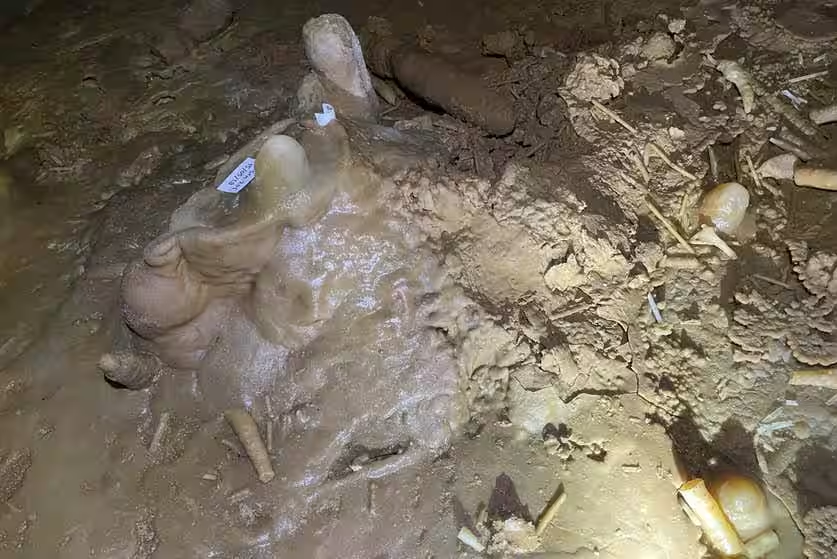
A remarkable discovery deep within the Bruniquel cave in south-west France may hold the key to understanding the lives of Neanderthals. A clay impression found in the cave could be the kneeprint of a Neanderthal who played a crucial role in building the cave’s enigmatic circular structures. The impression, preserved beneath a layer of calcite, has captured the attention of researchers studying one of Europe’s most fascinating prehistoric cave sites.
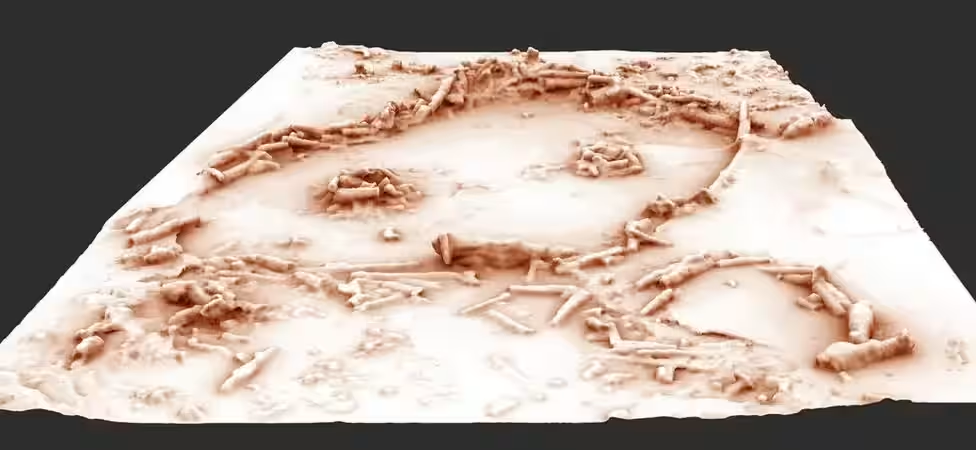
The possible kneeprint was identified near a series of rings made from broken stalagmites, which were first revealed to the scientific community in a 2016 study. The cave, located near Toulouse, contains hundreds of deliberately arranged stalagmite fragments positioned over 300 meters from the entrance, in complete darkness.
According to Sophie Verheyden from the Royal Belgian Institute of Natural Sciences, the impression may represent a rare form of prehistoric evidence. Human footprints from ancient periods are widely studied, but kneeprints have received little scientific attention so far.
Unveiling a Hidden Kneeprint
The kneeprint survived because it became covered by a thin layer of calcium carbonate, the same mineral material responsible for the cave’s stalagmites. This natural coating protected the mark while much of the surrounding evidence disappeared over time.
Sophie Verheyden explained that cave bears later occupied the site and destroyed many traces left on the floor. A specialist in prehistoric bear prints examined the impression and concluded it was not made by an animal. Researchers remain cautious about identifying it definitively as a human kneeprint.
“It’s just a hypothesis,” Verheyden said during a presentation at the European Geosciences Union meeting in Vienna on May 4. She added that: “To be sure of that, we need a lot of imprints of knees to compare it to.”
The possibility of recovering biological evidence has also emerged. Mareike Stahlschmidt of the University of Vienna noted that DNA can diffuse into calcite and remain preserved there under certain conditions. Scientists believe traces from skin cells, hair, or blood may have survived if the impression mineralized rapidly after it was formed.
Unraveling the Mystery of the Circular Formations
The circular formations inside Bruniquel cave continue to puzzle archaeologists nearly three decades after their rediscovery. The structures were assembled using broken stalagmites, some of them more than 20 centimeters thick at the base, as explained in a study published by Nature.
Verheyden explained that such large formations were unlikely to have been broken accidentally by cave bears. Her team recently located several of the original stalagmite bases and dated their breakage to the same period as the circles themselves.
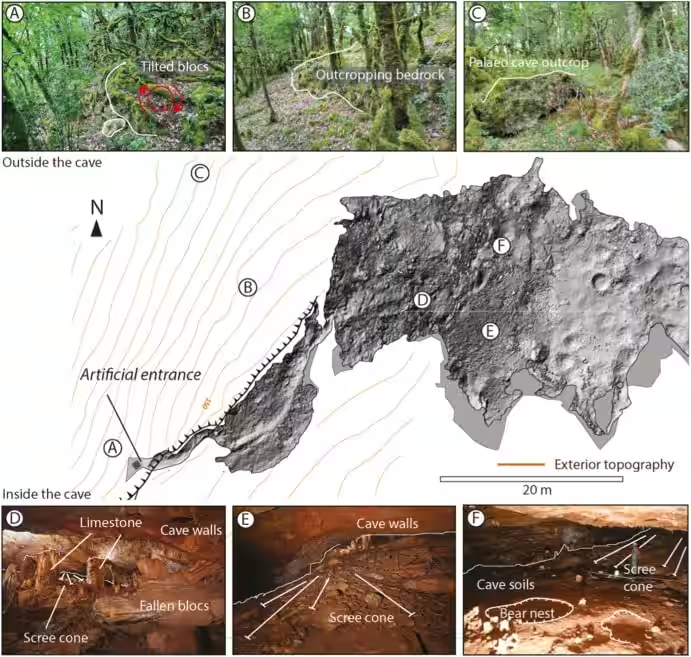
As mentioned in the latest research, published in Quaternary Science Reviews, the study team used radioactive isotope analysis on calcite deposits to establish the timeline. The dates point to activity around 175,000 years ago. Scientists attribute the structures to Neanderthals because Homo sapiens were not present in Europe at that time.
“We don’t know of any other humans present at that period,” Verheyden said.
The Enigma of the Underground Circles
One of the biggest questions concerns why Neanderthals ventured so far underground to construct the circles. The formations stand in sections of the cave completely deprived of natural light.
“You need to be sure of your light when you go 300 meters underground,” Verheyden noted. The study’s authors also argued that “their presence at 336m from the entrance of the cave indicates that humans from this period had already mastered the underground environment, which can be considered a major step in human modernity.”
Traces of fire found near the structures suggest the area was illuminated during use. Researchers say the circles may not have served as ordinary shelters because of their isolated location deep inside the cave system. The unusual setting has encouraged speculation about cultural or symbolic activities, although the team avoids making firm claims without stronger evidence.
Scientists are now developing methods to identify exactly where each stalagmite originated within the cave.Verheyden said that work may reveal whether the builders selected materials from particular areas rather than simply using the closest available formations.
This article has been fact checked for accuracy, with information verified against reputable sources. Learn more about us and our editorial process.
Last reviewed on .
Article history
- Latest version
Reference(s)
- “Sophie Verheyden | Institute of Natural Sciences.” <https://www.naturalsciences.be/sophie.verheyden>.
- Verheyden, Sophie. “ Speleothems used by Neanderthals, in the Bruniquel Cave, Southern France..”, March 13, 2026, doi: https://doi.org/10.5194/egusphere-egu26-12788. <https://meetingorganizer.copernicus.org/EGU26/EGU26-12788.html>.
- “Mareike Stahlschmidt – Personal Website.” <https://homepage.univie.ac.at/mareike.stahlschmidt/>.
- “Early Neanderthal constructions deep in Bruniquel Cave in southwestern France - PubMed.”, vol. 534, no. 7605, January 1, 2016 PubMed, doi: 10.1038/nature18291. <https://pubmed.ncbi.nlm.nih.gov/27251286/>.
- Génuite, K.., et al. “The evolution of the cave's entrance of Bruniquel and consequences for its accessibility by early Homo neanderthalensis.” Quaternary Science Reviews, vol. 377, April 1, 2026, pp. 109866 Elsevier BV, doi: 10.1016/j.quascirev.2026.109866. <https://www.sciencedirect.com/science/article/pii/S0277379126000752?via%3Dihub>.
Cite this page:
- Posted by Hassan Raza