Video Game Simulation Data Reveals How Virtual Player Attributes Drive Soccer Ratings
A new study analyzes 2,282 digital profiles to test machine learning models on video game rating thresholds

When young male soccer players are analyzed through the lens of a popular sports video game, physical and technical traits shape internal ratings in unexpected ways. A new study examining 2,282 digital profiles aged 15 to 18 years old shows that computer-generated video game metrics can successfully predict whether a virtual player reaches an overall score of 10 or higher in Football Manager 2023, though those patterns remain strictly confined to the digital simulation. The work was published in PLOS One on November 17, 2026, offering researchers a reproducible workflow to audit how artificial skill ratings interact within complex gaming algorithms.
How Virtual Attributes Drive Video Game Ratings
The research team set out to understand how baseline characteristics inside the simulation map onto future success within the game environment. The analysis dataset comprised anonymized profiles containing 14 technical attributes, 8 physical attributes, and 14 mental attributes. Out of the 2,282 total profiles evaluated, 313 players or 13.7 percent reached the target overall score threshold of 10, while the remaining 1,969 players fell below it.
Because weight and body mass index values contained 1,376 zero entries in the public files, anthropometric modeling was restricted to 906 profiles with valid measurements. For those players, the mean weight stood at 71.11 kilograms with a standard deviation of 7.15, while the mean body mass index reached 21.98. The authors deliberately kept these measurements out of the predictive algorithms to avoid skewing the results with missing data.
Comparing Four Untuned Machine Learning Models
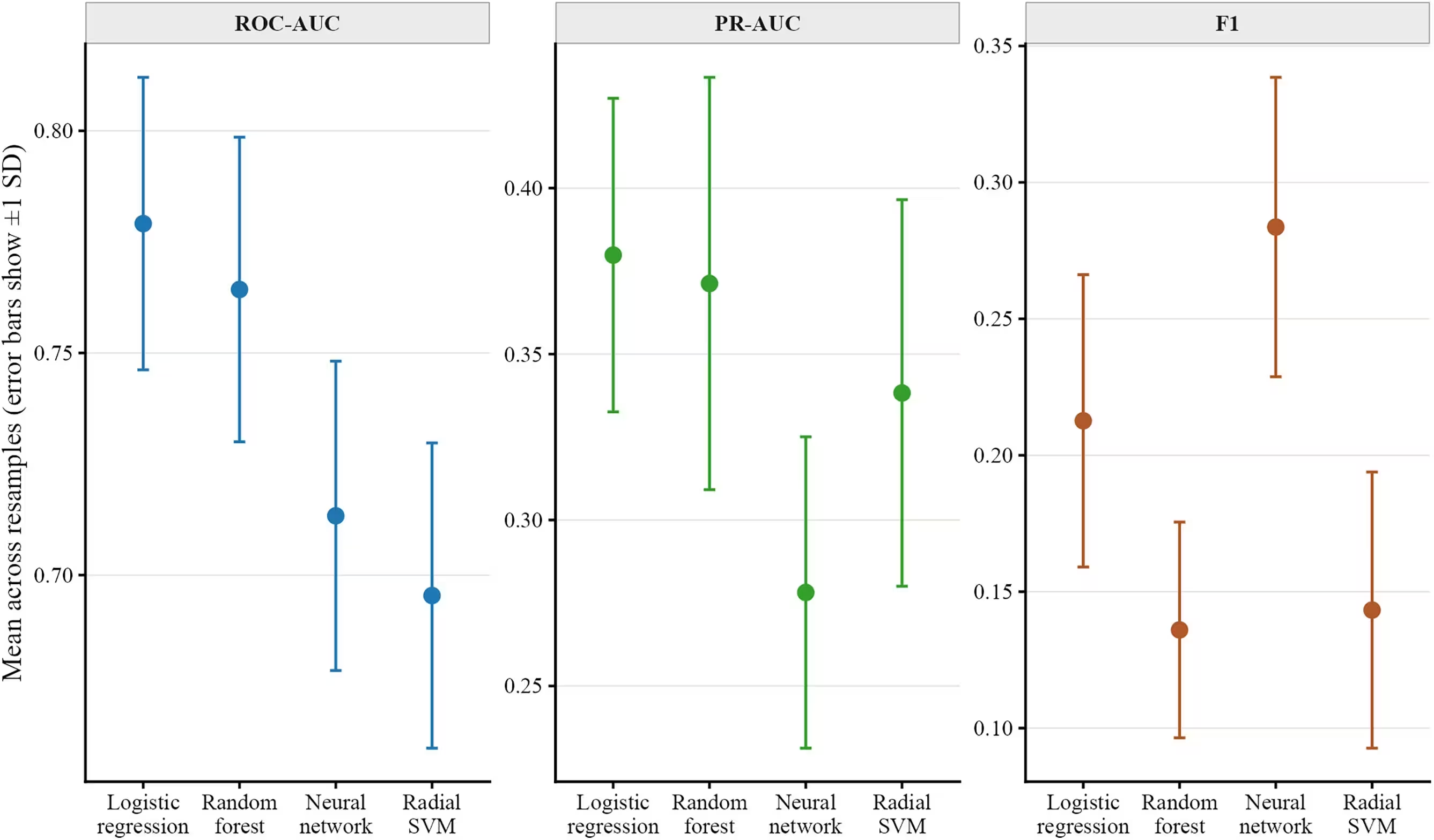
To test how different mathematical approaches handle the data, the investigators evaluated four benchmark models using repeated cross-validation across 15 resamples. Logistic regression achieved the highest mean area under the receiver operating characteristic curve at 0.779, followed closely by a random forest model at 0.764. A single-hidden-layer neural network and a radial support vector machine yielded lower discrimination scores.
However, examining traditional metrics at a standard probability threshold of 0.50 revealed significant limitations in sensitivity. Logistic regression yielded a sensitivity of just 0.132 alongside a specificity of 0.983, meaning the algorithm successfully avoided false positives but missed the vast majority of successful player outcomes. Lowering the decision threshold to 0.25 increased sensitivity to 0.505, but this adjustment simultaneously introduced a higher rate of false classifications.
Do Technical Skills Outweigh Physical Prowess
A common assumption in talent scouting is that technical mastery dominates physical traits, but the simulation data challenged that notion. The ten highest-ranked features contributing to the logistic regression model included five technical attributes, three physical attributes, and two mental attributes. Finishing, passing, jumping, teamwork, and heading topped the list of influential variables.
When measuring mean absolute contributions across all features, technical attributes averaged 0.1251 while physical attributes averaged 0.1293. A sign-flip permutation test yielded a two-sided p-value of 0.0002, indicating that physical attributes carried slightly higher average numerical weight in the linear predictor, though the authors caution against overstating this minor numerical difference as a practical advantage.
Position Specific Stability and Key Limitations
Splitting the cohort by tactical positions revealed distinct feature rankings for defenders, midfielders, and forwards, while goalkeepers were excluded because none reached the target threshold. Bootstrap stability analysis across 1,000 resamples showed that only a handful of traits maintained consistent presence in the top five. For defenders, corners and teamwork appeared most frequently, whereas midfielders relied heavily on vision and passing, and forwards leaned on jumping and corners.
The authors emphasize several critical boundaries for interpreting these findings. The dataset originates entirely from a proprietary video game simulation rather than real-world athletic academies. Consequently, the models describe internal game mechanics and cannot be used to validate real-world talent identification, scouting, or professional player recruitment.
The research was published in PLOS One on November 17, 2026.
This article has been fact checked for accuracy, with information verified against reputable sources. Learn more about us and our editorial process.
Last reviewed on .
Article history
- Latest version
Reference(s)
- Zhang, Zijian., et al. “Explainable machine learning audit of attribute rating relationships in Football Manager 2023.” PLOS One, vol. 21, no. 11, November 17, 2026, pp. e0363141 Public Library of Science (PLoS), doi: 10.1371/journal.pone.0363141. <https://doi.org/10.1371/journal.pone.0363141>.
Cite this page:
- Posted by Hassan Raza