Simple Blood Test Combined With Genetics Accurately Detects Alzheimer’s Disease
Researchers found that measuring 151 specific blood metabolites alongside genetic risk factors achieves high accuracy in identifying Alzheimer’s disease.

Blood-based tests could soon make detecting Alzheimer’s disease as simple as a routine checkup, according to a recent study evaluating 594 participants from the Alzheimer’s Disease Neuroimaging Initiative (ADNI) cohort. The research demonstrates that combining high-resolution blood metabolite profiling with standard genetic risk screening can reliably separate individuals with Alzheimer’s disease from those with typical cognitive function.
How Blood Metabolites and Genetics Reveal Brain Health
Metabolites are the tiny chemical byproducts of everyday cellular activity in the body, reflecting everything from how we digest food to how our cells handle stress. To capture these systemic changes, the research team analyzed serum samples using mass spectrometry to measure up to 630 distinct biochemical compounds. They integrated these metabolic measurements with the apolipoprotein E (APOE) ε4 gene, which is the most potent known genetic risk factor for sporadic Alzheimer’s disease.
By applying a machine learning technique called LASSO regression, the authors narrowed down a massive pool of biochemicals to an optimized panel of 151 key metabolites. The findings were published in PLOS One, detailing how this systems-level approach achieves robust diagnostic accuracy.
What the Optimized 151-Metabolite Panel Achieved
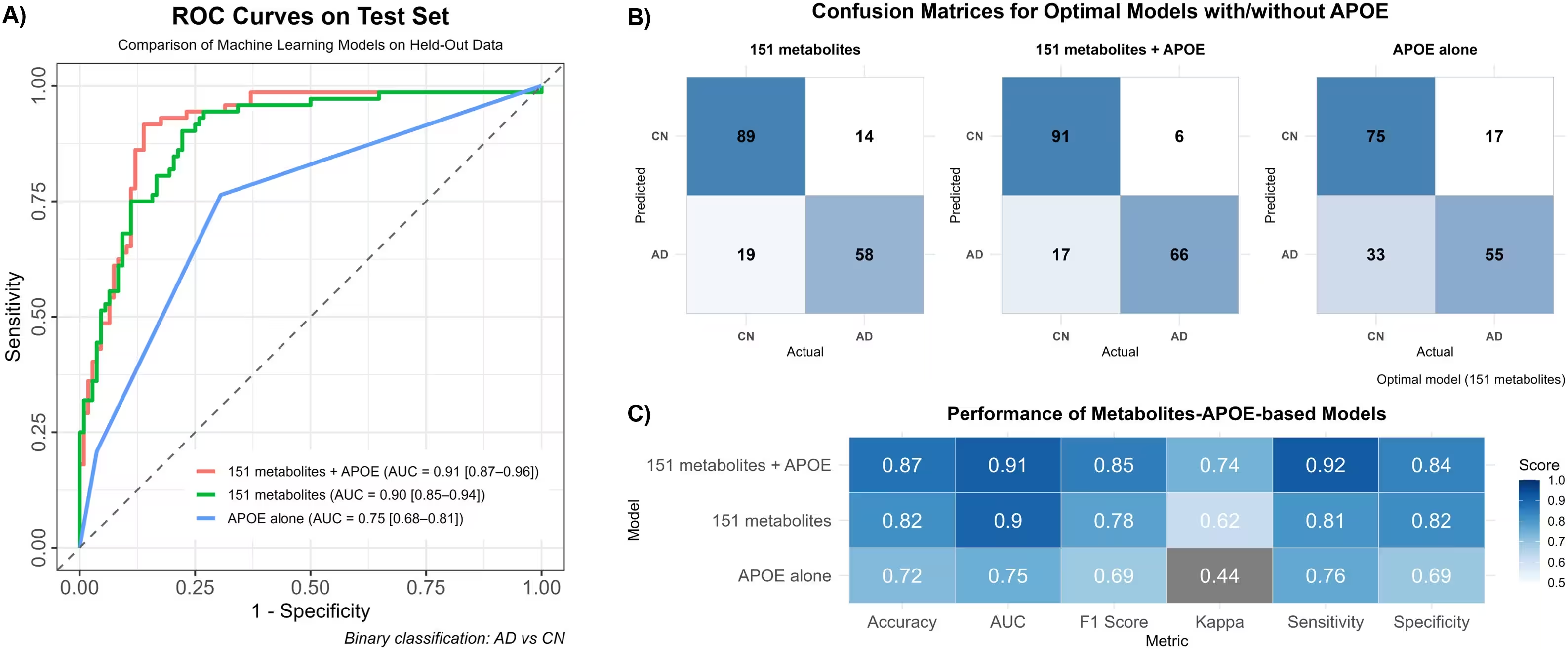
When evaluated on an independent held-out test set of participants, the combined model featuring both the 151 metabolites and the APOE genotype reached an area under the curve (AUC) of 0.91. This statistical measure indicates a high level of accuracy in distinguishing patients with Alzheimer’s disease from cognitively normal controls. The combined model significantly outperformed predictions based on genetics alone, which yielded an AUC of 0.75.
Furthermore, the model demonstrated a high negative predictive value of 0.94. In a primary care setting, this metric suggests the test could be exceptionally effective at ruling out Alzheimer’s disease in older adults experiencing mild memory complaints, helping patients avoid costly and invasive procedures like lumbar punctures or specialized brain scans.
Which Biological Pathways Drive the Test Results?
The top-ranked predictor in the panel was chenodeoxycholic acid, a primary bile acid involved in the gut-liver-brain axis. Other leading contributors included 4-hydroxyproline, an amino acid linked to collagen breakdown and blood vessel health, and numerous lipid species such as ether-linked phosphatidylcholines and ceramides.
The prominence of these compounds suggests that Alzheimer’s disease involves widespread systemic disruptions rather than isolated brain pathology. Lipid alterations point toward failing neuronal membrane integrity, while shifts in acylcarnitines highlight underlying mitochondrial exhaustion and altered energy production in tissues.
Limitations and Future Clinical Directions
Despite the high performance of the classifier, the authors noted several important limitations. The ADNI cohort analyzed in this study is predominantly white and North American, meaning the findings require validation in broader, more diverse global populations where diet, lifestyle, and genetic backgrounds differ.
Additionally, because the study relied on baseline cross-sectional data, the metabolic signature currently captures established disease rather than predicting who will develop symptoms in the future. Longitudinal studies tracking cognitively normal individuals over several years will be essential to determine whether these blood markers can forecast cognitive decline before it occurs.
The research was published in PLOS One on November 17, 2026.
This article has been fact checked for accuracy, with information verified against reputable sources. Learn more about us and our editorial process.
Last reviewed on .
Article history
- Latest version
Reference(s)
- Mukesha, Dany., et al. “Integrating large-scale serum baseline metabolomics and APOE ε4 genotype status for the non-invasive detection of Alzheimer’s disease in the Alzheimer’s Disease Neuroimaging Initiative (ADNI) cohort.” PLOS One, vol. 21, no. 11, November 17, 2026, pp. e0356137 Public Library of Science (PLoS), doi: 10.1371/journal.pone.0356137. <https://doi.org/10.1371/journal.pone.0356137>.
Cite this page:
- Posted by David Anderson