Researchers Test Four Gum Disease Treatments And Find Mechanical Cleaning Wins Over Lasers
A controlled clinical trial reveals that while laser therapy alters immune markers, mechanical cleaning is essential for lasting tissue recovery in severe periodontitis.
Researchers at Paulista University and Unicamp tested four different treatments on 20 patients with severe gum disease and found that deep mechanical cleaning outperforms laser-only therapy over a 12-month period.
Periodontitis is a serious inflammatory condition that destroys the tissues and bone supporting the teeth. Even after standard professional treatment, persistent problem areas known as residual periodontal pockets often remain, creating deep spaces where harmful bacteria thrive and drive further tooth decay. Treating these stubborn pockets is difficult, and dental specialists have debated whether adding modern light-based therapies or performing gum surgery yields better results than standard mechanical cleaning alone.
To test these approaches, the research team conducted a clinical trial involving 80 specific tooth sites across 20 participants diagnosed with severe generalized Stage IV, Grade C periodontitis. Each patient received all four test methods in different quadrants of their mouth in a randomized split-mouth design. The evaluated therapies included photodynamic therapy using a diode laser and a photosensitizing dye, subgingival instrumentation where dental instruments physically clean beneath the gumline, a combination of both mechanical cleaning and laser therapy, and open-flap debridement which involves surgically lifting the gum tissue to clean deep roots. The study is published in Brazilian Oral Research.
Which Treatments Successfully Reduced Pocket Depths Over Time?
All four tested modalities achieved significant reductions in probing pocket depth by the 3-, 6-, and 12-month evaluations. However, measuring pocket depth alone does not tell the whole story about gum tissue recovery. The team tracked relative clinical attachment level to determine whether the gums genuinely reattached to the tooth roots.
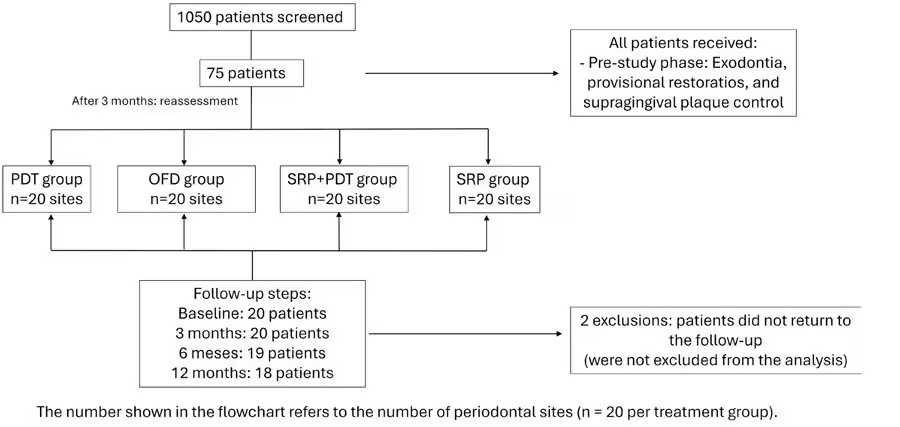
Only the procedures involving mechanical subgingival instrumentation, whether performed alone or paired with the laser, produced significant and sustained attachment improvements over the full 12-month timeline. Laser therapy applied by itself triggered temporary attachment gains at the 3-month mark, but those benefits faded away by 6 months. Meanwhile, the surgical gum procedure failed to produce significant attachment gains overall.
How Did Laser Therapy Alter Local Immune Responses?
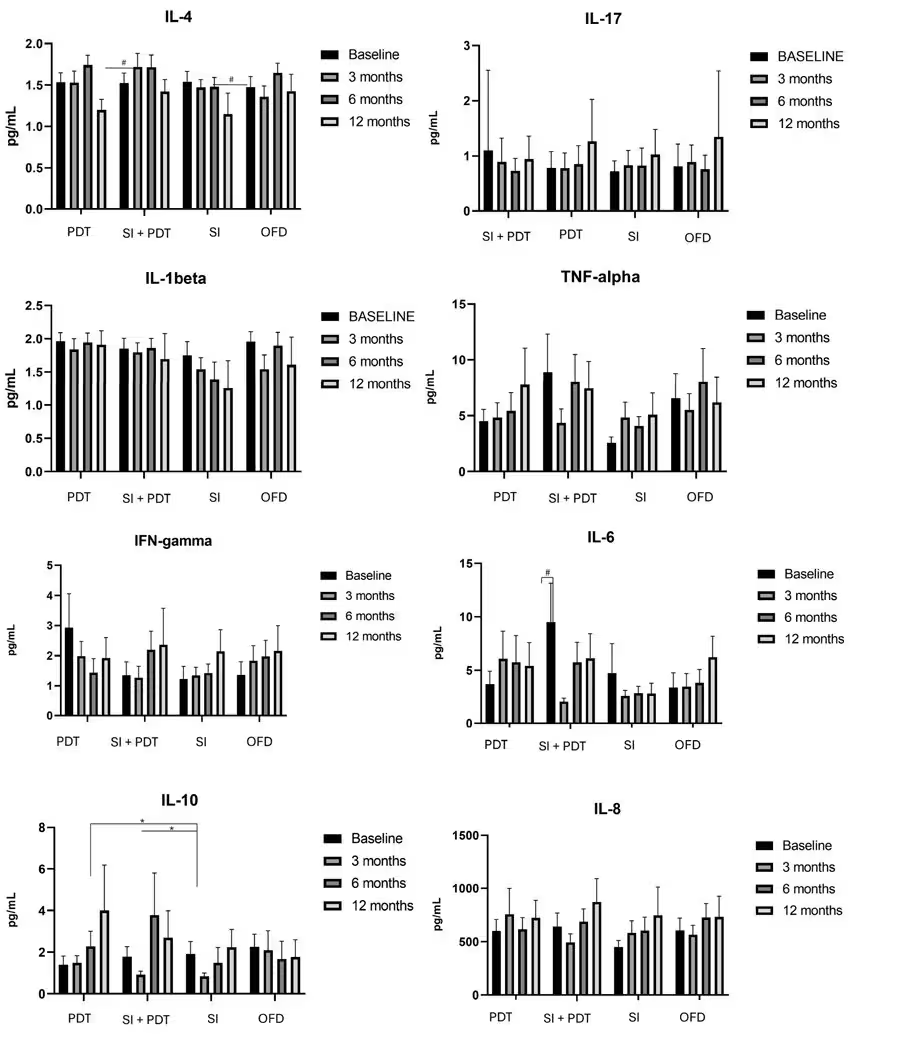
Although stand-alone laser treatment failed to secure long-term clinical attachment gains, laboratory analyses of gingival crevicular fluid, the fluid flowing within gum pockets, revealed clear biological activity. At 6 months post-treatment, patients showed significantly higher levels of interleukin-10, an anti-inflammatory cytokine that helps suppress destructive immune reactions, in the laser and combined-treatment groups compared to mechanical cleaning alone.
Furthermore, patients who received the combined treatment of mechanical cleaning and laser therapy experienced a notable drop in interleukin-6, a pro-inflammatory protein linked to bone destruction and tissue damage. The authors noted that while these biological changes point to a clear immunomodulatory effect, this local reduction in inflammation did not translate into superior clinical attachment recovery when the laser was used without mechanical scraping.
Did Bacterial Counts Drop Across All Test Sites?
The investigators also tracked bacterial populations by analyzing subgingival plaque samples for specific pathogens using real-time polymerase chain reaction testing. Across the board, microbial levels showed no major differences among the four treatment groups during the follow-up timeline. Levels of Aggregatibacter actinomycetemcomitans dropped significantly by 12 months in most groups, while Tannerella forsythia decreased across all therapies.
The persistence of certain bacteria highlights the challenge of eliminating pathogens that may hide in extra-pocket reservoirs like the tongue, mucosa, or saliva. The researchers emphasized that physical plaque removal remains the cornerstone of periodontal management because no chemical or light-based adjunct has yet proven capable of replacing mechanical biofilm disruption.
What Are The Limitations of This Dental Trial?
The trial focused exclusively on non-molar posterior teeth to maintain strict anatomical control and measurement consistency. Consequently, the findings might not apply directly to multi-rooted molars, which feature complex furcation anatomy that complicates deep cleaning procedures. Furthermore, the protocol evaluated only a single session of laser therapy, leaving open the question of whether repeated laser applications during ongoing maintenance visits could yield better clinical outcomes.
The research was published in Brazilian oral research on November 20, 2026.
This article has been fact checked for accuracy, with information verified against reputable sources. Learn more about us and our editorial process.
Last reviewed on .
Article history
- Latest version
Reference(s)
- LUCHESI, Vanessa Haguihara., et al. “Different clinical approaches for residual periodontal pockets in stage IV periodontitis: a randomized clinical trial.” Brazilian Oral Research, vol. 40, January 1, 2026 FapUNIFESP (SciELO), doi: 10.1590/1807-3107bor-2026.vol40.105. <https://doi.org/10.1590/1807-3107bor-2026.vol40.105>.
Cite this page:
- Posted by Hassan Raza