Water Lily Genomes Reveal How Nearly 20 Assembled Species Unlocked Ancient Flowering Plant Secrets
High-resolution genetic mapping uncovers how ancient aquatic plants evolved rare blue pigments, giant leaves, and complex beetle-trapping pollination syndromes.
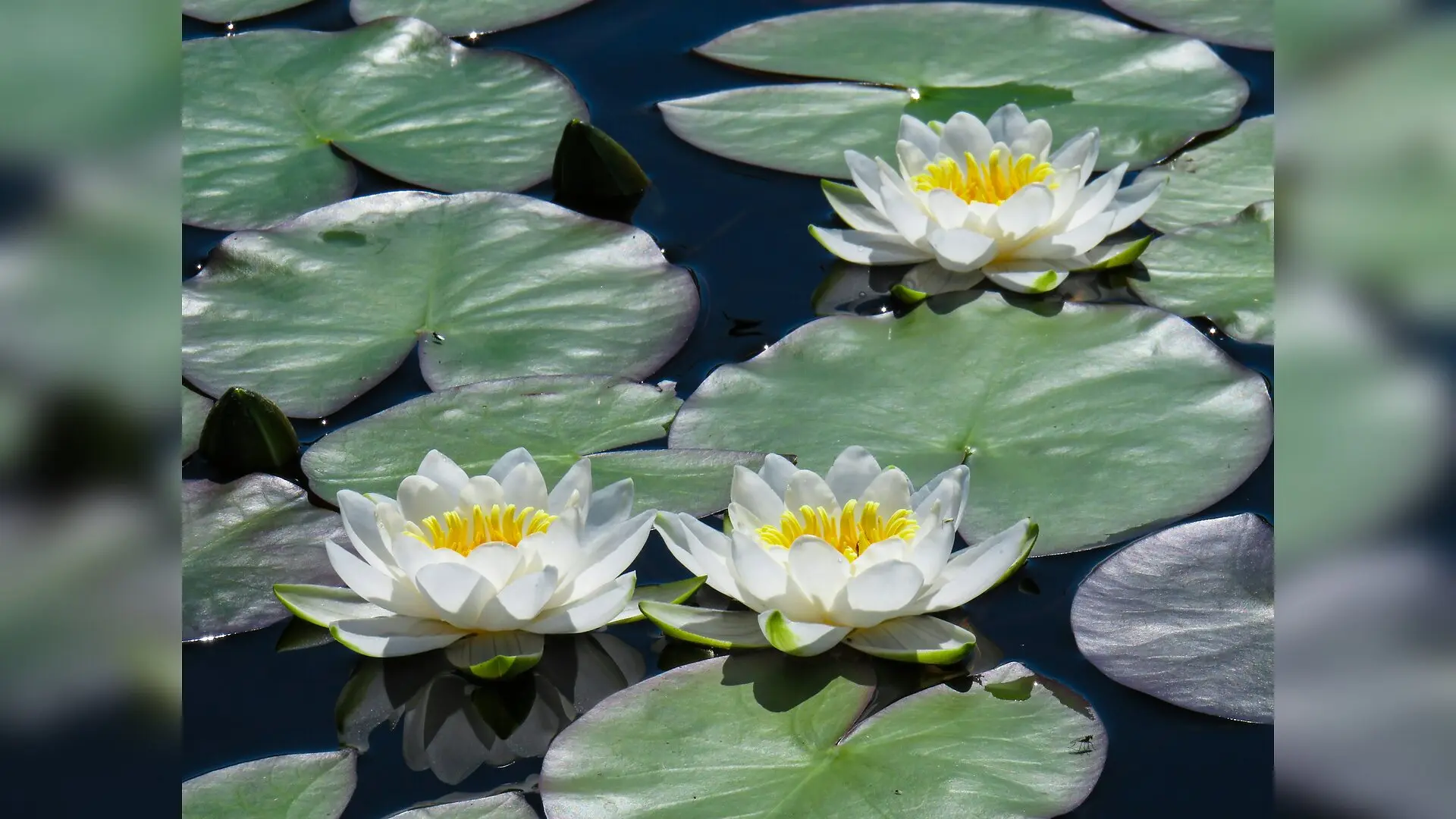
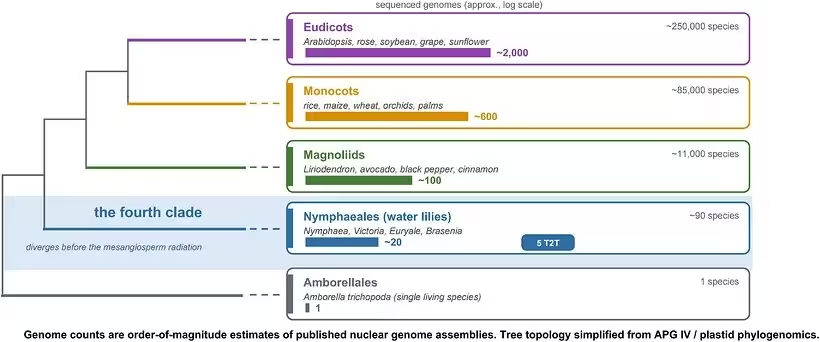
Over the past 6 years, genomic sequencing has transformed water lilies from evolutionary enigmas into the fourth major reference lineage for flowering plants, with nearly 20 genome assemblies now mapped across the order Nymphaeales. Researchers from Zhejiang Academy of Agricultural Sciences and collaborating institutions have cataloged these major advances, highlighting how 5 telomere-to-telomere assemblies and single-cell atlases are reshaping our understanding of early angiosperm evolution.
Flowering plants, known scientifically as angiosperms, trace their earliest diverging lineages to a grouping called the ANA grade, which includes water lilies, Amborella, and Austrobaileyales. Because water lilies retain many ancient traits while displaying showy flowers, they have long sat at the center of debates surrounding what Charles Darwin called an abominable mystery. For years, scientists relied on scattered genetic data and fragmented sequencing to study these aquatic plants. Now, high-throughput technologies and long-read sequencing have made repeat-rich aquatic genomes fully tractable, revealing surprising genetic mechanisms that allowed water lilies to conquer aquatic environments and evolve complex floral traits.
How Did Near-Perfect Genome Assemblies Reveal Hidden Chromosome Secrets?
Recent sequencing milestones have yielded gap-free genomes for several water lily species, allowing scientists to peer directly into centromeres, telomeres, and ribosomal DNA arrays that previous methods missed. As published in Advanced Science, the 1-gigabase telomere-to-telomere genome of the watershield plant Brasenia schreberi uncovered a non-standard telomere repeat unit that overturns the long-held assumption that all flowering plants share a universal chromosome-end sequence. This unexpected finding highlights a surprising diversity in chromosome biology among early-diverging plant lineages.
Complementary single-cell and spatial transcriptome atlases have further illuminated how water lily buds develop. By mapping gene activity across microscopic cell populations, researchers demonstrated that petals originated through the evolutionary modification of stamen identity. Rather than turning entirely new genes on or off, floral evolution in these plants was driven by quantitative shifts in protein complexes that gradually redirected organ fate during budding.
What Built the Unique Scent and Color Palettes of Water Lilies?
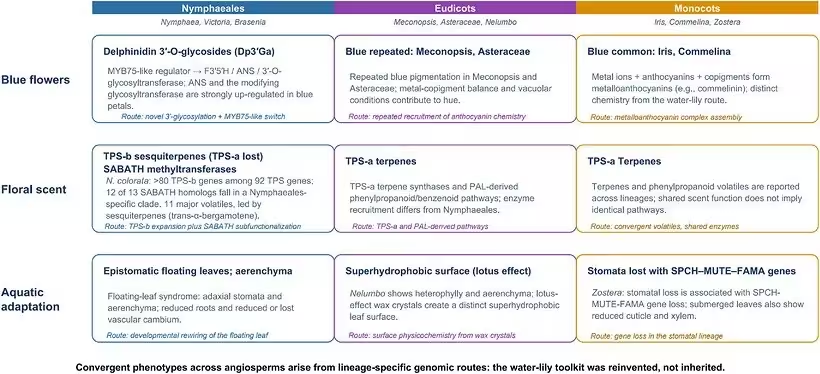
Water lilies produce striking blue flowers and intense fragrances that evolved completely independently from similar traits found in core eudicots and monocots. Phytochemical analyses and genomic mapping identified specific biosynthetic modules, including a delphinidin-modifying pathway responsible for rare blue hues in tropical species like Nymphaea colorata. For scent, an expanded family of methyltransferase enzymes drives the production of volatile compounds that attract pollinators.
In the giant Amazon water lily Victoria cruziana, whose leaves can span over 2 meters in diameter, these genetic traits converge into a specialized two-day pollination program. Flowers open white on the first day, emitting a fruity scent and raising their internal temperature by up to 10 degrees Celsius to trap pollinating scarab beetles inside a floral chamber. The trapped beetles are dusted with pollen before escaping the next day when the flower reopens in a pink male phase.
Does Ancient Seed Evolution Explain Modern Plant Reproduction?
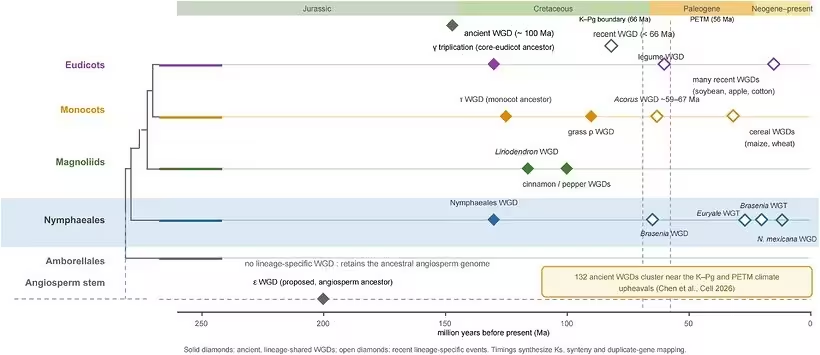
The water lily seed offers a living window into the origins of the plant endosperm, the nutritive tissue that nourishes developing embryos. Unlike most modern flowering plants that form a triploid endosperm, water lilies produce a diploid endosperm alongside a maternal storage tissue called the perisperm. Breeding experiments and genetic profiling showed that paternal gene copies drive extra tissue proliferation, proving that parental conflict over nutrient allocation dates back to the very dawn of flowering plant history.
This ancient system shares deep epigenetic and imprinting mechanisms with major crop plants, suggesting that core regulatory rules of seed development were established before triploid endosperm ever evolved. The findings bridge a major evolutionary gap between gymnosperms and modern flowering plants.
How Do Water Lilies Adapt to Life Underwater?
Returning to an aquatic lifestyle required drastic anatomical restructuring, which scientists found encoded directly in the genome through widespread gene losses and expansions. Species like Nuphar pumila manage dissolved carbon limitations underwater by deploying mixed photosynthetic pathways in specialized epidermal cells rather than traditional land-plant anatomy. Across the entire order, genomic comparisons revealed a consistent evolutionary pattern marked by the contraction of disease-resistance receptor repertoires and the expansion of metabolic pathways tailored for aquatic survival.
These wealths of genetic resources now provide practical targets for agricultural and ornamental breeding. Researchers have already established transformation systems in tropical water lilies to engineer cold tolerance and manipulate flower coloration. As international databases expand, water lily genomes will continue to serve as vital blueprints for understanding plant resilience and evolutionary adaptation.
The research was published in Advanced science (Weinheim, Baden-Wurttemberg, Germany) on November 25, 2026.
This article has been fact checked for accuracy, with information verified against reputable sources. Learn more about us and our editorial process.
Last reviewed on .
Article history
- Latest version
Reference(s)
- Chang, Xiaojun., et al. “Genomics of Water Lilies: Floral Evolution, Polyploidy, Aquatic Adaptation.” Advanced Science, November 25, 2026 Wiley, doi: 10.1002/advs.78868. <https://doi.org/10.1002/advs.78868>.
Cite this page:
- Posted by Hassan Raza