Reference Control Choice Dramatically Alters Emodin Anticancer Gene Signatures
Earth Science

Reference Control Choice Dramatically Alters Emodin Anticancer Gene Signatures

An audit of public breast cancer datasets reveals how experimental comparators and data normalization reshape inferred drug responses.

By Vikram Desai
Published:
Email this Article
Reference Control Choice Dramatically Alters Emodin Anticancer Gene Signatures
Photo by Esma Melike Sezer on Unsplash

When researchers reanalyze public biological datasets to test the anticancer properties of natural compounds, choosing the wrong experimental control can completely distort the results. A comprehensive data audit demonstrates that measuring a compound’s effect against other active substances instead of a matched baseline control alters both the size and the membership of the resulting gene lists.

The investigation, published in PLOS One by Liang Cai and colleagues at Ningxia Medical University, examined how computational and experimental signatures of emodin, an anthraquinone compound found in medicinal plants like rhubarb, depend heavily on how reference controls and data preprocessing are handled. Public gene expression databases are widely reused to screen compounds for potential tumor-suppressing activity, but the original experimental comparisons are not always straightforward. In the breast cancer cell experiments evaluated here, the data lacked a contemporaneous vehicle pair treated with the solvent dimethyl sulfoxide to serve as a direct, matched control for the emodin samples.

How Do Different Reference Controls Change Gene Discovery?

To understand the impact of reference choice, the authors audited two hundred twelve microarray arrays from a public dataset tracking traditional Chinese medicine components in Michigan Cancer Foundation 7 breast cancer cells. Because no paired solvent control existed for emodin, the researchers compared the emodin expression profile against an active background formed by fourteen other plant compounds. They discovered that switching from an active-compound comparison to an unmatched solvent control dramatically expanded the number of identified genes, jumping from seventy-nine selected genes up to six hundred twenty-eight genes.
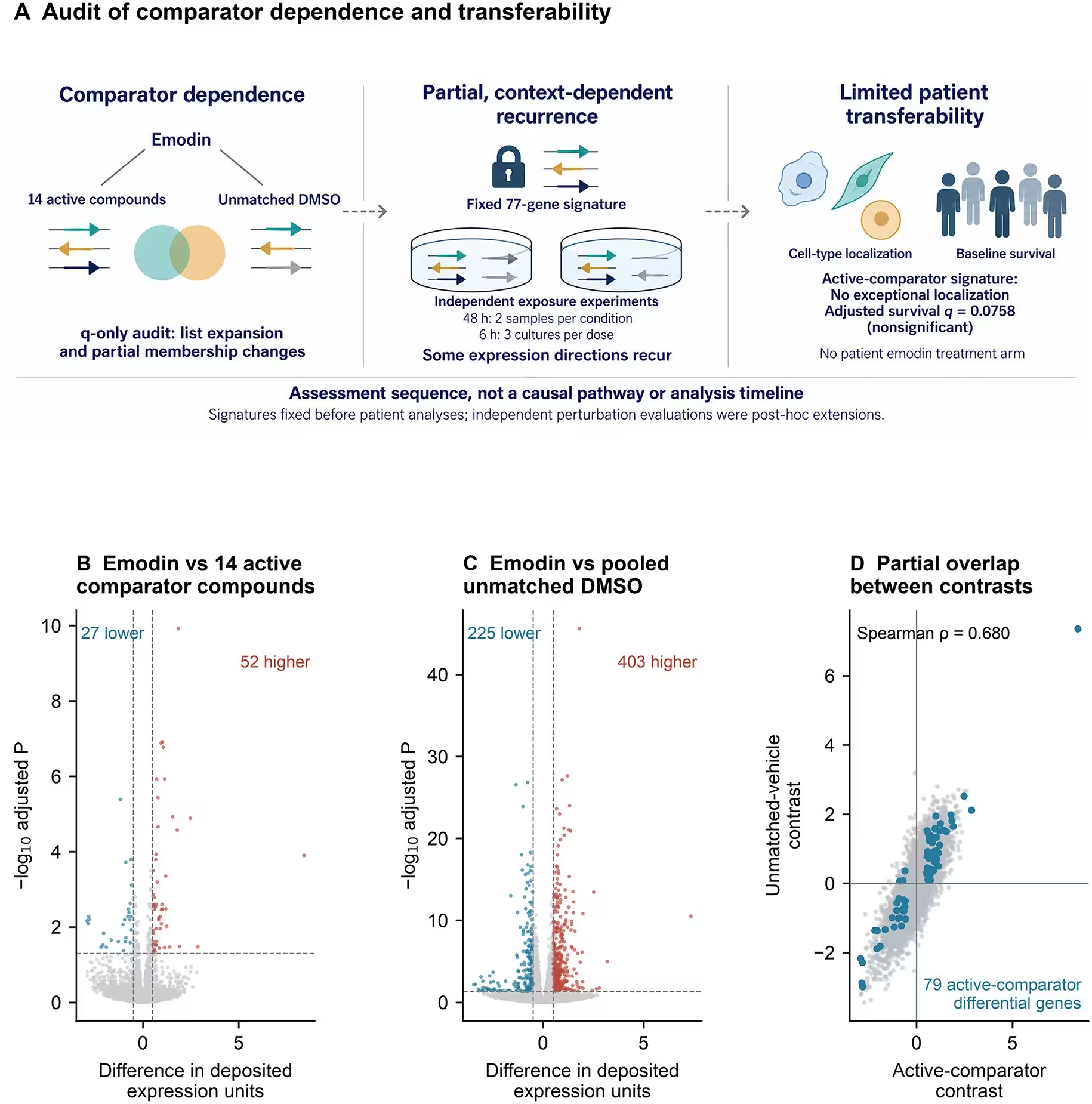
Fig 1: Control-audit framework and discovery comparisons. A, Comparator/preprocessing audit, independent exposure evaluation and secondary patient analyses. The diagram assigns roles to the analyses and makes no causal claim. The 77-gene active-comparator scoring signature was fixed before patient analyses; independent exposure evaluations were post hoc extensions. B, Two emodin arrays relative to 28 arrays from 14 active compounds. C, Emodin relative to the pooled three unmatched DMSO pairs. In B–C, selected points meet q < 0.05 and the arbitrary absolute deposited-unit filter ≥0.5. D, Effect comparison showing the original selected sets: 79 active-compound genes and 628 pooled-vehicle genes, with 47 shared. These selected sets differ from the fixed scoring sets (77 and 100 genes). The DMSO pairs were scanned 14, 212 and 400 days later; scan date does not establish biological matching. The original active-compound and vehicle fits pooled variance differently. Separate common-model comparison
Control-audit framework and discovery comparisons. A, Comparator/preprocessing audit, independent exposure evaluation and secondary patient analyses. The diagram assigns roles to the analyses and makes no causal claim. The 77-gene active-comparator scoring signature was fixed before patient analyses; independent exposure evaluations were post hoc extensions. B, Two emodin arrays relative to 28 arrays from 14 active compounds. C, Emodin relative to the pooled three unmatched DMSO pairs. In B–C, selected points meet q < 0.05 and the arbitrary absolute deposited-unit filter ≥0.5. D, Effect comparison showing the original selected sets: 79 active-compound genes and 628 pooled-vehicle genes, with 47 shared. These selected sets differ from the fixed scoring sets (77 and 100 genes). The DMSO pairs were scanned 14, 212 and 400 days later; scan date does not establish biological matching. The original active-compound and vehicle fits pooled variance differently. Separate common-model comparison Credit: Liang Cai et al. / PLOS One

Despite this massive list expansion, the two sets shared forty-seven genes, and their overall genome-wide effect estimates showed a positive rank correlation of zero point six eight. When the team removed arbitrary effect-size filters and examined genome-wide significance alone, solvent controls captured between sixty-six percent and seventy-three percent of the genes identified through active-compound comparisons. This indicates that low statistical overlap between different control choices combines list expansion with partial shifts in gene membership.

Does Raw Data Preprocessing Preserve Biological Signals?

Data normalization techniques also introduced noticeable variation into the discovered profiles. When the team reprocessed all two hundred twelve arrays using robust multi-array average normalization, individual array quality control checks showed that the emodin samples fell well within normal operational ranges, with median normalized unscaled standard errors of zero point nine nine and zero point nine nine. However, reprocessing altered which specific genes met statistical thresholds.

Within a fixed seventy-seven-gene active-comparator signature, seventy-four genes retained their direction of expression after reprocessing, and fifty-nine maintained statistical significance. The authors noted that direction of gene expression proved far more stable across different preprocessing pipelines than strict threshold-defined gene selection.
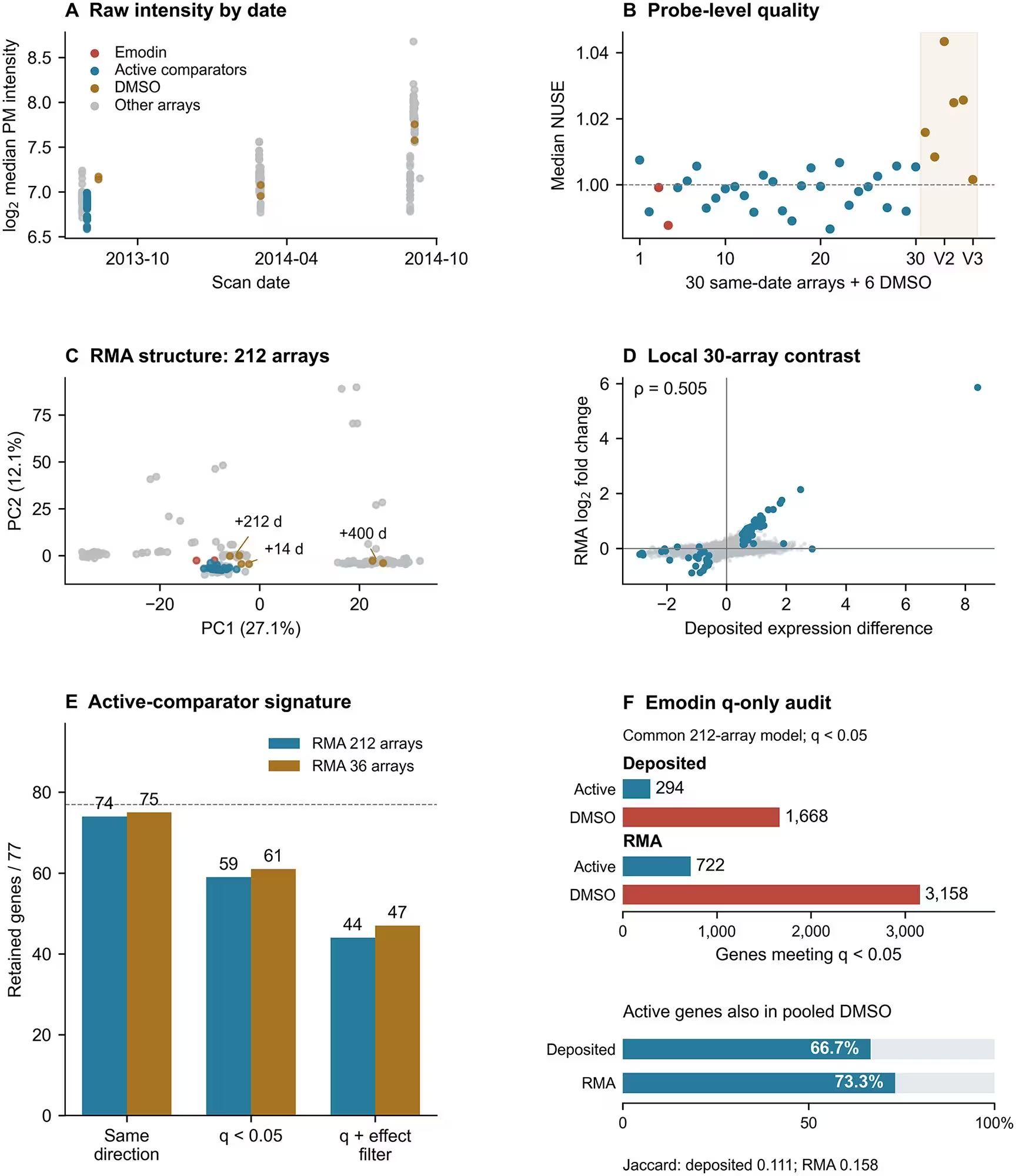
Fig 2: Raw-array QC, preprocessing sensitivity and q-only comparator audit. A, Median perfect-match intensity by scan date for 212 arrays. B, Median normalized unscaled standard error (NUSE) from the 36-array probe-level model. C, Principal components of all-array RMA probe-set expression. D, Deposited and RMA effects from the same local 30-array active-compound model; the fixed 77 genes are identified. The axes use different expression scales. E, Fixed-gene retention after 212-array and 36-array RMA: direction, q < 0.05, and q < 0.05 plus absolute RMA log2 effect ≥0.5. F, Post hoc emodin q-only gene counts for active-compound and pooled unmatched-DMSO contrasts in the common 212-array model, shown for deposited data and all-array RMA without an effect filter. Coverage divides the intersection by the active-compound count (196/294 and 529/722). It measures shared membership, irrespective of effect direction. Counts and coverage use linear axes. D–E use the local model; F uses the global model
Raw-array QC, preprocessing sensitivity and q-only comparator audit. A, Median perfect-match intensity by scan date for 212 arrays. B, Median normalized unscaled standard error (NUSE) from the 36-array probe-level model. C, Principal components of all-array RMA probe-set expression. D, Deposited and RMA effects from the same local 30-array active-compound model; the fixed 77 genes are identified. The axes use different expression scales. E, Fixed-gene retention after 212-array and 36-array RMA: direction, q < 0.05, and q < 0.05 plus absolute RMA log2 effect ≥0.5. F, Post hoc emodin q-only gene counts for active-compound and pooled unmatched-DMSO contrasts in the common 212-array model, shown for deposited data and all-array RMA without an effect filter. Coverage divides the intersection by the active-compound count (196/294 and 529/722). It measures shared membership, irrespective of effect direction. Counts and coverage use linear axes. D–E use the local model; F uses the global model Credit: Liang Cai et al. / PLOS One

Where Do These Gene Signatures Appear in Independent Experiments?

To test whether the emodin signatures recur in independent settings, the researchers evaluated external datasets covering different exposure times and dosages. In an independent forty-eight-hour exposure experiment utilizing two treated and two solvent samples per cell line, the active-comparator gene set showed partial directional agreement across forty-seven of seventy-seven genes in Michigan Cancer Foundation 7 cells and forty-two of seventy-seven in another breast cancer cell line, with statistically significant random-set comparisons.

A separate concentration series examining eight different doses over six hours across three independent biological cultures revealed that higher concentrations of emodin, specifically twenty-five point four micromolar and one hundred micromolar, produced measurable directional agreement with the discovery signature. Lower concentrations failed to reach statistical significance. The authors emphasize that these short-term cellular responses and viability measurements do not establish clinical anticancer efficacy or direct drug binding.
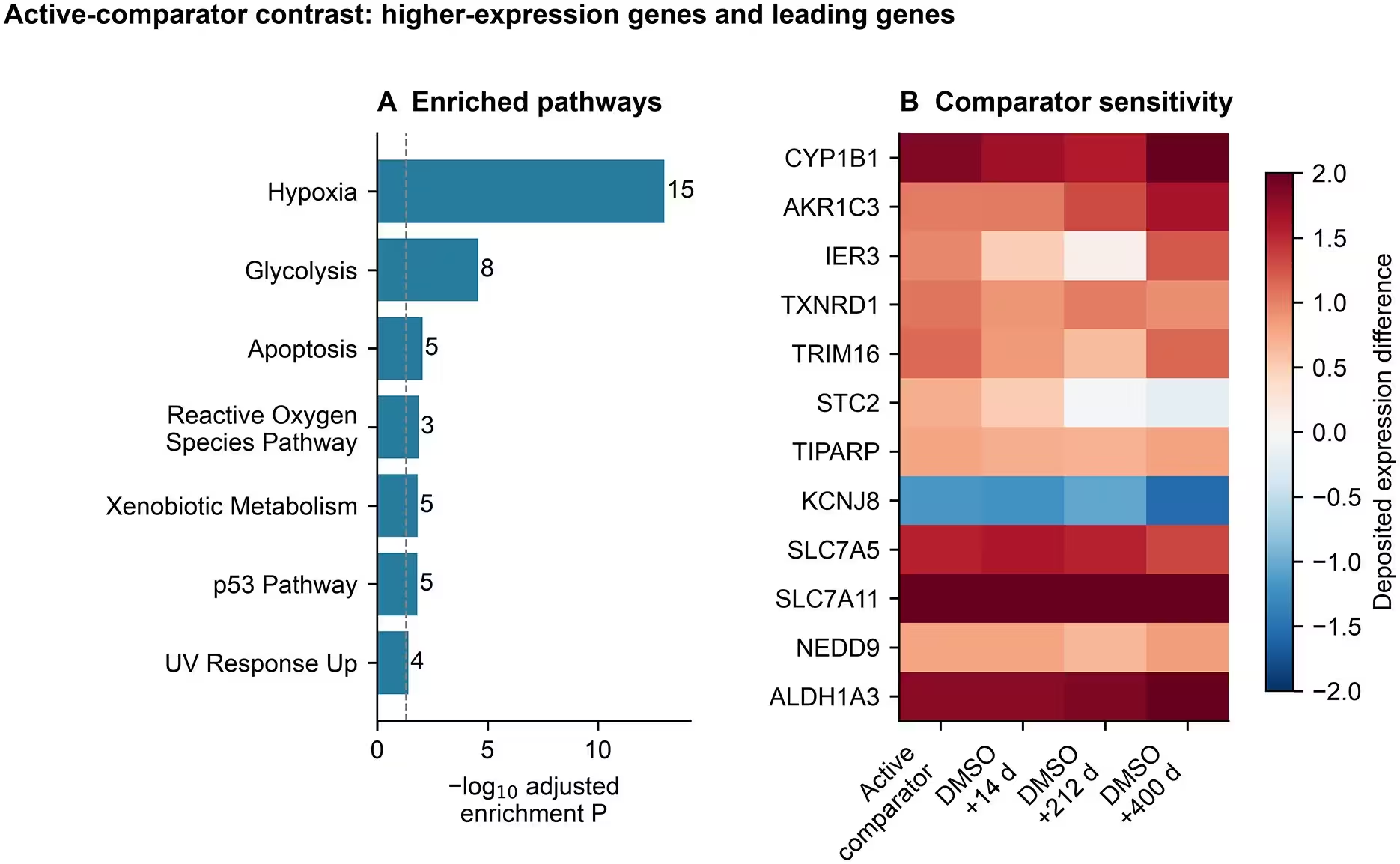
Fig 3: Exploratory pathway annotation and individual vehicle contrasts. A, Hallmark over-representation among the 52 higher-expression active-compound selected genes; labels give overlap counts and q values correct 200 pathway tests. B, Effects for the 12 genes with the smallest original active-compound q values, across the active background and each DMSO pair. Day offsets are scan-date differences. Effects are differences in deposited units. Colors saturate beyond the fixed limits of ±2; the supporting tables give the complete values. Annotation does not establish pathway activation or a treatment mechanism.
Exploratory pathway annotation and individual vehicle contrasts. A, Hallmark over-representation among the 52 higher-expression active-compound selected genes; labels give overlap counts and q values correct 200 pathway tests. B, Effects for the 12 genes with the smallest original active-compound q values, across the active background and each DMSO pair. Day offsets are scan-date differences. Effects are differences in deposited units. Colors saturate beyond the fixed limits of ±2; the supporting tables give the complete values. Annotation does not establish pathway activation or a treatment mechanism. Credit: Liang Cai et al. / PLOS One

What Do Patient Tumors Reveal About These Expression Patterns?

To explore how the emodin signature behaves in clinical settings, the researchers analyzed single-cell atlases and large clinical tumor cohorts containing over three thousand primary breast cancer tumors. In donor-paired single-cell analyses, the active-comparator score did not exceed expression-matched random reference signatures when localizing to cancer epithelial cells compared with other major cell populations.

In unadjusted survival models, higher active-comparator scores showed a modest association with overall survival, with a hazard ratio of one point four four per standard deviation. However, after adjusting for clinical covariates including patient age, tumor size, lymph node status, histological grade, and breast cancer intrinsic subtype, the association yielded a hazard ratio of one point one three and did not pass multiple testing correction. The authors conclude that reusing public perturbation signatures requires explicit comparator definitions and rigorous sensitivity testing, as baseline tumor biology can easily mimic compound-specific responses.

The research was published in PLOS One on November 25, 2026.

Fact Checked

This article has been fact checked for accuracy, with information verified against reputable sources. Learn more about us and our editorial process.

Last reviewed on .

Article history

  • Latest version

Reference(s)

  1. Cai, Liang., et al. “Control choice and reproducibility of dataset-specific emodin expression signatures in breast cancer.” PLOS One, vol. 21, no. 11, November 25, 2026, pp. e0363803 Public Library of Science (PLoS), doi: 10.1371/journal.pone.0363803. <https://doi.org/10.1371/journal.pone.0363803>.

Cite this page:

Desai, Vikram. “Reference Control Choice Dramatically Alters Emodin Anticancer Gene Signatures.” BioScience. BioScience ISSN 2521-5760, 26 November 2026. <https://www.bioscience.com.pk/en/subject/earth-science/control-choice-and-reproducibility-of-dataset-specific-emodin-expression-signatures-in-breast-cancer>. Desai, V. (2026, November 26). “Reference Control Choice Dramatically Alters Emodin Anticancer Gene Signatures.” BioScience. ISSN 2521-5760. Retrieved November 26, 2026 from https://www.bioscience.com.pk/en/subject/earth-science/control-choice-and-reproducibility-of-dataset-specific-emodin-expression-signatures-in-breast-cancer Desai, Vikram. “Reference Control Choice Dramatically Alters Emodin Anticancer Gene Signatures.” BioScience. ISSN 2521-5760. https://www.bioscience.com.pk/en/subject/earth-science/control-choice-and-reproducibility-of-dataset-specific-emodin-expression-signatures-in-breast-cancer (accessed November 26, 2026).
End of the article