Hidden Black Stems And Pink Leaves Found In Wild South Sulawesi Tuber Plants
DNA markers and physical traits reveal unexpected genetic structures among wild and cultivated mountain tuber populations facing habitat loss.

Wild populations of a valuable industrial tuber crop are quietly vanishing from rugged limestone cliffs and shallow soils across South Sulawesi before scientists can fully map them. A botanical team discovered that these fragmented mountain plants possess surprising physical traits, including jet black stems and pink leaf borders, which set them apart from standard agricultural varieties.
The research, published in Scientifica, focused on Amorphophallus muelleri, a tropical forest plant known locally as porang. This perennial herb produces underground tubers rich in glucomannan, a natural dietary fiber widely utilized across the food, pharmaceutical, and health sectors. As global market demand for the crop surges, agricultural cultivation has expanded rapidly across Indonesia, often relying on vegetative propagation through small bulb patches and tubers.
What Did Field Botanists Discover Across the Mountain Karst Zones?
Led by Rinaldi Sjahril and colleagues at Hasanuddin University, the research team conducted field explorations spanning two consecutive rainy seasons from November 2023 through May 2025. They documented 24 plant accessions across eight distinct administrative regencies in the South Sulawesi karst landscape, including Tana Toraja, Bone, Maros, and Selayar. The rugged study region features shallow soils, scarce water access, and heavily fragmented habitats that exert immense selection pressure on local plant life.
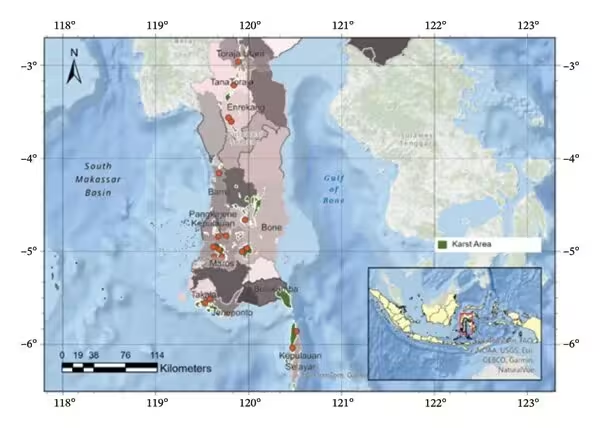
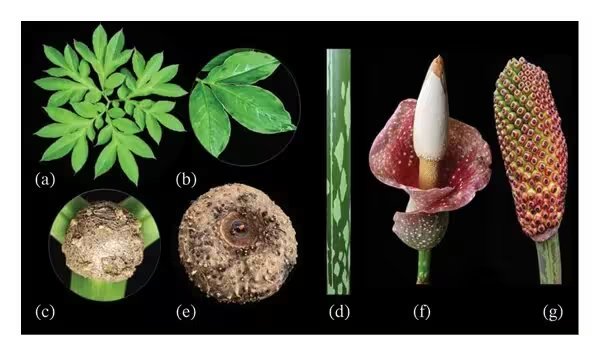
During physical assessments, the team evaluated 18 vegetative traits covering leaves, petioles, tubers, and bulbils using standard agricultural descriptors. While standard plants typically display green stems and leaves, the team identified rare morphotypes featuring striking pink leaf margins and unusual black petioles concentrated particularly in the Maros and Pangkep mountain zones. Statistical evaluations of physical traits yielded an average Shannon-Wiener diversity index of about 0.6, alongside an evenness score of roughly 0.85, pointing to moderate phenotypic variation overall.
How Much Genetic Variation Hides Within Mountain Populations?
To understand the genetic underpinnings of these physical differences, the investigators utilized ten Inter Simple Sequence Repeat DNA markers to analyze molecular profiles across the samples. These molecular markers generated an average of about 10.5 DNA bands per primer, with an overall polymorphism rate of approximately 83.2 percent. Analysis of molecular variance revealed that nearly all genetic variation, about 99.9 percent, existed within local regency groups rather than between different mountain regions.
Statistical tests for isolation by distance showed a very weak and statistically non-significant correlation between genetic dissimilarity and geographic separation. The Mantel test yielded a correlation coefficient of 0.135 with a p-value of roughly 0.097, indicating that physical distance between plants did not dictate their genetic makeup. Bayesian clustering algorithms further confirmed that the sampled individuals divided into two main genetic groups that did not align neatly with their geographic origins or whether they were wild or cultivated.
Why Are These Wild Mountain Plants Disappearing Fast?
The disconnect between physical traits and molecular markers suggests that environmental adaptation and phenotypic plasticity play major roles in how these plants respond to patchy mountain microhabitats. Steep slopes, limited seed dispersal ranges, and localized animal frugivory keep populations isolated in micro-pockets. However, intense anthropogenic pressures, including commercial limestone mining and heavy wild harvesting for trade, are rapidly shrinking natural forest habitats in regions like Maros.
The authors emphasize that while cultivated fields maintain high genetic uniformity due to cloning, remaining wild populations harbor critical baseline diversity that must be protected. Safeguarding these fragile limestone ecosystems is essential for preserving unique genetic resources before land-use changes erase them permanently.
The research was published in Scientifica on November 22, 2026.
This article has been fact checked for accuracy, with information verified against reputable sources. Learn more about us and our editorial process.
Last reviewed on .
Article history
- Latest version
Reference(s)
- Sjahril, Rinaldi., et al. “Genetic Diversity of Amorphophallus muelleri in South Sulawesi Karst Based on Morphological and ISSR Markers.” Scientifica, vol. 2026, no. 1, November 22, 2026 Wiley, doi: 10.1155/sci5/1954770. <https://doi.org/10.1155/sci5/1954770>.
Cite this page:
- Posted by Michael Ellison