Supercomputer Simulations Reveal How Numerical Methods Change Dust Behavior In Space Clouds
Comparing two leading computer models for interstellar dust reveals unexpected differences in local gas ratios and cloud density calculations.
Supersonic turbulence inside cosmic star-forming clouds forces tiny dust grains to decouple from surrounding gas in ways that depend heavily on how computer simulations handle the math. Researchers modeling the movement of three and ten micron dust grains inside interstellar clouds found that two common numerical approaches yield significantly different results for local dust concentration. These findings matter because astronomers rely on dust measurements to calculate the masses of giant molecular clouds and understand how new stars eventually form.
The study, published in The Astrophysical Journal, was conducted by Narges Vadood and Terrence S. Tricco from Memorial University of Newfoundland in Canada. The team set out to compare two distinct computational strategies used to simulate the interaction between gas and dust in turbulent space environments. One approach treats gas and dust as two separate fluids interacting through drag forces, while the other treats the mixture as a single combined fluid using a mathematical shortcut known as the diffusion approximation.
How Do Two Different Computer Models Handle Interstellar Dust?
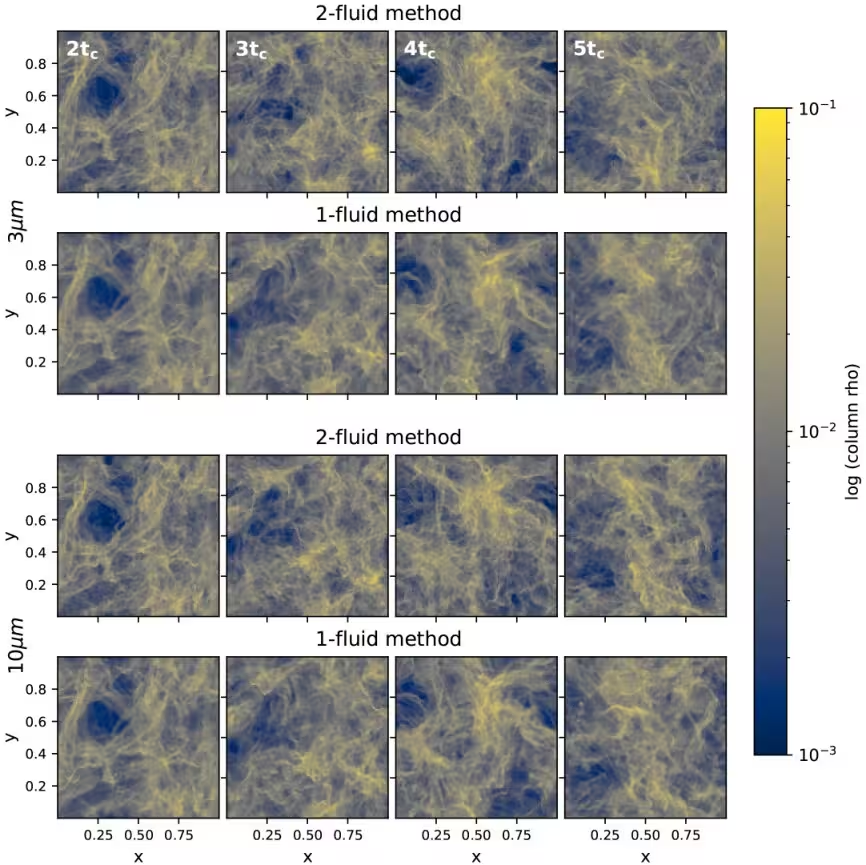
To test both techniques under identical conditions, the researchers used the Phantom code to simulate a three-parsec cubic box filled with gas and dust. They drove turbulence inside the box to match the supersonic conditions typical of cold molecular clouds, where temperatures hover around eleven degrees Kelvin and gas densities reach thousands of particles per cubic centimeter. Both simulation methods successfully reproduced the standard lognormal gas density distributions expected in turbulent space, but the dust distributions diverged over time, particularly in low-density regions.
When tracking the dust-to-gas ratio, the two-fluid method produced much wider distributions than the single-fluid approach. The two-fluid simulations revealed extreme local increases in dust concentration, reaching up to thirty-nine times the average ratio in certain areas. In contrast, the single-fluid method produced a much narrower range of dust-to-gas ratios, limiting the maximum increase to about five times the average. This discrepancy stems from a specialized mathematical limiter applied in the single-fluid approach to maintain stability when dust stopping times exceed local dynamical crossing times.
Why Do Numerical Choices Change the Simulation Outcomes?
The researchers analyzed their results using a dimensionless metric called the numerical Stokes number, which measures how tightly dust grains are coupled to moving gas. When this number is much less than one, dust and gas move together seamlessly. When the Stokes number exceeds one, grains begin to decouple and move independently. In the simulations, roughly thirty percent of particles for three micron grains and seventy-five percent of particles for ten micron grains fell into the decoupled regime where the single-fluid limiter had to intervene.
Without this stopping time limiter, the single-fluid method suffered from numerical instability, causing unphysical growth in total dust mass and generating spurious artificial peaks at extremely low dust-to-gas ratios. However, applying the limiter artificially forces the dust and gas to remain tightly coupled in low-density zones. The authors caution that while both methods are viable for studying molecular clouds, researchers must carefully select their numerical framework based on the specific Stokes number regime of their calculation to avoid artificial clustering or excessive smoothing.
The study was posted to the arXiv preprint server on November 25, 2026.
This article has been fact checked for accuracy, with information verified against reputable sources. Learn more about us and our editorial process.
Last reviewed on .
Article history
- Latest version
Reference(s)
- Vadood, Narges., et al. “A Comparison of Two- and One-fluid Dust Solvers for Dusty, Supersonic Turbulence.” The Astrophysical Journal, vol. 1009, no. 1, September 11, 2026, pp. 17 American Astronomical Society, doi: 10.3847/1538-4357/ae9cb9. <https://doi.org/10.3847/1538-4357/ae9cb9>.
Cite this page:
- Posted by Nida Rehman