Heliophysics Early-Career Funding Rates Plunge From 28 To 6 Percent
A new study reveals that volatile grant schedules and rigid eligibility windows are threatening the next generation of space physicists.
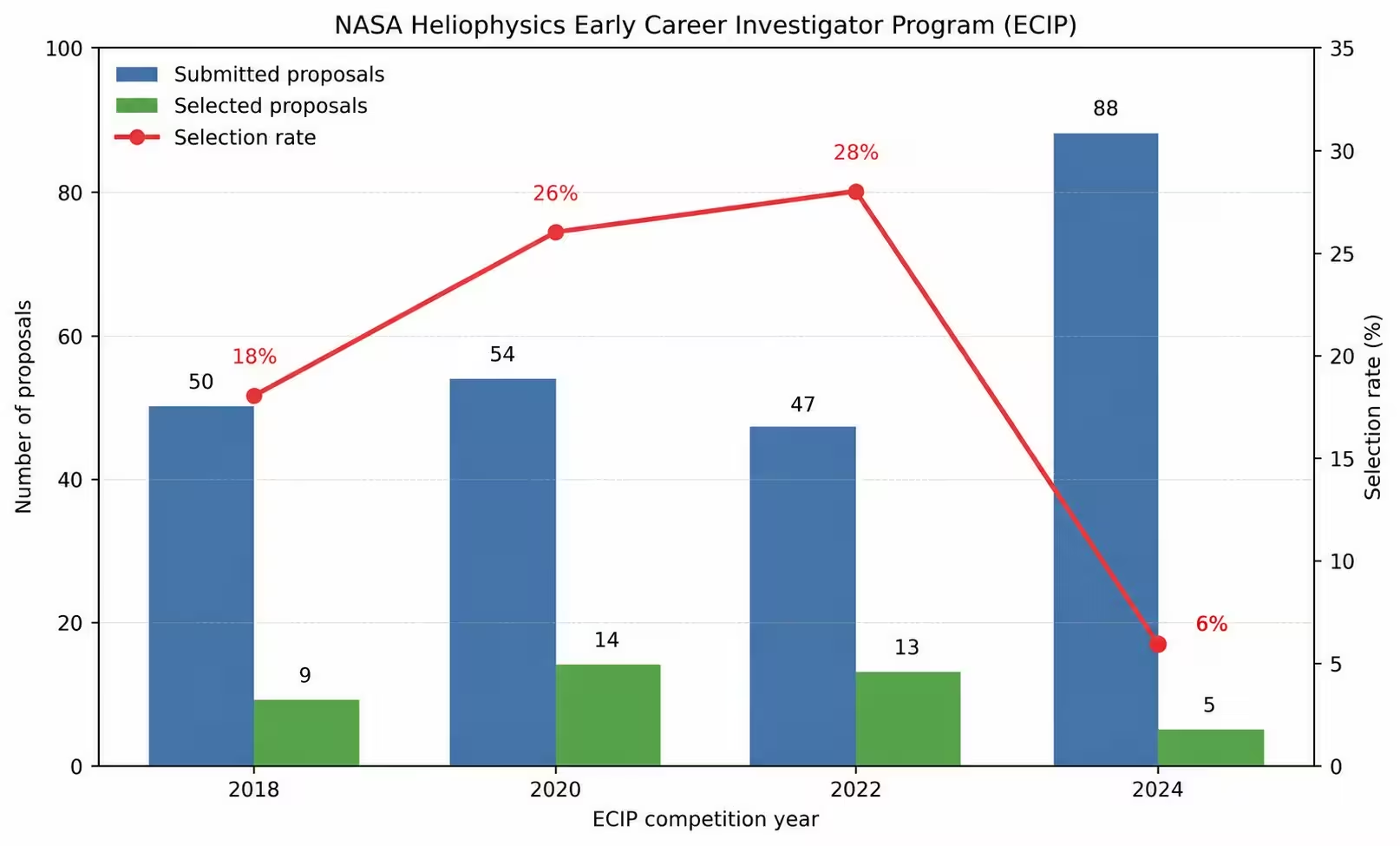
Early-career space physicists face plunging success rates and erratic funding cycles that threaten to drain institutional knowledge from heliophysics long before researchers can establish independent science programs. A new analysis led by Savvas Raptis of the Johns Hopkins University Applied Physics Laboratory shows that selection rates for major early-career grants have swung wildly in recent years, dropping from 28 percent down to just 6 percent in a single program.
The study, published in the Journal of Geophysical Research: Space Physics, examines the critical transition period when new doctorate holders move from working inside a supervisor team to leading their own investigations. Heliophysics encompasses the study of the Sun, the solar wind, and how space weather impacts Earth and other planets in our solar system. Maintaining a steady pipeline of fresh talent is vital for ambitious multi-generational mission concepts, but researchers report that today’s financial environment makes long-term planning exceedingly difficult.
How Did Proposal Success Rates Collapse So Fast?
The authors cataloged major United States federal programs supporting early-career space scientists, documenting deep discrepancies in eligibility, citizenship requirements, and application schedules. The most dramatic example appears in NASA’s Heliophysics Early Career Investigator Program, which gives grants to researchers within ten years of receiving their terminal degree. In 2022, the program funded 28 percent of submitted proposals, but by 2024, that success rate plummeted to only 6 percent after authorities received 88 proposals and selected just five awards.
Such extreme volatility combines with strict eligibility clocks to create intense pressure. Many scientists work on temporary soft-money positions where their salary depends directly on external grants rather than stable institutional funds. When federal agencies delay or shift major funding solicitations, researchers on two-year postdoctoral appointments may run out of time before they can even submit a proposal.
What Lessons Do Established Scientists Share About Survival?
To place these contemporary struggles into a wider historical framework, the researchers surveyed 30 established space physicists whose doctorates span from 1972 to 2016 and conducted eight in-depth interviews. Most respondents characterized today’s funding landscape as significantly more difficult than the one they faced at the start of their own careers. Interestingly, older generations did not report that funding was easy to secure in the past. Instead, they emphasized that predictability was what allowed them to build sustainable careers.
Researchers who navigated the post-Apollo funding contractions of the 1970s recalled that even when individual proposal attempts failed, they maintained confidence that another opportunity, mission, or facility call would soon follow. Today’s system features irregular schedules, sudden program pauses, and opaque selection feedback. Interviewees noted that securing a first principal investigator grant acts as the definitive turning point where a scientist proves their ideas can sustain an independent research program.
What Are the Long-Term Costs of Funding Instability?
The authors warn that losing young scientists carries a heavy institutional toll. Technical expertise and historical mission knowledge accumulated over decades can easily vanish when early-career researchers are forced out of the field due to funding gaps. Furthermore, relying entirely on large collaborative projects run exclusively by senior leaders risks turning junior scientists into routine employees rather than autonomous research leaders.
To safeguard the future of space physics, the authors recommend that federal agencies maintain predictable annual grant cycles, publicly report detailed application and selection statistics across all programs, and continue evaluating dual-anonymous peer review systems to eliminate bias. They also advocate for formal leadership roles within major space missions that grant early-career researchers genuine authority over science questions and resource management.
The study was posted to the arXiv preprint server on November 25, 2026.
This article has been fact checked for accuracy, with information verified against reputable sources. Learn more about us and our editorial process.
Last reviewed on .
Article history
- Latest version
Reference(s)
- Raptis, Savvas. “Funding Landscape of Early-Career Scientists: A Perspective from the AGU SPA Early Career Leadership Advisory Committee.” arXiv.org <http://arxiv.org/abs/2611.34392v1>.
Cite this page:
- Posted by Karan Das