Plasma Simulations Reveal How Trapped Electrons Power Whistler Waves In Space
High-resolution computer models demonstrate that magnetic valleys shape electron distributions to trigger high-frequency waves across space plasmas
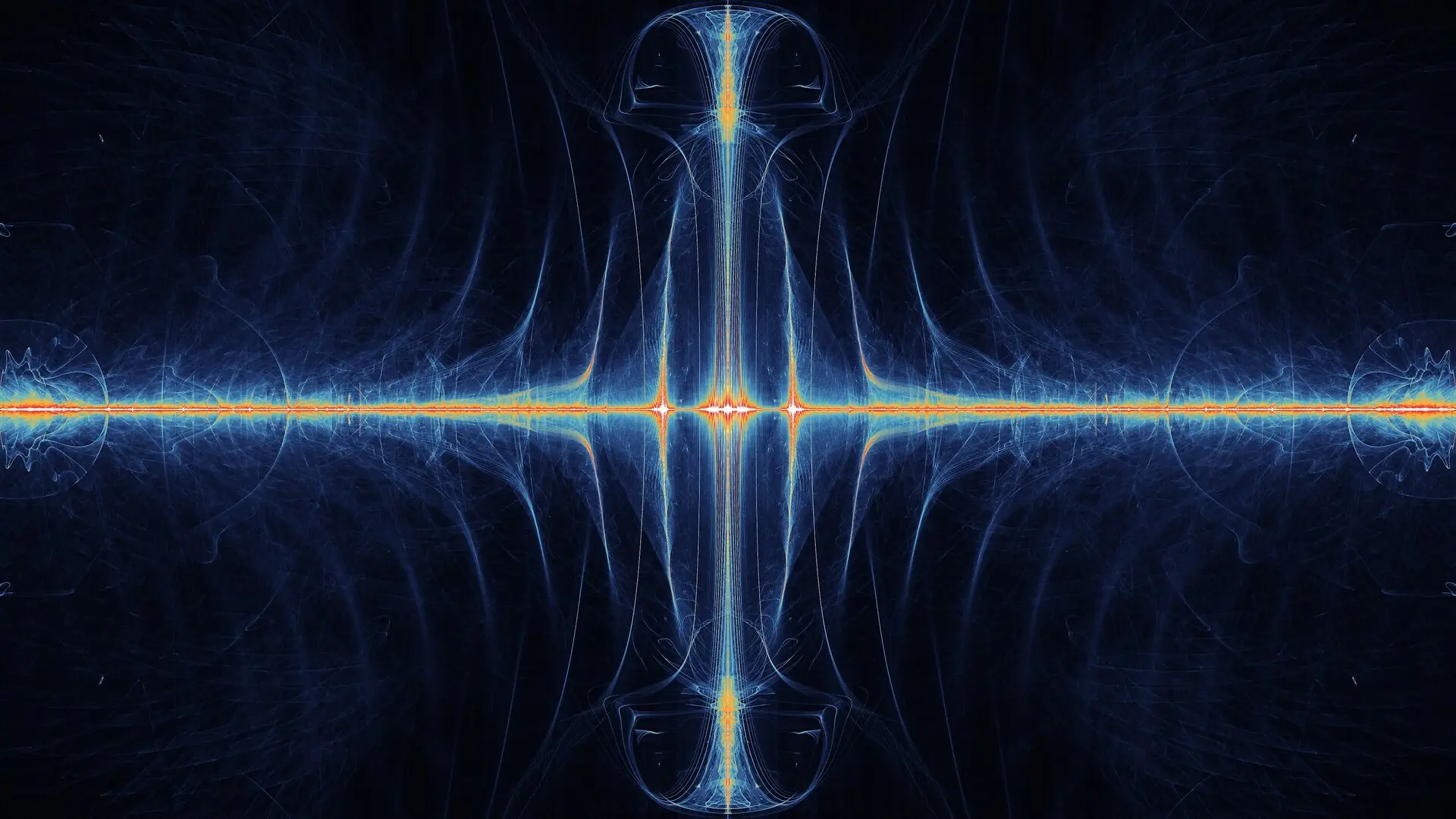
Plasma simulations reveal how energy cascades from large ion scales down to tiny electron scales in space weather, solving a longstanding space physics mystery. Researchers discovered that when magnetic fields warp into shallow valleys called magnetic dips, trapped electrons develop peculiar butterfly-shaped velocity distributions that actively trigger high-frequency electromagnetic waves known as whistlers.
Space plasmas like the Earth’s magnetosheath are packed with free energy stored in large-scale pressure imbalances. This energy typically discharges through ion-scale instabilities, generating magnetic structures that interact directly with electrons. Previous spacecraft missions, including NASA’s Magnetospheric Multiscale mission, frequently detected intense whistler waves inside magnetic valleys known as lion roars. However, scientists could not explain exactly how electron populations inside these magnetic traps evolved to generate the waves.
How Do Magnetic Dips Trap And Shape Electron Populations?
To trace this multi-scale energy transfer, a research team led by Ida Svenningsson from Chalmers University of Technology utilized fully kinetic particle-in-cell simulations, available on the arXiv preprint server. The team initiated their virtual plasma with an ion temperature anisotropy, serving as the sole source of free energy in the system. As ion cyclotron waves grew in amplitude, they became partly compressional, carving out distinct magnetic valleys across a simulation domain measuring two hundred eighty by two hundred eighty inertial lengths.
As these magnetic valleys deepened, electrons became trapped inside the local field minima. Particles with small pitch angles escaped easily along the magnetic field lines, leaving behind a trapped population that developed an enhanced temperature anisotropy. This trapping mechanism distorted the electron velocity distribution functions into characteristic butterfly shapes, featuring depleted populations at parallel and perpendicular angles.
What Role Do Sharp Velocity Gradients Play In Generating Whistler Waves?
The simulations demonstrate that these non-Maxwellian distributions create steep velocity-space gradients at the boundaries of the trapping region. By tracking energy transfer in velocity space, the authors found that these precise gradients drive whistler waves through first-order cyclotron resonance. The newly generated whistlers then propagate outward away from the magnetic minima, scattering the trapped electrons in pitch angle and smoothing out the velocity gradients.
Comparing the simulation outcomes with the classic double-adiabatic prediction highlights the vital role of wave-particle interactions. Without the moderating effect of whistler waves, electron temperature anisotropy would continue climbing steadily as magnetic compression intensifies. Instead, once the whistler power peaks, particle scattering heats the electrons along the magnetic field, dropping the overall electron anisotropy to roughly half of its purely adiabatic value and settling it near established instability thresholds.
Why Must Researchers Look Beyond Simple Bi-Maxwellian Thresholds?
These findings provide a clear physical explanation for observational data collected by spacecraft crossing planetary magnetosheaths. In both the simulations and satellite data, density fluctuations remain anti-correlated with magnetic field strength, and the strongest whistler emissions coincide precisely with the deepest magnetic dips exhibiting butterfly distributions. In shallower structures where temperature anisotropy alone peaks without the required distribution shape, whistler activity remains absent.
The results emphasize that traditional bi-Maxwellian instability thresholds are insufficient for predicting wave generation inside localized space plasma structures. Instead, understanding how energy crosses spatial boundaries requires accounting for the full, complex shape of the electron velocity distribution shaped by magnetic trapping and resonant wave scattering.
The study was posted to the arXiv preprint server on November 24, 2026.
This article has been fact checked for accuracy, with information verified against reputable sources. Learn more about us and our editorial process.
Last reviewed on .
Article history
- Latest version
Reference(s)
- Svenningsson, Ida. “Whistler instability driven by electron trapping in magnetic dips.” arXiv.org <http://arxiv.org/abs/2611.32922v1>.
Cite this page:
- Posted by Deepak Malhotra