Physicists Calculate Self-Force Effects Around Extreme Charged Black Holes Using Quantum Integrability
New analytical methods match numerical simulations for particle orbits around maximally charged black holes.
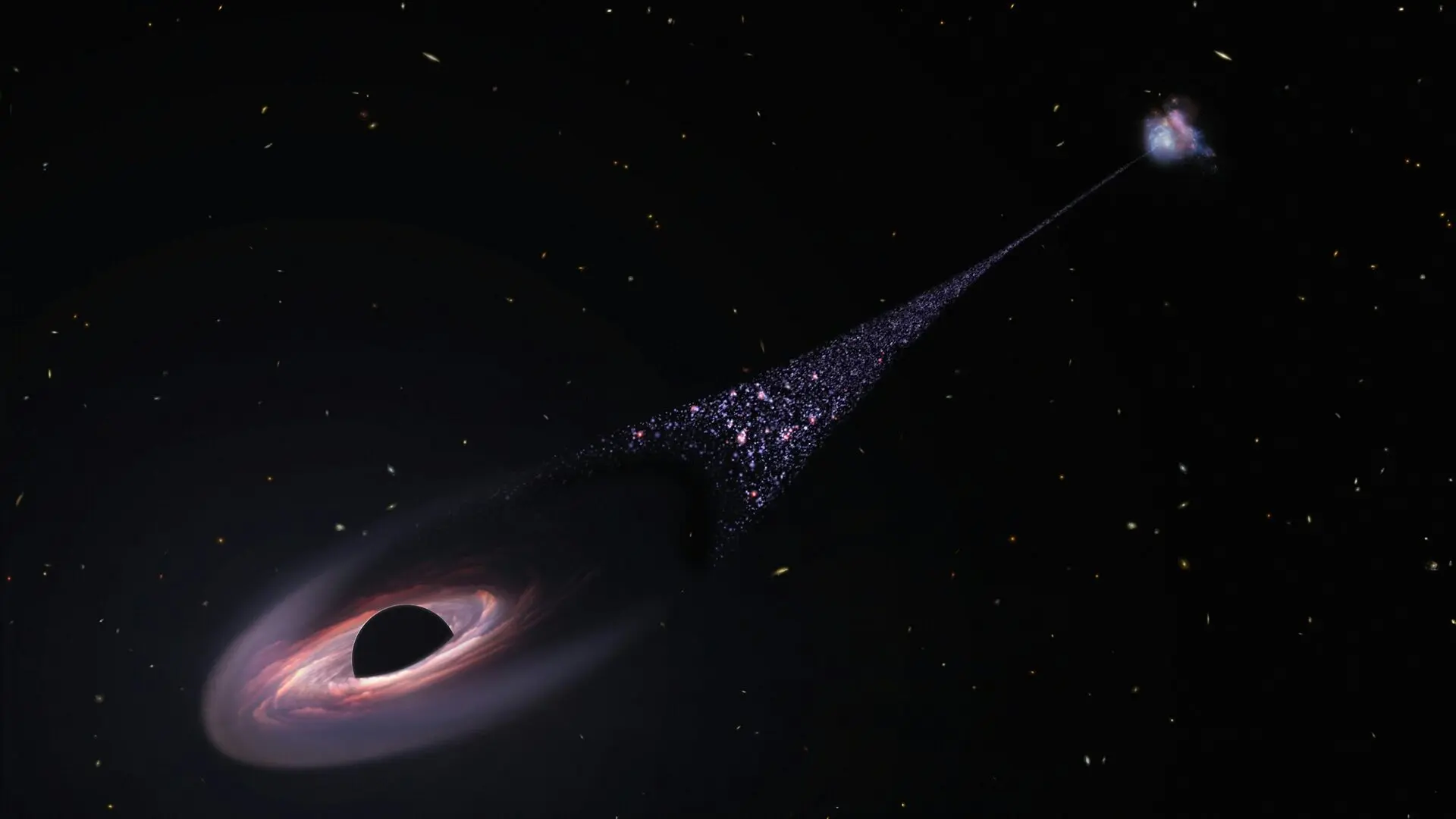
Physicists have calculated how a tiny charged particle tugs on itself while orbiting an extreme black hole, revealing exact energy ripples that match numerical simulations. The work explores the complex behavior of scalar radiation around a maximally charged black hole known as an extremal Reissner-Nordström spacetime.
When a particle travels in a circular path around such a dense object, it emits waves and experiences a self-force created by its own disturbed field. Giorgio Di Russo and colleagues from the Hangzhou Institute for Advanced Study, the INFN of Bologna, the University of Bologna, and the University of Calabria, available on the arXiv preprint server, tackled this problem by solving radial wave equations directly in the extremal geometry.
What Happens When Two Horizons Merge Into One?
An extremal black hole is a special type of theoretical object where the inner event horizon and outer event horizon merge into a single boundary. This merging changes the differential equations governing physical fields, turning them into a Doubly Confluent Heun Equation. Ordinary perturbation methods often break down here because they fail to preserve the correct boundary conditions, such as waves traveling strictly inward at the horizon or outward to infinity.
To bypass this obstacle, the research team employed two distinct analytical strategies. The first technique uses quantum integrability and a method known as kink transformations, while the second adapts a classical approach developed decades ago by researchers Mano, Suzuki, and Takasugi. Both frameworks successfully yielded closed-form expressions that describe the wave behavior without requiring cumbersome infinite expansions.
How Well Do the Analytic Formulas Match Simulations?
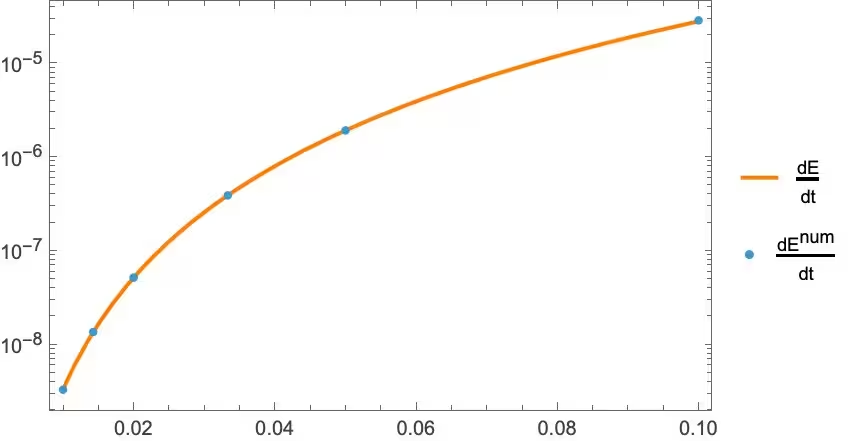
The authors computed the radiative energy fluxes carried by scalar waves to both infinity and across the event horizon. Their analytical results reproduce previous numerical findings with high precision, showing residuals that scale correctly with the truncation order. For example, comparisons of the energy flux at infinity against numerical values from earlier studies showed discrepancies dropping below one thousandth of a percent at higher expansion orders.
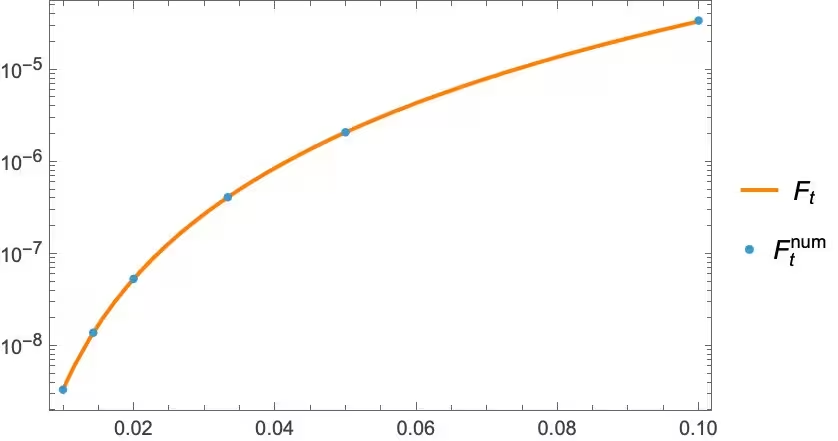
Furthermore, the team evaluated the regularized scalar self-force acting on the orbiting particle across multiple multipole modes. By subtracting the divergent parts of the field near the particle, they isolated the physical components of the self-force. The resulting post-Newtonian formulas satisfy energy-balance relations identically and align closely with established numerical data for both the dissipative and conservative components of the self-force.
What Are the Limits and Next Steps for This Framework?
While the study provides robust analytical proof for scalar-charged particles, it remains a simplified model compared to full gravitational perturbations caused by orbiting masses. Gravitational self-force calculations involve considerably more complex tensor equations, though they share similar mathematical structures. The authors note that the kink method could eventually be extended to more general orbital configurations and higher-dimensional black hole spacetimes, offering a powerful new toolkit for theoretical physicists studying extreme gravitational environments.
The study was posted to the arXiv preprint server on November 24, 2026.
This article has been fact checked for accuracy, with information verified against reputable sources. Learn more about us and our editorial process.
Last reviewed on .
Article history
- Latest version
Reference(s)
- Di Russo, Giorgio. “Scalar perturbations in extremal Reissner-Nordström geometry: new methods at work.” arXiv.org <http://arxiv.org/abs/2611.33123v1>.
Cite this page:
- Posted by Aisha Ahmed