Quantum Algorithm Roadblock Exposed in Two-Dimensional Lattice Field Theories
Physicists uncover hidden mathematical barriers that halt adaptive quantum algorithms when simulating physical systems in higher dimensions.

Quantum computers simulating fundamental physics face unexpected roadblocks when stepping beyond one-dimensional models, according to a recent theoretical analysis. Researchers investigated how an adaptive quantum algorithm behaves in two spatial dimensions plus time, uncovering subtle barriers that halt or misdirect quantum simulations.
Variational quantum algorithms are hybrid classical-quantum procedures designed to find the ground state of physical systems by adjusting circuit parameters iteratively. One popular technique, known as adaptive variational quantum eigensolver, builds quantum circuits step-by-step by measuring the energy gradients of various operator pools and adding the steepest descent at each round. While this method successfully mapped simple one-dimensional lattice gauge theories involving over one hundred qubits, moving to higher dimensions introduces distinct mathematical hurdles.
Why Do Real Qubit Hamiltonians Silence Standard Quantum Algorithms?
The study, available on the arXiv preprint server and conducted by Nico Dichter and colleagues from the University of Bonn and DESY, identifies two primary failure modes. The first limitation stems from qubit-level time-reversal symmetry. When a qubit Hamiltonian and its starting state are entirely real-valued, meaning they remain unchanged under complex conjugation, every real pool operator yields a vanishing gradient. As a result, the algorithm completely ignores these operators and terminates prematurely in the very first iteration.
This qubit-level constraint occurs independently of whether the underlying physical system breaks time-reversal symmetry. The authors point out that previous successful simulations sidestepped this obstacle by deliberately building operator pools containing purely imaginary components. Without complex-valued operators or non-real starting states, standard adaptive algorithms fail to construct functional circuits.
How Does Premature Convergence Trap Quantum Simulations in Excited States?
The second major hurdle involves energy eigenstates acting as stationary points where gradients naturally drop to zero. Once a simulation path gets close enough to an eigenstate, all gradients approach zero, causing the algorithm to exit prematurely. In physical systems featuring sharp level crossings, where the ground state abruptly shifts its characteristics as parameters change, this trap becomes particularly disruptive.
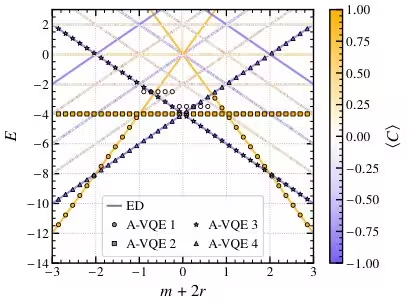
To test these theoretical insights in higher dimensions, the researchers performed a case study on free massive Wilson fermions configured on an eight-qubit two-by-two lattice. Although physical time-reversal symmetry is broken for these fermions, the mapped qubit Hamiltonian remains entirely real due to the mathematical conventions of the Jordan-Wigner transformation. Consequently, standard real-valued operator pools failed entirely.
Can Symmetry-Adapting Operator Pools Recover the Ground State?
By incorporating charge conjugation symmetry into the operator pools and choosing appropriate initial states, the team managed to map out the system more effectively. While no single combination of operator pools and initial states successfully reconstructed the ground state across every possible mass parameter value, combining multiple experimental configurations successfully recovered both the ground state and the first excited state over the entire mass range.
These findings provide practical guidelines for physicists planning quantum simulations for multi-dimensional lattice field theories. Before executing simulations on quantum hardware, researchers must verify whether their qubit Hamiltonian is real-valued, ensure their operator pools include non-vanishing imaginary terms, and account for parameter-driven symmetry changes across level crossings.
The study was posted to the arXiv preprint server on November 24, 2026.
This article has been fact checked for accuracy, with information verified against reputable sources. Learn more about us and our editorial process.
Last reviewed on .
Article history
- Latest version
Reference(s)
- Dichter, Nico. “Prospects and limitations of adaptive variational quantum algorithms for lattice field theories: a case study in 2+1 dimensions.” arXiv.org <http://arxiv.org/abs/2611.33138v1>.
Cite this page:
- Posted by Karan Das