Physicists Construct Exact Wave Function for a New Fractional Chern Semimetal That Defies Conventional Gapped States
A newly calculated tensor network state reveals how fractional topological order can survive without an energy gap.
Physicists have constructed an exact mathematical wave function for a strange new phase of matter where fractional quantum charges move freely without forming the energy gaps usually required for such behavior. The state, called a fractional Chern semimetal, bridges the gap between conventional fractional quantum Hall states and metals by combining fractional topological order with gapless quantum excitations.
How Can Fractional Quantum Order Exist Without an Energy Gap?
In standard fractional Chern insulators, electrons interact within nearly flat quantum bands under conditions that mimic powerful magnetic fields. This environment traps electrons into fractional charges, such as one third of an electron charge, creating a gapped state where long-range entanglement thrives. Researchers previously assumed that closing this energy gap would destroy the fragile fractional topology entirely.
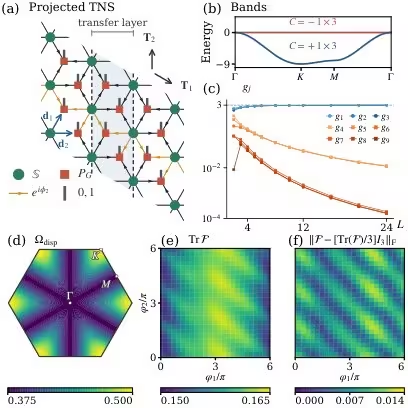
The new research demonstrates that a lattice model can maintain fractional topological order even when its excitation gap vanishes. Fa-Jie Wang from Peking University and their colleagues constructed an exact tensor network state on a honeycomb lattice by starting from a critical parton state and applying a Gutzwiller projection, which restricts local electron configurations. The resulting quantum state possesses an integer physical filling of one electron per unit cell, yet its underlying topological properties mimic those of fractional states.
What Does the Conformal Field Theory Reveal About This Semimetal?
To understand the strange behavior of this gapless phase, the authors analyzed its bulk correlations using transfer matrix methods and conformal field theory, published in arXiv. Their analytical and numerical calculations reveal that the wavefunction norm is governed by a combined five dimensional conformal field theory framework. This framework couples a set of massless Dirac fermions to a non-linear sigma model known as a Wess-Zumino-Witten sector.
The calculations show that the stiffness of this color field is directly controlled by the idealness of the underlying parton quantum geometry. When the geometry aligns properly, the system flows naturally toward a specific conformal fixed point. This dual description explains how gapless fermionic excitations can coexist with robust topological invariants like a fractionally quantized many-body Chern number of one third.
Why Do the Entanglement Spectra Match Laughlin States?
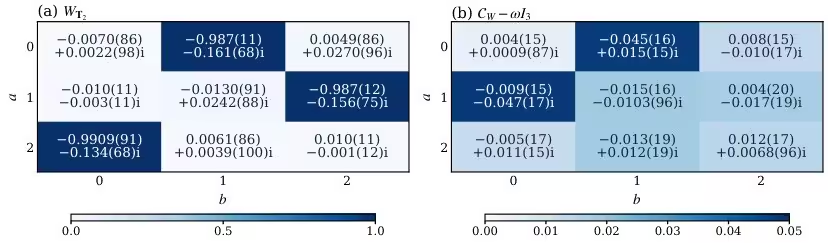
Despite the lack of an insulating bulk gap, numerical analyses of the half-cylinder entanglement spectrum reveal clear signatures of chiral edge states. The low-lying energy levels match the distinct counting patterns of a single chiral boson, mirroring the behavior found in standard fractional quantum Hall systems. Furthermore, calculations of the modular matrices confirm that the emergent quasiparticles satisfy the expected fractional exchange statistics.
These findings suggest that fractional topology is more flexible than previously recognized, able to survive in semimetallic environments where particle momenta form continuous Fermi points. The authors note that while these exact tensor network models provide valuable analytical control, finding simpler physical Hamiltonians to realize these fractional Chern semimetals in experimental settings remains an important challenge for future work.
The study was posted to the arXiv preprint server on November 23, 2026.
This article has been fact checked for accuracy, with information verified against reputable sources. Learn more about us and our editorial process.
Last reviewed on .
Article history
- Latest version
Reference(s)
- Wang, Fa-Jie. “A Fractional Chern Semimetal: Exact Wavefunction and Conformal Criticality.” arXiv.org <http://arxiv.org/abs/2611.31234v1>.
Cite this page:
- Posted by Deepak Malhotra