Math Models Successfully Track Winter Illness Waves But Stumble On Christmas
A multi-model evaluation in Germany reveals how holiday reporting gaps disrupt infection forecasts.

When respiratory infections surged across Germany during the winter of 2024 and 2025, public health scientists faced a familiar puzzle in trying to predict how many hospital beds would be needed in the weeks ahead. A collaborative multi-model forecasting effort led by Johannes Bracher at the Karlsruhe Institute of Technology and colleagues tested nine distinct mathematical models to track acute respiratory infections and severe hospitalizations in real time. The study, published in PLOS Computational Biology, reveals that while computers can successfully estimate short-term trends, the chaotic disruptions of the Christmas holiday season consistently trick the algorithms into overestimating future cases.
How Well Can Math Models Predict Winter Illness Waves?
Monitoring the rise and fall of winter sickness is vital for health agencies to allocate staff and resources before emergency rooms become overwhelmed. The research team evaluated predictions submitted to a public platform called the RESPINOW Hub between October 2024 and March 2025. These models attempted to forecast general practitioner consultations for acute respiratory infections, hospital admissions for severe acute respiratory infections, and confirmed laboratory cases of influenza and respiratory syncytial virus.
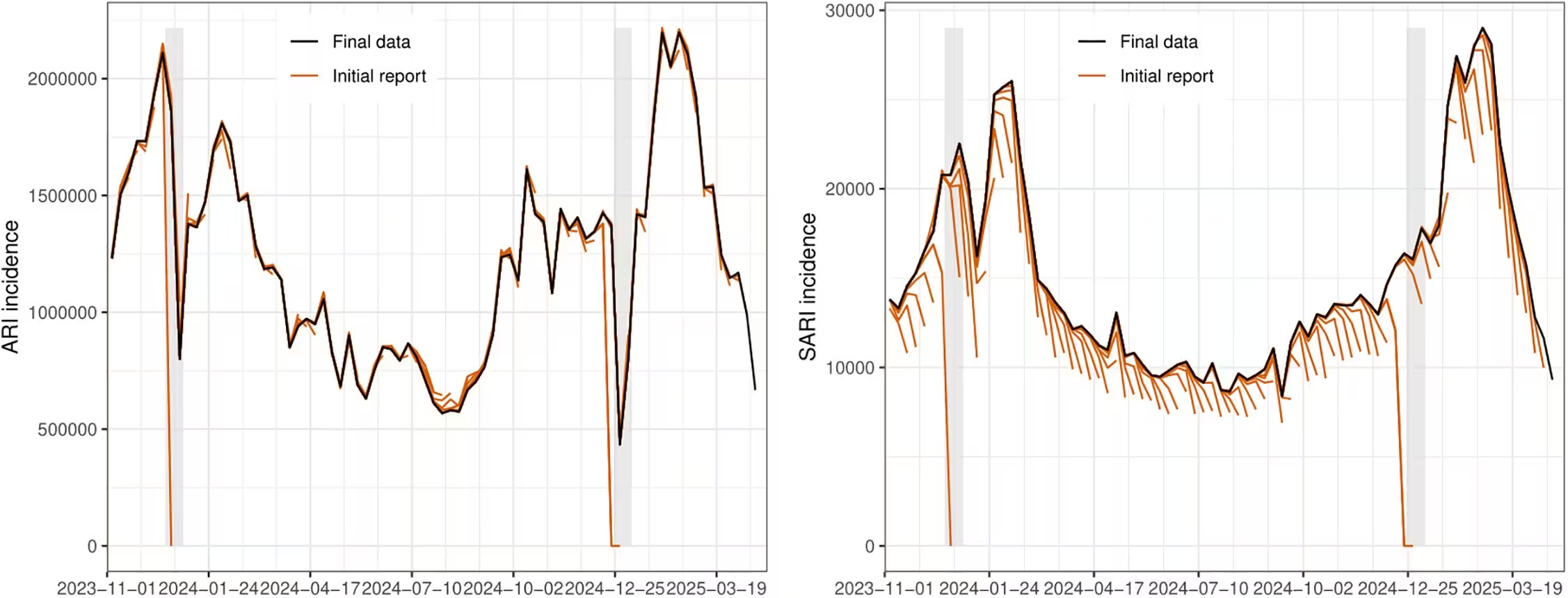
The forecasting framework relied on three broad model categories, including mechanistic compartmental models that simulate disease transmission, data-driven statistical models that analyze past patterns, and specialized nowcasting tools designed to correct for reporting delays. Because health data often takes days or weeks to clear administrative hurdles, the forecasting models had to be mathematically coupled with nowcasting systems to estimate what was happening at that exact moment before projecting one to four weeks into the future.
Why Did the Christmas Holidays Break the Predictions?
One of the most striking findings from the evaluation was how severely the winter holiday season disrupted algorithmic accuracy. Most models struggled to adjust to the sudden drop in doctor visits and delayed reporting during the Christmas and New Year break. Because the algorithms expected normal reporting patterns, the subsequent rebound in January caused nearly every model to suffer from an upward bias, predicting higher infection numbers than what actually materialized.
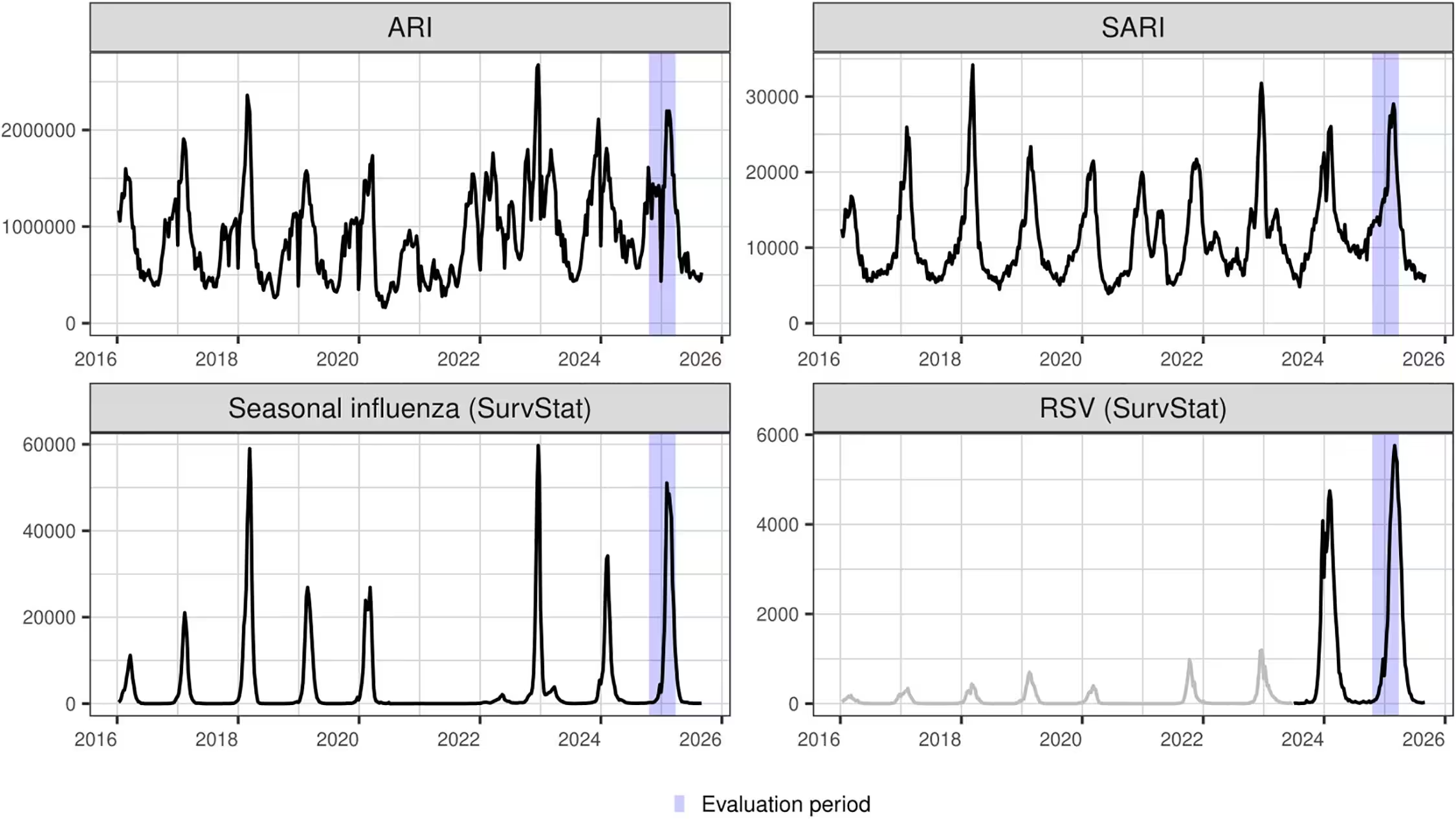
The team discovered that simple modifications could fix this blind spot. When researchers updated a seasonal time series model known as hhh4 to explicitly account for the first and last calendar weeks of the year, its predictive performance improved dramatically. Without that adjustment, however, most models failed to capture the holiday dip and prematurely predicted that the seasonal infection peak would arrive much earlier than it actually did.
What Were the Limits of the Multi-Model Ensemble Approach?
Combining multiple predictions into a single consensus forecast is a popular strategy in public health monitoring, but this season showed mixed results. For general practitioner consultations, an ensemble of models managed moderate improvements over a simple baseline that assumes tomorrow will look exactly like today. For severe hospitalizations, however, individual models and ensembles alike struggled to outperform basic persistence benchmarks at the one-week horizon, frequently underestimating the peak magnitude of the epidemic wave.
Age-stratified predictions offered finer details, showing that infection waves consistently hit younger age groups earlier before rippling through older populations who faced the highest risk of hospitalization. Yet, the authors note that incomplete real-time participation by some research teams meant that certain missing weekly forecasts had to be filled in retrospectively using historical data snapshots, introducing a potential risk of hindsight bias into the hybrid assessment.
What Comes Next for Infectious Disease Forecasting?
The 2024 and 2025 operational season demonstrated both the promise and the organizational fragility of running continuous public health prediction hubs. Maintaining constant participation from independent academic groups remains difficult amid shifting funding priorities and declining research focus on respiratory pathogens following the acute phase of the pandemic.
Despite these hurdles, the initiative successfully strengthened ties between academic modelers and Germany’s federal public health agency, the Robert Koch Institute, with certain nowcasting tools transitioning directly into routine weekly reporting. The authors suggest that future forecasting efforts might benefit from integrating emerging automated coding agents to streamline model updates, though human oversight remains essential to ensure these mathematical systems do not stumble when holiday disruptions rewrite the calendar.
The research was published in PLOS Computational Biology on November 23, 2026.
This article has been fact checked for accuracy, with information verified against reputable sources. Learn more about us and our editorial process.
Last reviewed on .
Article history
- Latest version
Reference(s)
- Bracher, Johannes., et al. “Multi-model forecasting of respiratory disease activity in Germany during the 2024–2025 season.” PLOS Computational Biology, vol. 22, no. 11, November 23, 2026, pp. e1014985 Public Library of Science (PLoS), doi: 10.1371/journal.pcbi.1014985. <https://doi.org/10.1371/journal.pcbi.1014985>.
Cite this page:
- Posted by Joseph Jackson