How Copper Migration Inside Microchip Wires Slashes Lifespans in Unexpected Ways
Simulations reveal that insoluble copper precipitates form abrupt steps that eliminate wire immortality and complicate accelerated aging tests.

Tiny amounts of copper added to aluminum wires inside microchips can dramatically extend their operating lifespan by slowing down the destructive movement of metal atoms driven by electric currents. Yet a team of researchers found that copper does not simply sit still or move uniformly, but instead forms microscopic steps and precipitates that can unexpectedly trigger failures under certain conditions. This complex interplay challenges decades-old industry assumptions about how microchip wiring degrades under intense heat and electrical stress.
How Does Copper Migration Shape Microchip Reliability?
Electromigration occurs when rushing electrons knock metal atoms out of place, gradually wearing away microscopic wires until they snap or short circuit. For more than thirty years, engineers have doped aluminum interconnects with about half a percent to two percent copper by weight to obstruct grain boundaries and lock aluminum atoms in place. Most theoretical models assumed that all copper atoms dissolved in the aluminum alloy move freely under the influence of electric fields, or that copper simply acts as a static roadblock.
To test these assumptions more rigorously, Narahara Chari Dingari of Worcester Polytechnic Institute and David R. Heskett of the University of Rhode Island developed a numerical simulation tracking both stress accumulation and copper redistribution across thousands of random grain maps. Their work is available on the arXiv preprint server. By coupling an evolving copper concentration field to the standard Korhonen stress equation, the authors modeled wide wires measuring ten micrometers across, narrow three-micrometer wires, and near-bamboo microstructures where individual grains span the entire width of the line.
Why Do Intermittent Copper Steps Remove Wire Immortality?
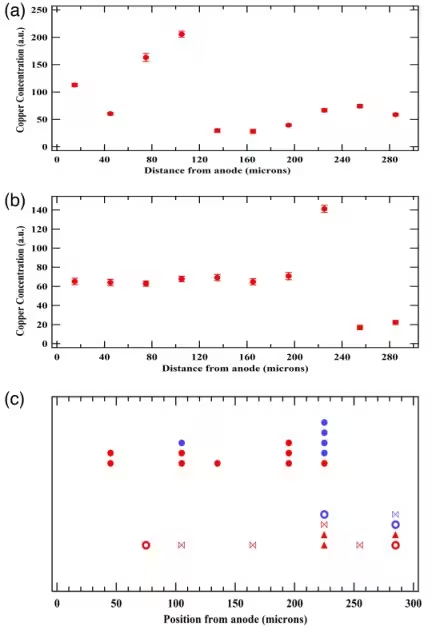
The simulations revealed a surprising distinction between dissolved copper and excess copper trapped as immobile precipitates. At two hundred degrees Celsius, the solubility limit of copper in aluminum is only about one-tenth of a percent by weight, meaning the vast majority of copper forms microscopic precipitates rather than dissolving into the metal matrix. When current flows, only the dissolved portion drifts toward the anode, leaving behind immobile precipitates that cannot travel backward.
In wide wires connected to large electrical reservoirs, this uneven movement creates sharp local concentration steps. Instead of protecting the wire, these copper steps act as severe flux divergences where mechanical stress builds up rapidly. The team reported that copper actually removes the long-term immortality previously predicted for certain wide wire geometries at low current densities, causing every simulated line to eventually fail as stress concentrates near these abrupt chemical boundaries.
What Happens When Accelerated Tests Are Extrapolated to Real Conditions?
Microchip manufacturers routinely test wiring reliability at elevated temperatures like two hundred fifty to three hundred degrees Celsius and high current densities, then use mathematical formulas such as Black’s law to predict how long the chips will survive at cooler everyday operating temperatures. The new study evaluated whether copper redistribution alters the current-density exponent, which typically stays near two for void nucleation driven by mechanical stress.
The calculations confirmed that for narrow lines where failures initiate at the cathode, the current-density exponent remains close to two regardless of whether copper is mobile or immobile. However, because copper solubility increases significantly at higher temperatures, the fraction of dissolved copper changes along the thermodynamic solvus curve. As a result, extrapolating high-temperature test data to cooler operating conditions can overestimate chip lifetimes by a factor of more than two when copper concentrations exceed the solubility limit.
What Are the Next Steps for Microchip Design Physics?
While the computer simulations successfully reproduced several qualitative features observed in physical experiments, such as cathode-side damage patterns and mid-line copper accumulation in wide wires, certain discrepancies remained. The one-dimensional model predicted wider depletion zones near cathodes in narrow lines than what physical cross-sectional analyses revealed. The authors note that incorporating finite-rate precipitate dissolution, explicit void growth stages, and fully resolved three-dimensional grain networks will be essential next steps for refining physical models of microchip degradation.
The study was posted to the arXiv preprint server on November 23, 2026.
This article has been fact checked for accuracy, with information verified against reputable sources. Learn more about us and our editorial process.
Last reviewed on .
Article history
- Latest version
Reference(s)
- Dingari, Narahara. “Solute-Aware Stochastic Korhonen Model of Electromigration in Wide vs Near-Bamboo Al-Cu Lines.” arXiv.org <http://arxiv.org/abs/2611.31206v1>.
Cite this page:
- Posted by Bilal Abbasi