Pressed Powder Pellet Reveals Antiferromagnetic Magnon Chirality Without Single Crystals
Strong magnetic fields lock spin precession across random grains, bypassing traditional crystal growth hurdles.
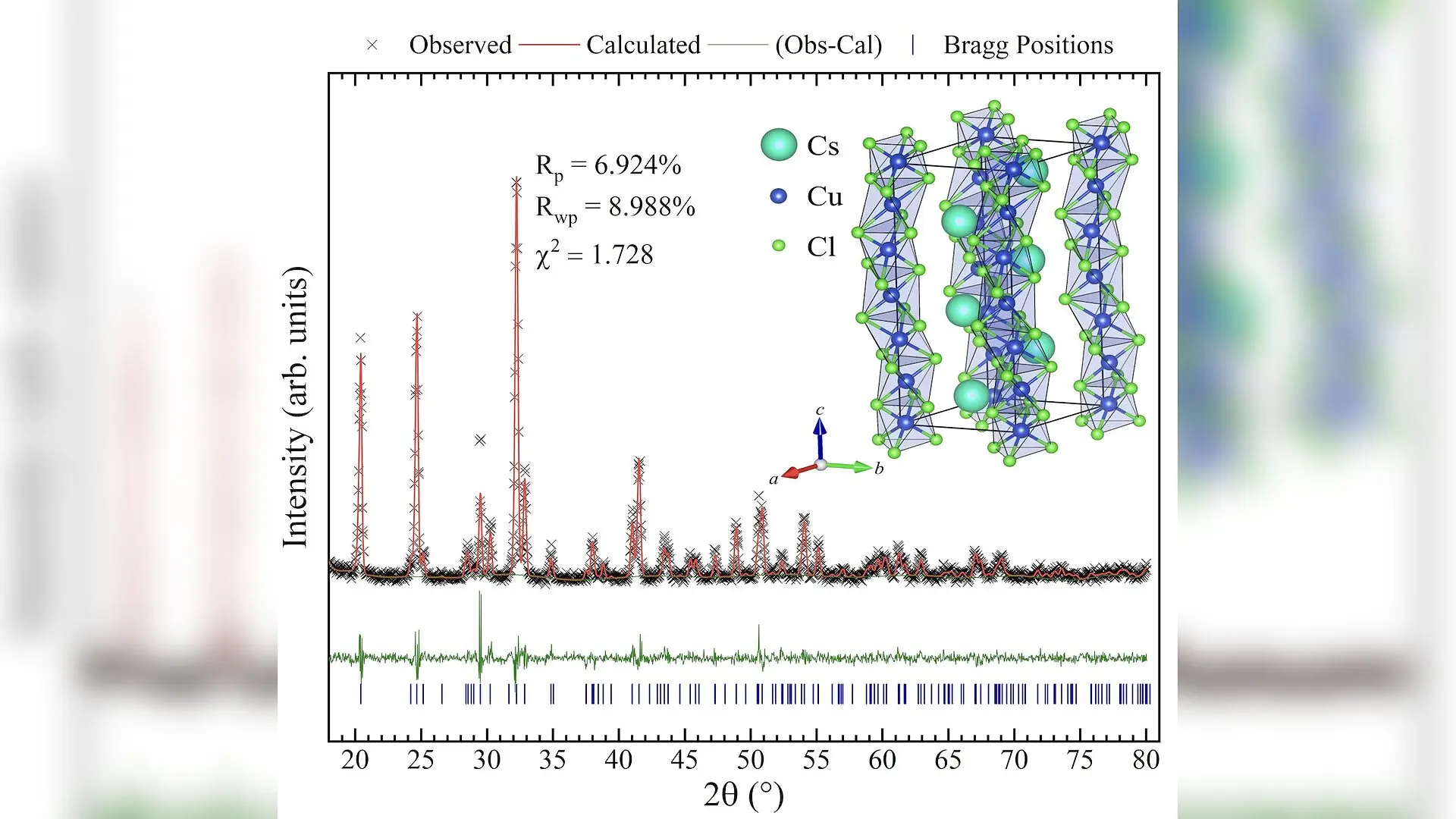
A compressed pellet of a chiral helimagnet called cesium copper chloride (CsCuCl3) can absorb sub-terahertz electromagnetic waves of one circular polarization more than twenty times as strongly as the opposite polarization when placed in a magnetic field between 5 and 7 Tesla. This laboratory-scale study demonstrates that external magnetic fields can lock the precession axis of magnetic excitations known as magnons across randomly oriented microscopic grains, bypassing the need for pristine single crystals.
How Can Random Grains Share One Precession Axis?
In standard antiferromagnets, individual crystal grains lack spontaneous magnetization, meaning their internal magnetic moments precess around axes dictated entirely by their own lattice orientations. When researchers examine a powdered or pressed sample, these random orientations typically blur out any directional signatures. However, when the work was published in a preprint server study available on arXiv, a team of physicists from the University of São Paulo discovered that a strong enough magnetic field completely overrides this local grain control.
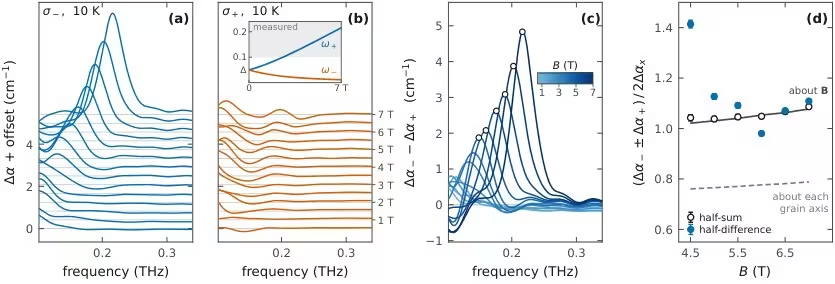
Lead author Juan S. Rodríguez-Hernández and their colleagues investigated how terahertz radiation interacts with polycrystalline samples containing mixed structural chiralities. They found that in fields ranging from 5 to 7 Tesla, the Zeeman frequency (the interaction energy between the magnetic field and the electron spins) becomes two to four times larger than the exchange-enhanced energy gap. This massive energy difference forces every grain to lock its precession axis directly to the external magnetic field rather than its internal atomic axes.
What Does Terahertz Spectroscopy Reveal About Magnon Chirality?
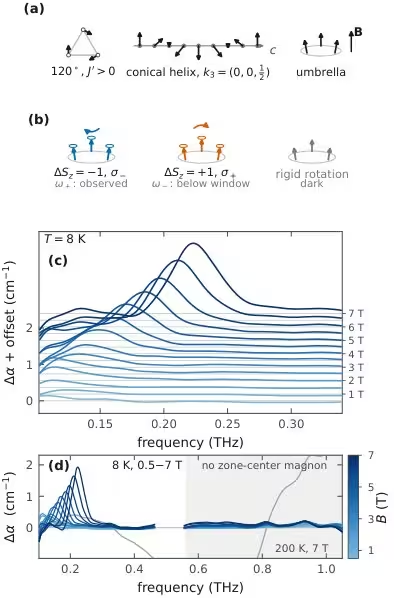
Magnons carry angular momentum and typically exist in pairs with opposite handedness, a property referred to as magnon chirality. Measuring this directional behavior has historically required large, flawless single crystals combined with polarization-resolved probes like inelastic neutron scattering or synchrotron x-rays. By crushing single crystals into particles measuring 10 to 50 micrometers and pressing them into a 1.3-millimeter-thick pellet, the team tested whether terahertz time-domain spectroscopy could still extract clear circular dichroism.
The spectral measurements showed that at 10 Kelvin and 7 Tesla, the active absorption channel peaked sharply while the opposite polarization channel remained virtually silent. The active channel absorbed radiation more than twenty times more strongly than the dark channel. If the grains had been precessing around their own internal axes, the expected ratio between these channels would have topped out at a factor of 7, confirming that the external field successfully dominated the magnetic dynamics.
Why Does Field Locking Matter for Frustrated Magnets?
The spin-wave analysis performed by the authors links these observations to the material’s complex underlying structure, where copper ions form ferromagnetic chains coupled antiferromagnetically on a triangular lattice. Dzyaloshinskii-Moriya interactions twist these chains into a helical pattern below a Néel temperature of 10.7 Kelvin. The data indicate that the same transition driving chiral magnons below the ordering temperature smoothly continues into a paramagnetic resonance above it, surviving up to 60 Kelvin.
These findings suggest that magnon chirality studies are no longer restricted to rare, perfectly ordered single crystals. Because field locking requires only a Zeeman frequency that exceeds the material energy gap, similar polarization-resolved terahertz measurements could soon be deployed across a wide range of frustrated magnets where large single-crystal samples are difficult or impossible to grow.
The study was posted to the arXiv preprint server on November 23, 2026.
This article has been fact checked for accuracy, with information verified against reputable sources. Learn more about us and our editorial process.
Last reviewed on .
Article history
- Latest version
Reference(s)
- Rodríguez-Hernández, Juan. “Terahertz detection of magnon chirality in polycrystalline CsCuCl$_3$.” arXiv.org <http://arxiv.org/abs/2611.30992v1>.
Cite this page:
- Posted by Anjali Singh