Engineered Microscopic Robots Swim Through Tumors to Solve Drug Delivery Bottlenecks
Biotechnology

Engineered Microscopic Robots Swim Through Tumors to Solve Drug Delivery Bottlenecks

A comprehensive review details how actively propelled nanorobots navigate biological barriers, though major hurdles remain for human clinical use.
By Robert Brown
Published:
Email this Article
Engineered Microscopic Robots Swim Through Tumors to Solve Drug Delivery Bottlenecks
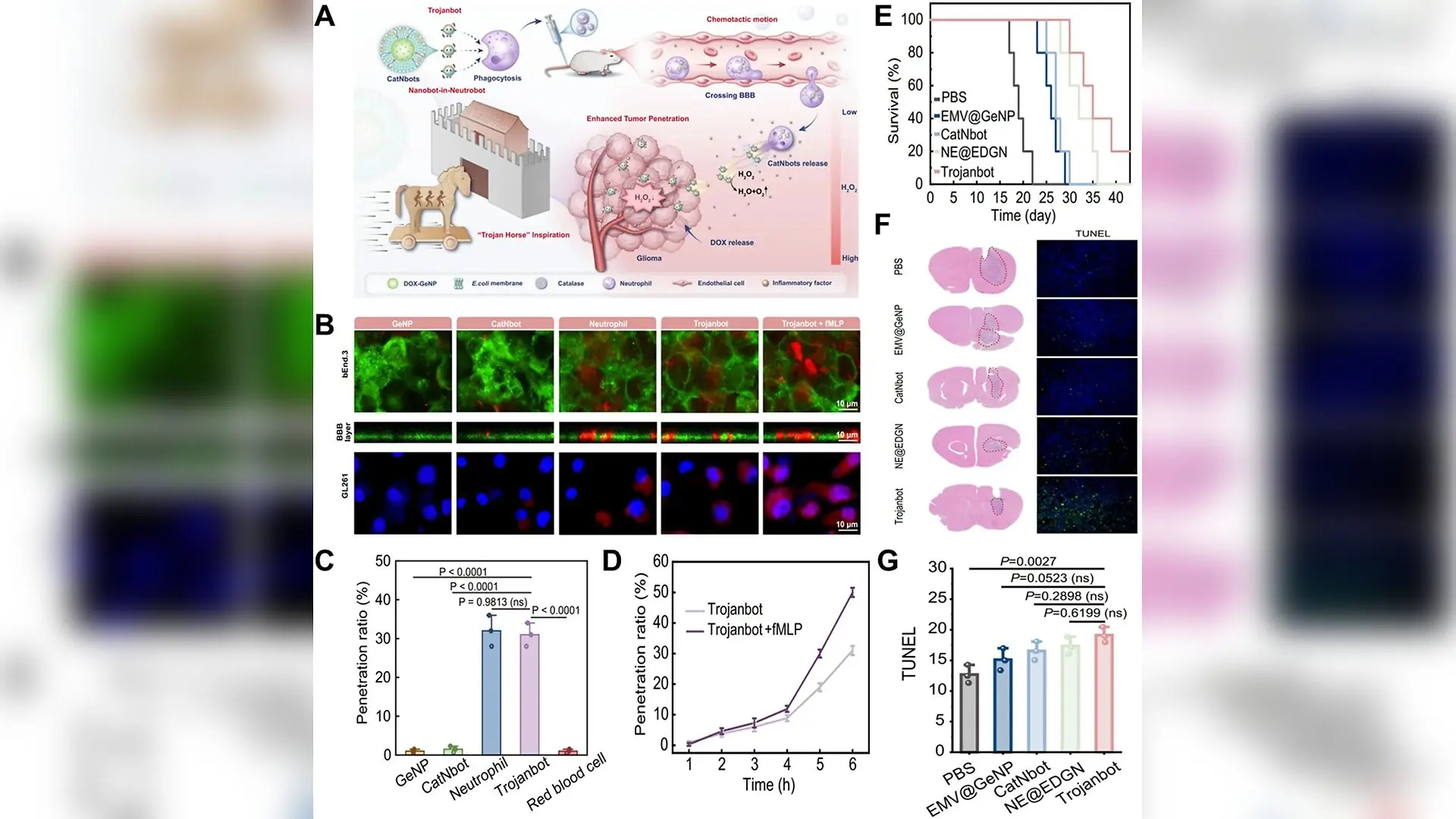
Trojanbot actively penetrating the BBB, achieving anti-glioma therapy. (A) Trojanbot fabrication and in vivo navigation. (B) Representative CLSM images of BBB penetration. Scale bar, 10 μm. (C) BBB penetration ratios at 6 h. (D) Time-dependent penetration with/without fMLP stimulation. (E) Survival curves of glioma-bearing mice. (F) Representative H&E and TUNEL staining. Red dashed lines indicate tumor regions, green indicates TUNEL-positive apoptotic cells, blue indicates nuclei. (G) Quantification of TUNEL fluorescence. Data are presented as mean ± SD. ns, not significant (P ≥ 0.05) (Adapted with permission from Ref.28 under the CC BY-NC-ND 4.0 license). Ying Zhou et al. / International journal of nanomedicine

Tiny engineered devices driven by chemical reactions or magnetic fields can actively swim through dense biological barriers to reach deep inside solid tumors, bypassing the sluggish blood flow that traps conventional drug carriers. Despite decades of intense investment, standard nanodrugs often fail to penetrate tumor interiors because they rely entirely on passive diffusion and fluid transport, leaving core cancer cells largely untouched.

A comprehensive review published in the International Journal of Nanomedicine by a multi-institutional team led by researchers at the Affiliated Hangzhou First People’s Hospital examines how microscale and nanoscale robots are designed to overcome these physical and biochemical bottlenecks. The authors, including Ying Zhou and colleagues, systematically evaluated how these active delivery systems navigate the body from initial injection down to intracellular targets.

How Do Tiny Machines Propel Themselves Through Human Tissues?

Micro/nanorobots generate active motion through a variety of energy sources, such as catalytic chemical reactions, external magnetic fields, ultrasound waves, and light stimulation. Enzyme-powered or catalytic motors convert local biological molecules like hydrogen peroxide, glucose, and lactate into asymmetric concentration gradients or gas bubbles that push the device forward. Alternatively, external magnetic fields can apply rotational torque and directional force, guiding devices along precise trajectories through deep tissue.
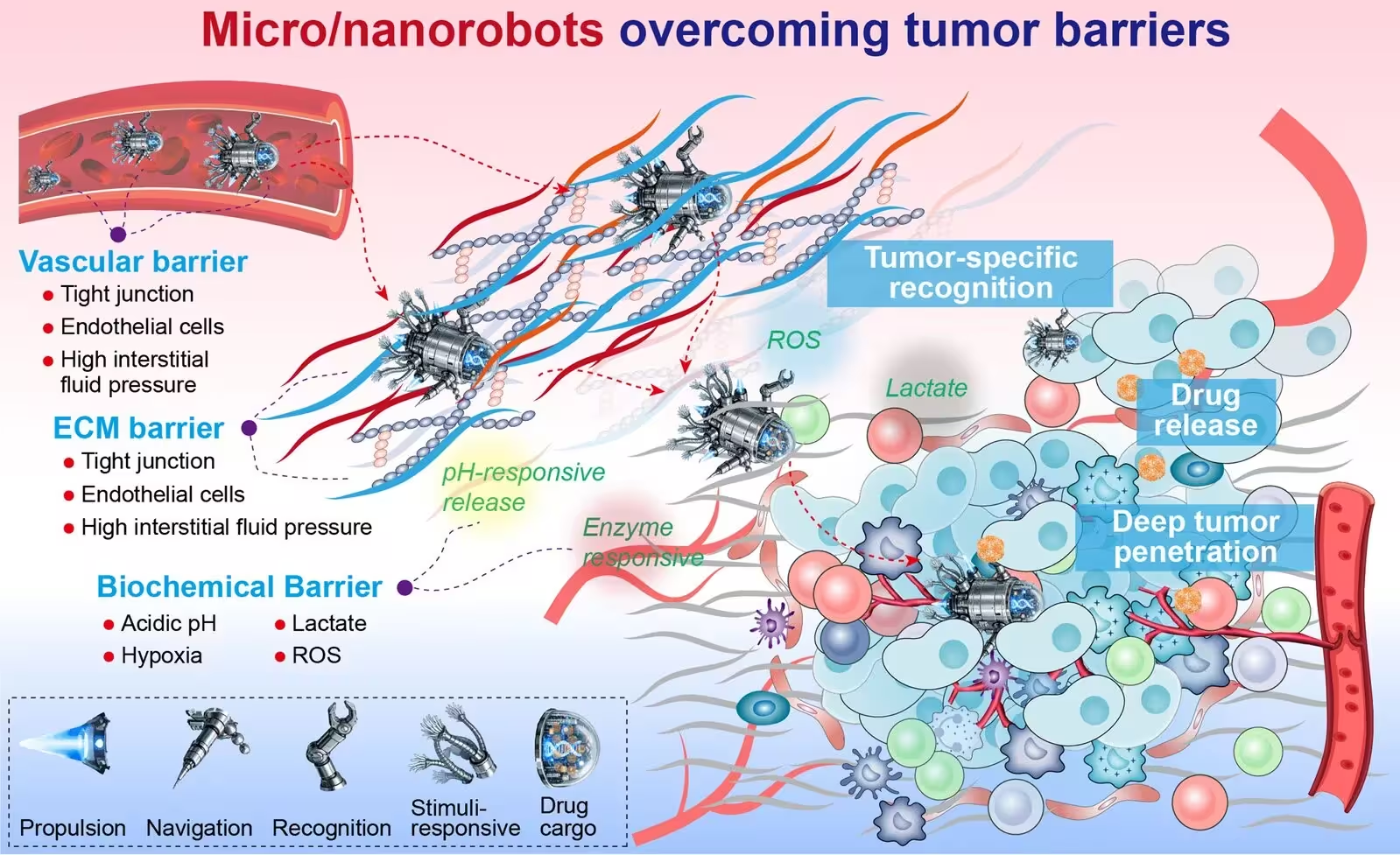
Figure 1: Core design principles of micro/nanorobots for tumor barrier navigation. Schematic overview of key micro/nanorobot design modules, including propulsion engines, directional navigation, structural adaptability, target recognition, and microenvironment-responsive activation, which collectively enable active tumor navigation and precision therapy.
Core design principles of micro/nanorobots for tumor barrier navigation. Schematic overview of key micro/nanorobot design modules, including propulsion engines, directional navigation, structural adaptability, target recognition, and microenvironment-responsive activation, which collectively enable active tumor navigation and precision therapy. Credit: Ying Zhou et al. / International journal of nanomedicine

These systems must be carefully engineered to withstand harsh biological environments where high fluid viscosity, ionic strength, and protein binding can quickly immobilize passive particles. The review notes that effective designs must balance propulsion power against biocompatibility, ensuring that catalytic components do not cause unwanted oxidative stress or tissue damage.

What Biological Obstacles Stand in Their Way?

To deliver therapeutics successfully, these robots must conquer a sequential gauntlet of physiological hurdles known in drug delivery frameworks as the circulation, accumulation, penetration, internalization, and release cascade. Upon entering the bloodstream, raw nanoparticles quickly attract plasma proteins that form a crown, triggering immune clearance by macrophage cells in the liver and spleen.

To outsmart immune surveillance, scientists have developed biohybrid platforms such as neutrophil-based micromotors. In one highlighted study, researchers encapsulated drug-loaded magnetic nanogels inside living white blood cells coated with bacterial membranes. This camouflage reduced rapid immune recognition and significantly improved targeted delivery to aggressive brain tumors like glioblastoma.
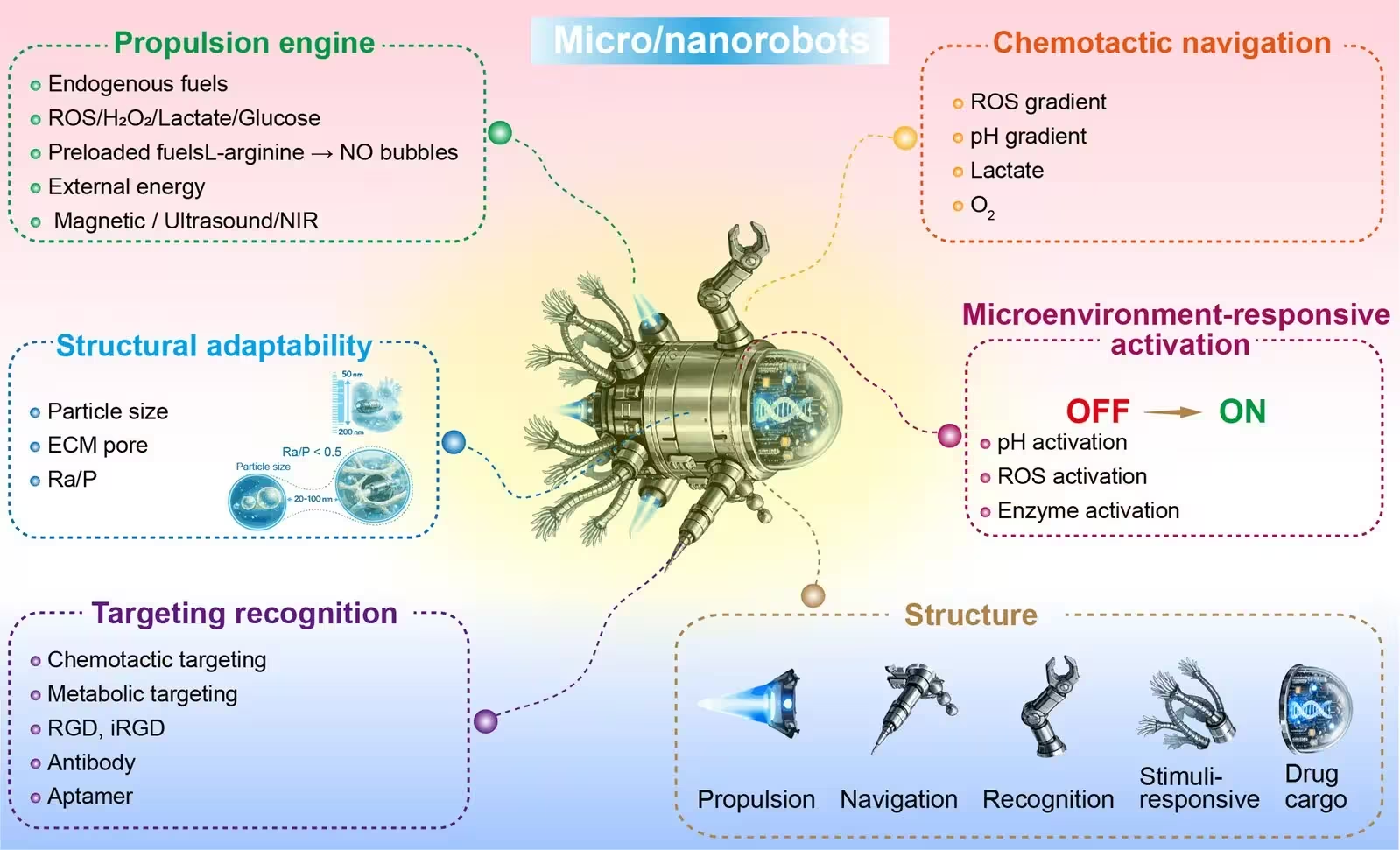
Figure 2: Micro/nanorobots for multistage tumor barrier navigation. Schematic illustration of micro/nanorobots navigating sequential tumor barriers, including vascular, ECM, and biochemical barriers. Integrated propulsion, tumor recognition, and microenvironment-responsive activation facilitate barrier navigation, deep tumor penetration, and controlled payload release. RGD, Arg-Gly-Asp; iRGD, internalizing RGD peptide; Rₐ/P, particle-to-pore size ratio.
Micro/nanorobots for multistage tumor barrier navigation. Schematic illustration of micro/nanorobots navigating sequential tumor barriers, including vascular, ECM, and biochemical barriers. Integrated propulsion, tumor recognition, and microenvironment-responsive activation facilitate barrier navigation, deep tumor penetration, and controlled payload release. RGD, Arg-Gly-Asp; iRGD, internalizing RGD peptide; Rₐ/P, particle-to-pore size ratio. Credit: Ying Zhou et al. / International journal of nanomedicine

Can These Devices Breach the Blood-Brain Barrier and Dense Matrix?

Reaching tumors nestled behind specialized protective layers requires sophisticated navigation strategies. For instance, specialized robotic constructs have demonstrated the ability to cross the blood-brain barrier by following biochemical gradients and inflammatory signals released by diseased brain tissue. Once they arrive at the tumor site, dense extracellular matrix networks and high internal fluid pressure often halt conventional drug movement.

To tackle this structural mesh, advanced nanorobots utilize localized heat generation or enzymatic degradation to loosen collagen fibers, clearing a path for deeper tissue infiltration. Other designs rely on self-diffusiophoretic motion, swimming autonomously through tight interstitial spaces without disrupting the surrounding extracellular architecture.
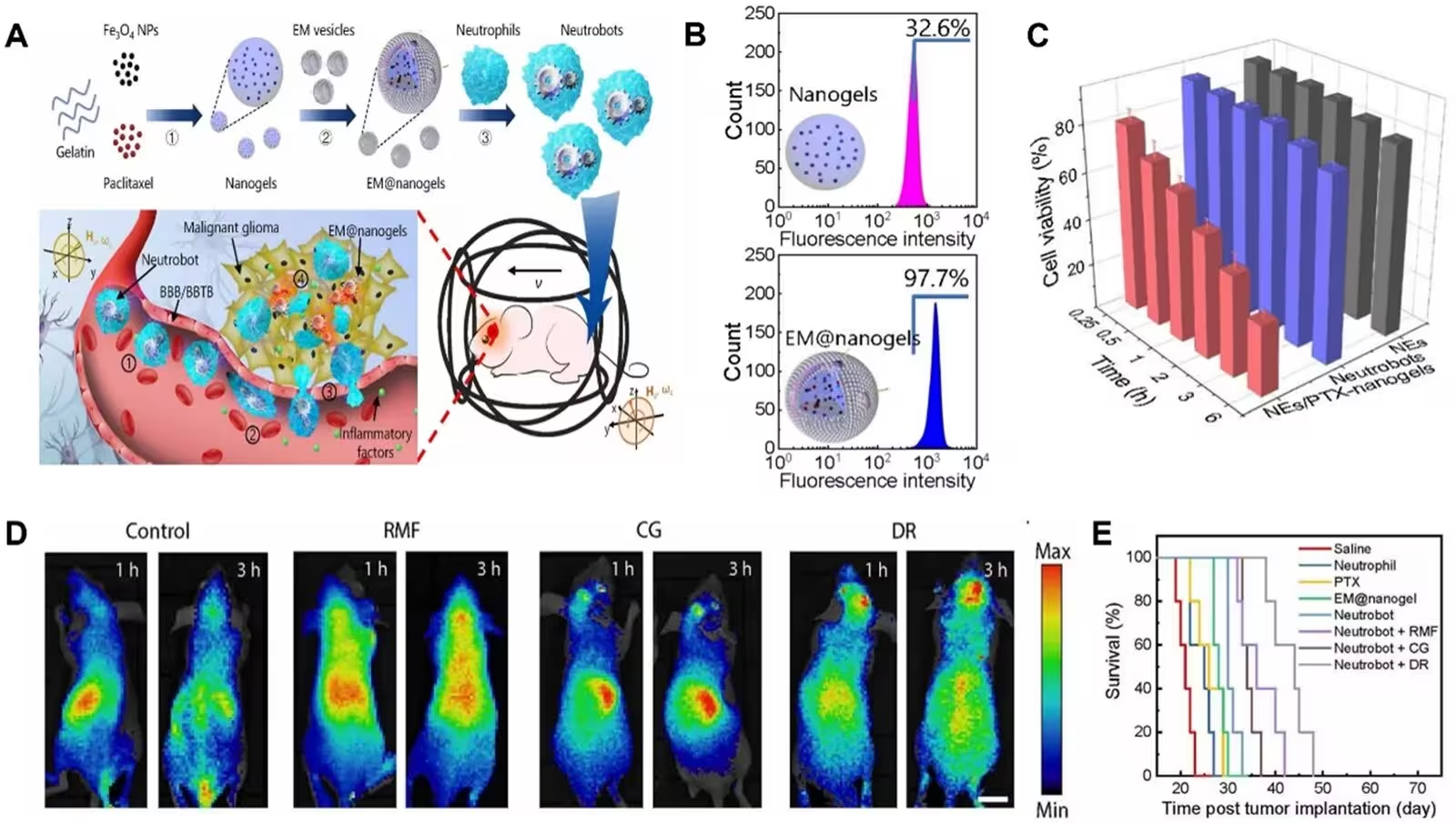
Figure 3: Fuel-responsive biohybrid neutrobot overcoming immune/phagocytic clearance barriers and enhancing GBM therapy. (A) Schematic illustration of active GBM delivery. ①, ②, ③, ④ represent the sequential biological processes of neutrobots crossing the blood-brain barrier/blood-brain tumor barrier, responding to inflammatory factors, penetrating tumor tissue and releasing drugs, respectively. (B) Nanogel uptake analysis of neutrophils detected by flow cytometry; annotated values represent that 97.7% of neutrophils engulfed EM@nanogels and 32.6% of neutrophils loaded with bare nanogels. (C) Cell viability analysis. (D) In vivo fluorescence image. (E) Survival curves of glioma-bearing mice (Adapted with permission from Ref.55 Copyright © 2021 American Association for the Advancement of Science).
Fuel-responsive biohybrid neutrobot overcoming immune/phagocytic clearance barriers and enhancing GBM therapy. (A) Schematic illustration of active GBM delivery. ①, ②, ③, ④ represent the sequential biological processes of neutrobots crossing the blood-brain barrier/blood-brain tumor barrier, responding to inflammatory factors, penetrating tumor tissue and releasing drugs, respectively. (B) Nanogel uptake analysis of neutrophils detected by flow cytometry; annotated values represent that 97.7% of neutrophils engulfed EM@nanogels and 32.6% of neutrophils loaded with bare nanogels. (C) Cell viability analysis. (D) In vivo fluorescence image. (E) Survival curves of glioma-bearing mice (Adapted with permission from Ref.55 Copyright © 2021 American Association for the Advancement of Science). Credit: Ying Zhou et al. / International journal of nanomedicine

What Challenges Remain Before Human Trials?

Despite impressive preclinical results in cell cultures and small-animal models, translating these robotic platforms into human therapies remains a monumental challenge. Human tumors are vastly larger, more structurally complex, and more heterogeneous than murine models, meaning that propulsion forces observed in a millimeter-scale mouse lesion may fall short across human organ systems.

Furthermore, researchers emphasize the need for rigorous standardized benchmarking. Many laboratory studies measure effective diffusion coefficients in simple buffers, which do not reflect real-world performance in whole blood or dense tumor tissue. Future development will require stringent quality control, scalable manufacturing techniques, and clear proof that active robotic propulsion provides a distinct clinical advantage over traditional, simpler drug formulations.

The research was published in International journal of nanomedicine on November 17, 2026.

Fact Checked

This article has been fact checked for accuracy, with information verified against reputable sources. Learn more about us and our editorial process.

Last reviewed on .

Article history

  • Latest version

Reference(s)

  1. Zhou, Ying., et al. “Engineering Micro/Nanorobots for Tumor Barrier Crossing: Design Principles, Multilevel Barrier Overcoming, and Challenges Toward Clinical Intelligence.” International Journal of Nanomedicine, vol. Volume 21, November 1, 2026, pp. 1-27. Informa UK Limited, doi: 10.2147/IJN.S641995. <https://doi.org/10.2147/IJN.S641995>.

Cite this page:

Brown, Robert. “Engineered Microscopic Robots Swim Through Tumors to Solve Drug Delivery Bottlenecks.” BioScience. BioScience ISSN 2521-5760, 24 November 2026. <https://www.bioscience.com.pk/en/subject/biotechnology/engineering-micro-nanorobots-for-tumor-barrier-crossing-design-principles-multilevel-barrier-overcoming-and-challenges-toward-clinical-intelligence>. Brown, R. (2026, November 24). “Engineered Microscopic Robots Swim Through Tumors to Solve Drug Delivery Bottlenecks.” BioScience. ISSN 2521-5760. Retrieved November 24, 2026 from https://www.bioscience.com.pk/en/subject/biotechnology/engineering-micro-nanorobots-for-tumor-barrier-crossing-design-principles-multilevel-barrier-overcoming-and-challenges-toward-clinical-intelligence Brown, Robert. “Engineered Microscopic Robots Swim Through Tumors to Solve Drug Delivery Bottlenecks.” BioScience. ISSN 2521-5760. https://www.bioscience.com.pk/en/subject/biotechnology/engineering-micro-nanorobots-for-tumor-barrier-crossing-design-principles-multilevel-barrier-overcoming-and-challenges-toward-clinical-intelligence (accessed November 24, 2026).
End of the article