Artificial Intelligence Transforms Nanomedicine Design But Faces Major Clinical Validation Hurdles
A comprehensive review outlines how machine learning can optimize targeted drug delivery carriers while emphasizing the critical need for rigorous clinical validation.

Artificial intelligence is transforming how scientists design targeted drug delivery systems, helping engineers tackle major bottlenecks that have limited medical nanotechnologies for decades. Despite thousands of laboratory formulations created to transport cancer therapies and gene treatments, most nanocarriers fail to translate into successful human treatments because their behavior inside living organisms remains notoriously unpredictable.
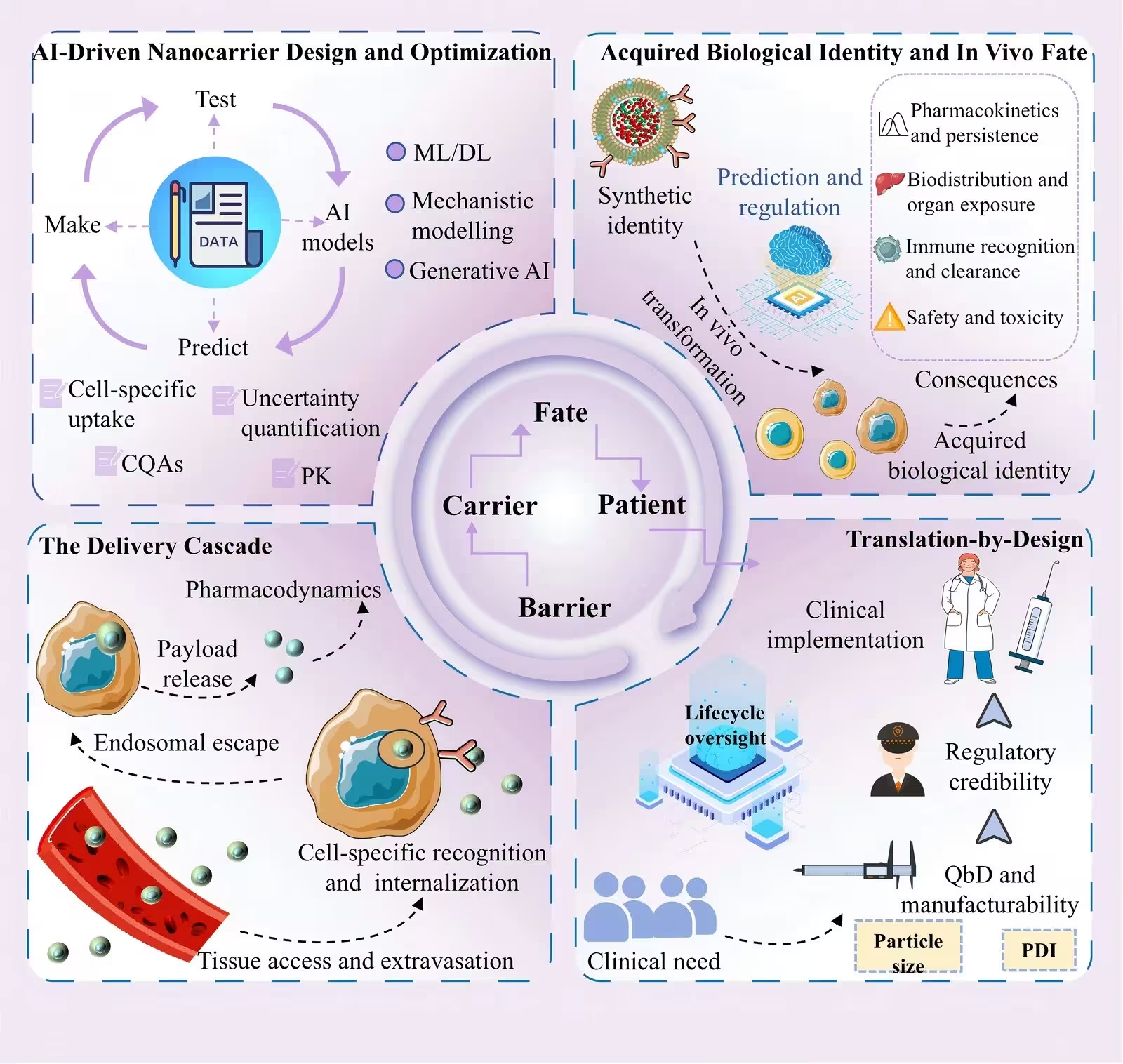
To address this clinical barrier, a comprehensive review published in the International Journal of Nanomedicine by MengJia Li and colleagues from Xichang People’s Hospital and other institutions examines how artificial intelligence can bridge the gap between computer models and real-world medicine. The authors propose an integrated framework that connects computational design, biological fate prediction, and clinical translation into a single pipeline.
Why Do Advanced Drug Carriers Struggle in the Body?
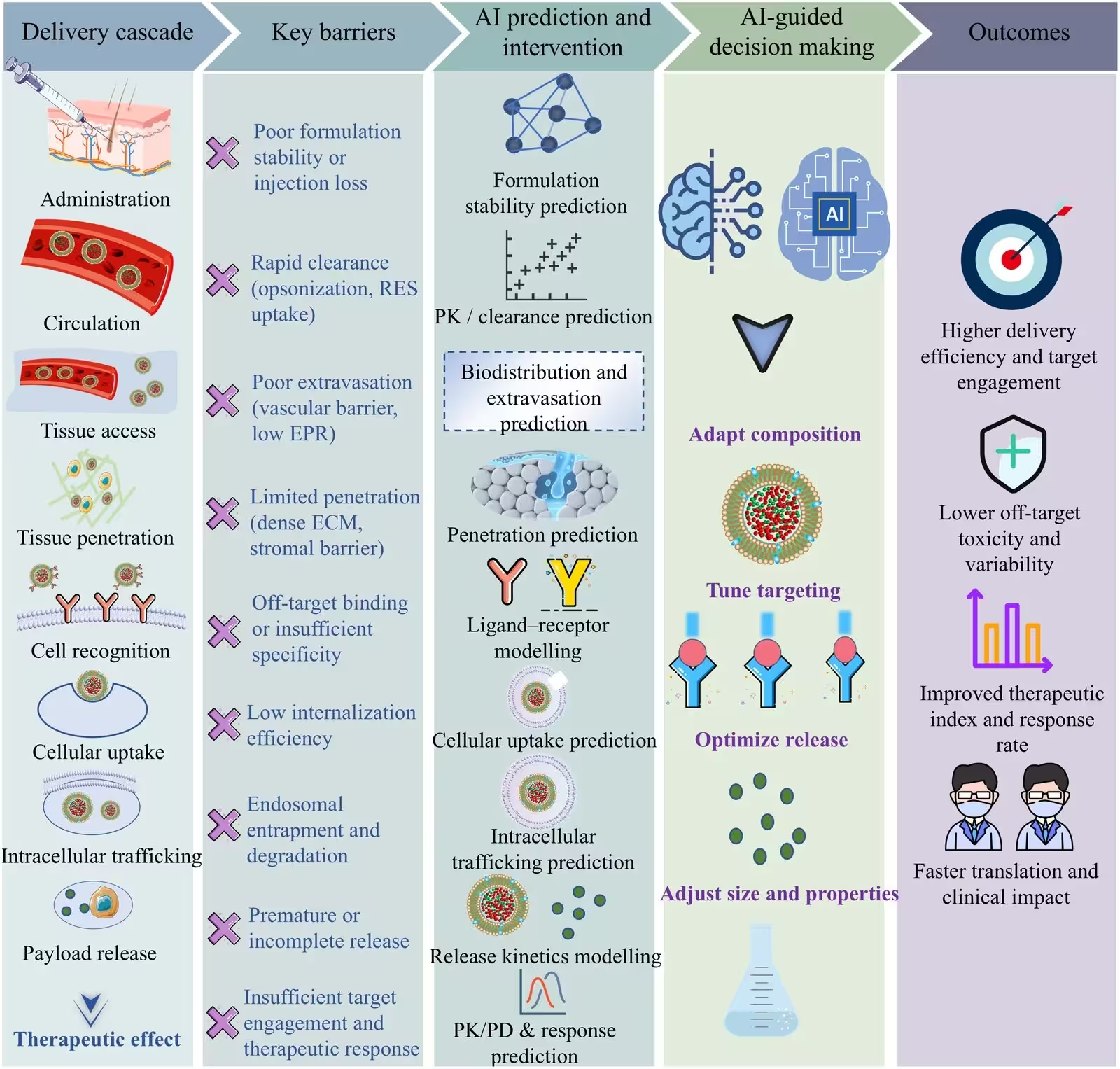
Targeted drug delivery is not a single event, but rather a complex multistep biological cascade. After injection, a microscopic carrier must circulate safely, avoid immune clearance, cross vascular barriers, penetrate dense diseased tissue, enter specific cells, and release its therapeutic payload at the precise time and place.
Traditional trial-and-error development struggles with this multi-objective design space because changing one property often worsens another. For instance, increasing a carrier’s stability to prevent premature leakage may also prevent it from releasing its drug payload at the tumor site. Artificial intelligence can analyze these nonlinear interactions to identify optimal formulation designs.
What is the Principle of Minimum Sufficient Complexity?
A central concept introduced by the researchers is translation-by-design, emphasizing that the most effective nanocarrier is not the most multifunctional or complex system, but the least complex platform that can successfully solve a defined delivery problem. Added structural features, such as targeting ligands or imaging labels, should only be included if they directly overcome a demonstrated failure point.
The review categorizes nanocarrier platforms by their best-suited delivery roles:
- Nanocrystals and Liposomes: Best for improving the solubility, pharmacokinetics, and tolerability of small-molecule drugs with minimal structural complexity.
- Lipid Nanoparticles: Essential for protecting and delivering nucleic acid payloads like mRNA and siRNA into cells.
- Polymeric Systems: Offer high programmability for sustained or stimulus-responsive release profiles.
- Inorganic and Biomimetic Carriers: Integrate imaging or cell membrane interfaces to enable advanced theranostic functions.
How Does Artificial Intelligence Improve Formulation and Safety?
Machine learning and deep learning models can predict critical quality attributes, such as particle size, encapsulation efficiency, and storage stability. Furthermore, hybrid models combine data-driven learning with physical and chemical constraints to simulate pharmacokinetics and tumor delivery in living models.
However, the authors caution that most current AI models rely on internal validation or simple laboratory datasets, lacking the independent external testing required for clinical reliability. Moreover, nanocarriers quickly acquire an acquired biological identity when exposed to blood proteins and immune cells, transforming their surface characteristics after administration.
What Challenges Remain Before Clinical Implementation?
The primary hurdle facing AI-enabled nanomedicine is the scarcity of standardized human-relevant data, alongside the challenge of biological variability across different patients and disease lesions. Future development must transition from retrospective data fitting to prospective validation, ensuring that computational predictions can reliably guide clinical decisions and improve patient outcomes.
The research was published in International journal of nanomedicine on November 17, 2026.
This article has been fact checked for accuracy, with information verified against reputable sources. Learn more about us and our editorial process.
Last reviewed on .
Article history
- Latest version
Reference(s)
- Li, MengJia., et al. “Artificial Intelligence-Guided Precision Nanomedicine: Bridging Delivery Barriers, Controlled Release, and Clinical Translation.” International Journal of Nanomedicine, vol. Volume 21, November 1, 2026, pp. 1-44. Informa UK Limited, doi: 10.2147/IJN.S652520. <https://doi.org/10.2147/IJN.S652520>.
Cite this page:
- Posted by Rohan Kumar