Blood Marker Elevation in Breast Cancer Patients Surprisingly Linked to Better Survival Rates
Biotechnology

Blood Marker Elevation in Breast Cancer Patients Surprisingly Linked to Better Survival Rates

A new clinical study reveals that elevated blood serum proteins involved in immune recognition correlate with longer survival in breast cancer patients.

By Robert Brown
Published:
Email this Article
Blood Marker Elevation in Breast Cancer Patients Surprisingly Linked to Better Survival Rates
Photo by Sasun Bughdaryan on Unsplash

Patients with early and invasive breast cancer show surprisingly elevated levels of circulating immune molecules in their blood, and higher concentrations of these proteins correlate with longer overall survival, according to a recent clinical study.

The research, published in BMC Cancer by Christian M. Tegeler and colleagues at the University Hospital Tübingen, explores how classical soluble human leukocyte antigen class I molecules, which are protein complexes normally involved in presenting molecular fragments to immune cells, behave in patients diagnosed with breast tumors.

Why Do Soluble Immune Markers Rise During Early Tumor Stages?

Human leukocyte antigen molecules typically sit on the surfaces of cells to help the immune system distinguish healthy tissue from infected or malignant cells. However, pieces of these markers also shed or release into the bloodstream as soluble variants known as soluble human leukocyte antigen or sHLA complexes. Researchers have long debated whether these circulating proteins suppress immune defenses or reflect active immune recognition against a growing tumor.
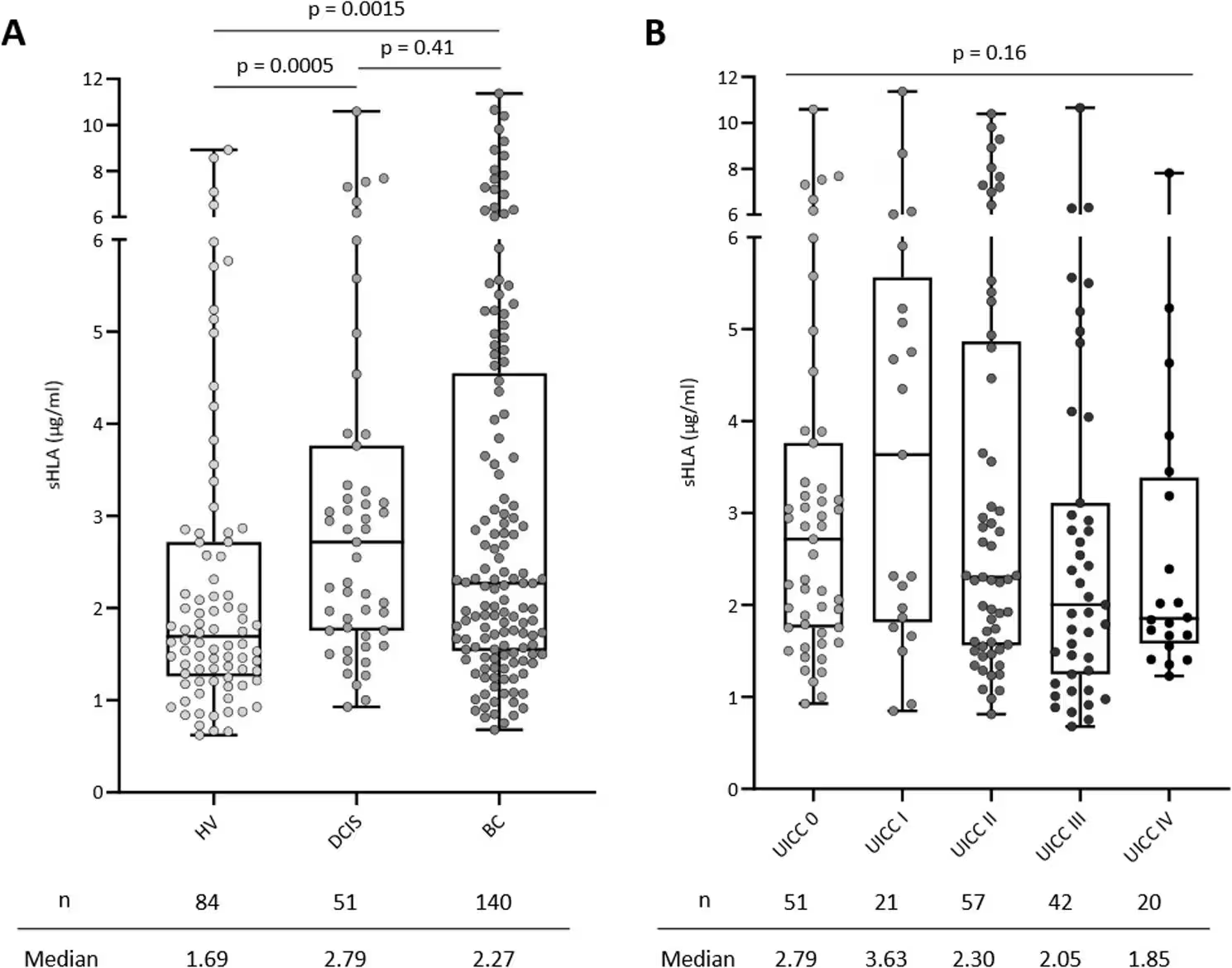
Fig. 1: Quantification of classical soluble HLA class I in patients with ductal carcinoma in situ and invasive breast cancer. A Serum concentration of sHLA class I (HLA-A, -B, -C) in serum of HV (n = 84), patients with DCIS (n = 51) and BC (n = 140). B Serum concentration of sHLA class I in regard to UICC tumor stage in patients with DCIS (UICC 0, n = 51) and BC (UICC I - IV, n = 140). Each dot represents the sHLA class I serum level of a single individual measured by enzyme-linked immunosorbent assay (ELISA). Boxes represent median with 25% to 75% quantiles and min/max whiskers. Kruskal-Wallis test with Dunn’s multiple comparisons test. Abbreviations: HV, healthy volunteers; DCIS, patients with ductal carcinoma in situ; BC, patients with invasive breast cancer; UICC 0 - UICC IV, tumor stage according to Union for International Cancer Control classification; p, p value
Quantification of classical soluble HLA class I in patients with ductal carcinoma in situ and invasive breast cancer. A Serum concentration of sHLA class I (HLA-A, -B, -C) in serum of HV (n = 84), patients with DCIS (n = 51) and BC (n = 140). B Serum concentration of sHLA class I in regard to UICC tumor stage in patients with DCIS (UICC 0, n = 51) and BC (UICC I - IV, n = 140). Each dot represents the sHLA class I serum level of a single individual measured by enzyme-linked immunosorbent assay (ELISA). Boxes represent median with 25% to 75% quantiles and min/max whiskers. Kruskal-Wallis test with Dunn’s multiple comparisons test. Abbreviations: HV, healthy volunteers; DCIS, patients with ductal carcinoma in situ; BC, patients with invasive breast cancer; UICC 0 - UICC IV, tumor stage according to Union for International Cancer Control classification; p, p value Credit: Christian M Tegeler et al. / BMC cancer

To investigate this relationship, the research team analyzed pretreatment blood serum from one hundred ninety-one patients. The cohort included fifty-one individuals with ductal carcinoma in situ, which is a non-invasive precursor lesion where abnormal cells line the milk ducts, and one hundred forty patients with invasive breast cancer. The findings were compared against a healthy control group of eighty-four volunteers.

What Did Blood Tests Reveal About Patient Survival Rates?

The laboratory analyses showed that classical soluble human leukocyte antigen class I serum levels were significantly higher in patients with non-invasive and invasive breast tumors compared to healthy individuals. Specifically, the median concentration reached about two point seventy-nine micrograms per milliliter in the ductal carcinoma in situ group and two point twenty-seven micrograms per milliliter in the invasive breast cancer group, while healthy volunteers exhibited a median of just one point sixty-nine micrograms per milliliter.

When tracking clinical outcomes over a follow-up period of up to ten years, the investigators discovered that patients in the highest quartile of soluble human leukocyte antigen concentrations experienced more favorable overall survival rates. Statistical models adjusting for age and baseline metastatic status confirmed that elevated levels of these blood proteins remained independently associated with a lower hazard of death.
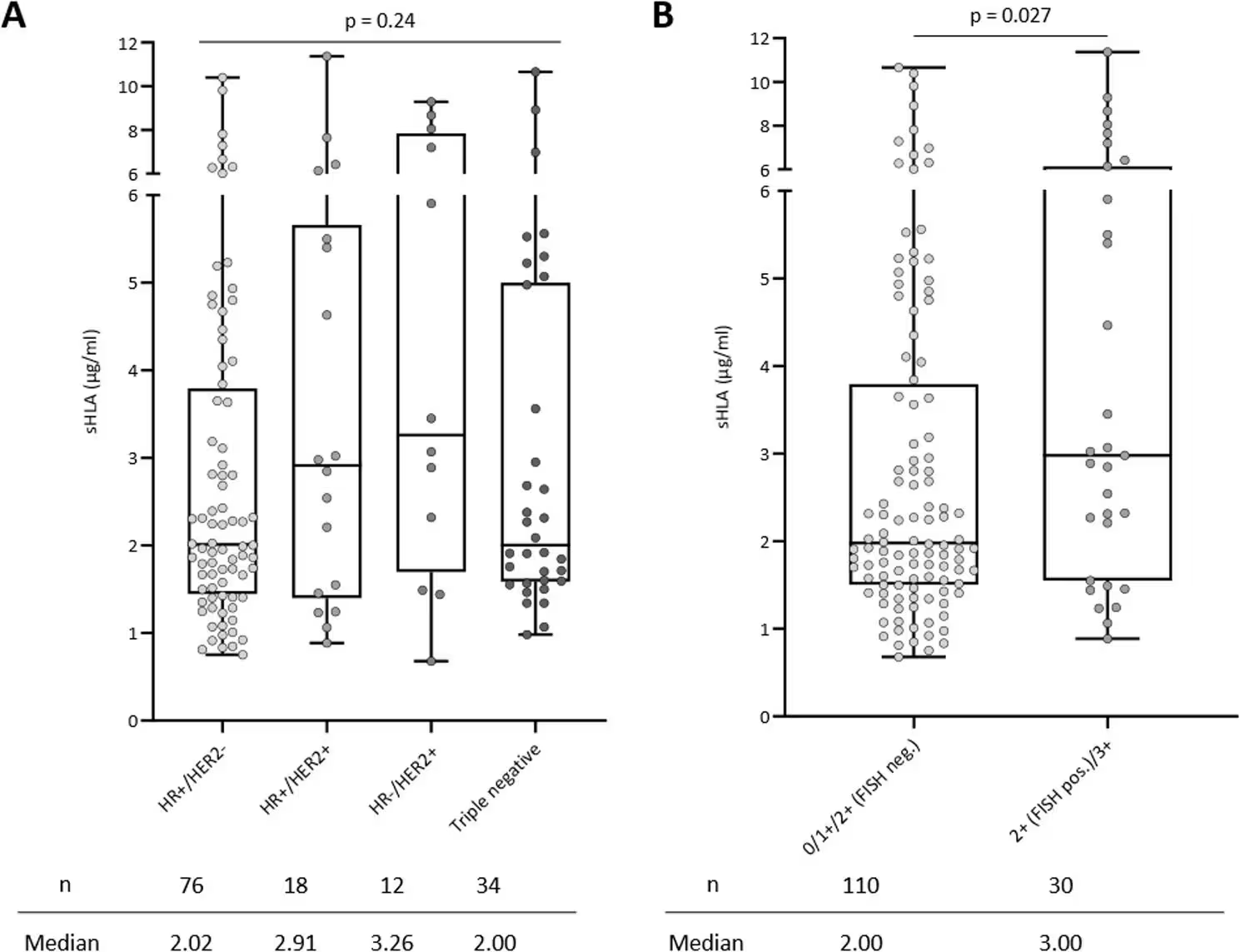
Fig. 2: Quantification of soluble HLA class I according to molecular characteristics. A Serum concentration of sHLA class I (HLA-A, -B, -C) in patients with BC (n = 140) according to molecular subtype. B Serum concentration of sHLA class I in patients with BC (n = 140) according to HER2 expression. Each dot represents the sHLA serum level of a single patient measured by enzyme-linked immunosorbent assay (ELISA). Boxes represent median with 25% to 75% quantiles and min/max whiskers. A Kruskal-Wallis test, B Mann-Whitney U test. Abbreviations: sHLA, soluble HLA; HR+/HER2-, hormone receptor positive, human epidermal growth factor receptor 2 negative; HR+/HER2+, hormone receptor positive, human epidermal growth factor receptor 2 positive; HR-/HER2+, hormone receptor negative with 3 + or 2+ (with positive fluorescence in situ hybridization (FISH)) HER2-staining in immunohistochemistry; TNBC, triple-negative breast cancer; 0/1+/2+ (FISH neg.), no therapy-relevant overexpression of HER2; 2+ (FISH pos
Quantification of soluble HLA class I according to molecular characteristics. A Serum concentration of sHLA class I (HLA-A, -B, -C) in patients with BC (n = 140) according to molecular subtype. B Serum concentration of sHLA class I in patients with BC (n = 140) according to HER2 expression. Each dot represents the sHLA serum level of a single patient measured by enzyme-linked immunosorbent assay (ELISA). Boxes represent median with 25% to 75% quantiles and min/max whiskers. A Kruskal-Wallis test, B Mann-Whitney U test. Abbreviations: sHLA, soluble HLA; HR+/HER2-, hormone receptor positive, human epidermal growth factor receptor 2 negative; HR+/HER2+, hormone receptor positive, human epidermal growth factor receptor 2 positive; HR-/HER2+, hormone receptor negative with 3 + or 2+ (with positive fluorescence in situ hybridization (FISH)) HER2-staining in immunohistochemistry; TNBC, triple-negative breast cancer; 0/1+/2+ (FISH neg.), no therapy-relevant overexpression of HER2; 2+ (FISH pos Credit: Christian M Tegeler et al. / BMC cancer

How Does Tumor Subtype Influence Circulating Protein Levels?

The study also examined whether protein concentrations varied across different molecular subtypes of breast cancer. While overall levels did not differ significantly across standard hormone receptor classifications, patients whose tumors showed overexpression of the human epidermal growth factor receptor 2 protein exhibited notably higher soluble human leukocyte antigen concentrations than those without this specific receptor amplification.

Interestingly, patients with four or more lymph node metastases displayed lower soluble protein levels compared to those without nodal involvement, indicating that the circulating molecules do not simply act as a passive proxy for total tumor mass. Instead, the authors suggest that these elevated blood markers may reflect robust systemic immune activation and productive tumor immunosurveillance.
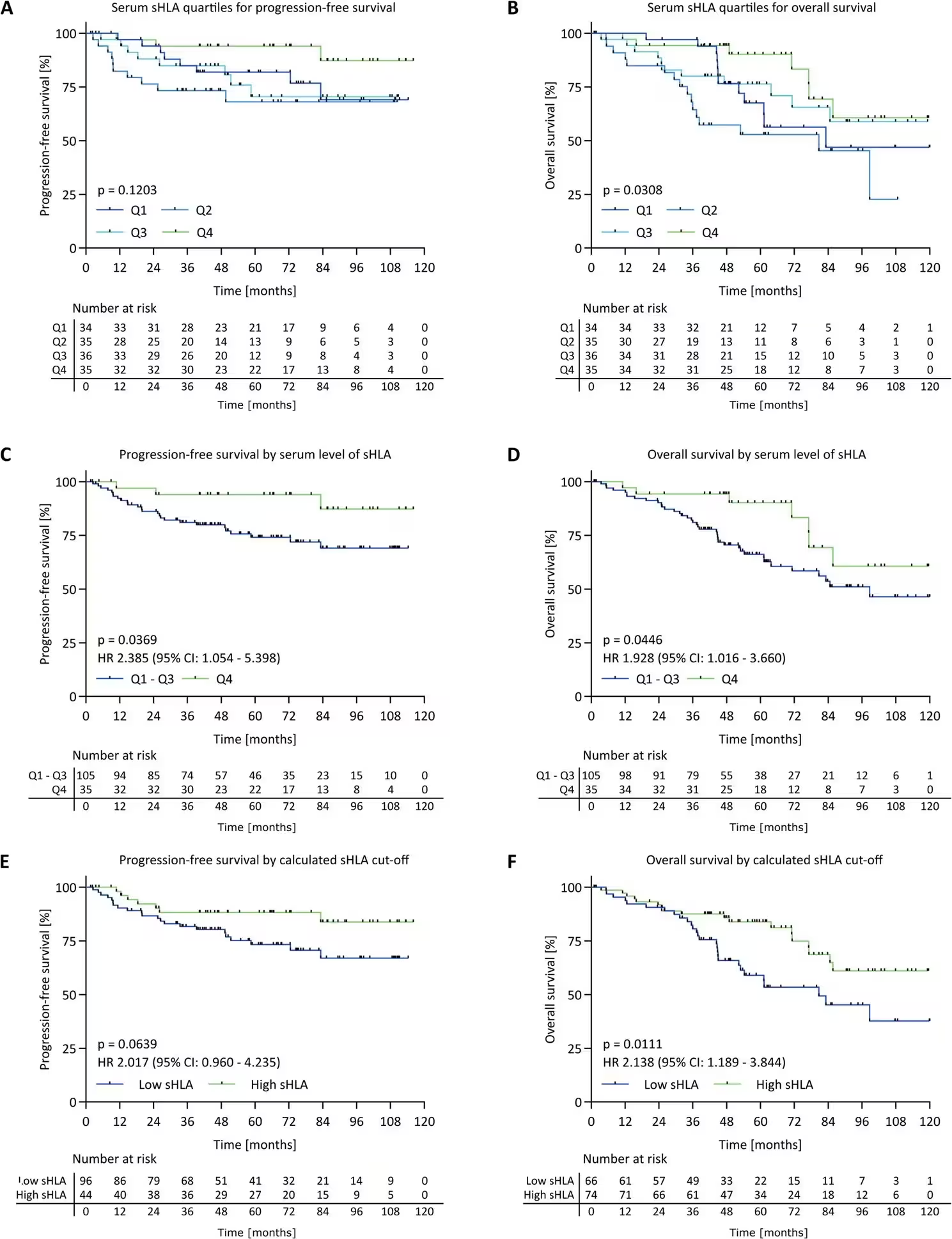
Fig. 3: Association of classical soluble HLA class I serum levels with clinical outcome of patients with invasive breast cancer. Kaplan-Meier estimates of (A, C, E) progression-free survival (PFS) and (B, D, F) overall survival (OS) of patients with BC (n = 140) stratified by sHLA class I (HLA-A, -B, -C) serum levels at diagnosis. A, B PFS and OS according to quartiles (Q1 - Q4) of sHLA class I serum levels. C, D PFS and OS of patients in the highest quartile (Q4; sHLA class I > 4.6 µg/ml) compared with patients in Q1 - Q3. E, F PFS and OS according to endpoint-specific cut-off values determined by ROC analysis (maximal Youden index; PFS: ≤ / > 3.32 µg/ml; OS: ≤ / > 2.14 µg/ml). HRs (95% CI) are given for Q1 - Q3 vs. Q4 (C, D) and for low vs. high sHLA class I (E, F). Time was calculated from diagnosis; maximum observation time was 116 months for PFS and 120 months for OS. Number-at-risk tables are shown beneath the curves. Kaplan-Meier analysis, log-rank test. Abbreviations: sHLA, soluble HLA
Association of classical soluble HLA class I serum levels with clinical outcome of patients with invasive breast cancer. Kaplan-Meier estimates of (A, C, E) progression-free survival (PFS) and (B, D, F) overall survival (OS) of patients with BC (n = 140) stratified by sHLA class I (HLA-A, -B, -C) serum levels at diagnosis. A, B PFS and OS according to quartiles (Q1 - Q4) of sHLA class I serum levels. C, D PFS and OS of patients in the highest quartile (Q4; sHLA class I > 4.6 µg/ml) compared with patients in Q1 - Q3. E, F PFS and OS according to endpoint-specific cut-off values determined by ROC analysis (maximal Youden index; PFS: ≤ / > 3.32 µg/ml; OS: ≤ / > 2.14 µg/ml). HRs (95% CI) are given for Q1 - Q3 vs. Q4 (C, D) and for low vs. high sHLA class I (E, F). Time was calculated from diagnosis; maximum observation time was 116 months for PFS and 120 months for OS. Number-at-risk tables are shown beneath the curves. Kaplan-Meier analysis, log-rank test. Abbreviations: sHLA, soluble HLA Credit: Christian M Tegeler et al. / BMC cancer

What Limitations Shape the Interpretation of These Findings?

The authors note several important caveats, including the single-center design, the limited sample size within specific clinical subgroups, and an age mismatch between the patient cohort and the younger healthy control group. Additionally, the analytical assay quantified total conformational complexes without distinguishing between specific gene variants or tracking matched tissue-level protein expression.

While these exploratory results point to soluble human leukocyte antigen molecules as promising circulating biomarker candidates for future prognostic frameworks, the research team emphasizes that larger, prospectively validated cohort studies and functional analyses will be necessary to confirm the underlying biological mechanisms.

The research was published in BMC cancer on November 20, 2026.

Fact Checked

This article has been fact checked for accuracy, with information verified against reputable sources. Learn more about us and our editorial process.

Last reviewed on .

Article history

  • Latest version

Reference(s)

  1. Tegeler, Christian M.., et al. “Elevated classical soluble HLA class I molecules in breast cancer patients are associated with favorable disease outcome.” BMC Cancer, vol. 26, no. 1, November 20, 2026 Springer Science and Business Media LLC, doi: 10.1186/s12885-026-17386-0. <https://doi.org/10.1186/s12885-026-17386-0>.

Cite this page:

Brown, Robert. “Blood Marker Elevation in Breast Cancer Patients Surprisingly Linked to Better Survival Rates.” BioScience. BioScience ISSN 2521-5760, 23 November 2026. <https://www.bioscience.com.pk/en/subject/biotechnology/elevated-classical-soluble-hla-class-i-molecules-in-breast-cancer-patients-are-associated-with-favorable-disease-outcome>. Brown, R. (2026, November 23). “Blood Marker Elevation in Breast Cancer Patients Surprisingly Linked to Better Survival Rates.” BioScience. ISSN 2521-5760. Retrieved November 23, 2026 from https://www.bioscience.com.pk/en/subject/biotechnology/elevated-classical-soluble-hla-class-i-molecules-in-breast-cancer-patients-are-associated-with-favorable-disease-outcome Brown, Robert. “Blood Marker Elevation in Breast Cancer Patients Surprisingly Linked to Better Survival Rates.” BioScience. ISSN 2521-5760. https://www.bioscience.com.pk/en/subject/biotechnology/elevated-classical-soluble-hla-class-i-molecules-in-breast-cancer-patients-are-associated-with-favorable-disease-outcome (accessed November 23, 2026).
End of the article